

























































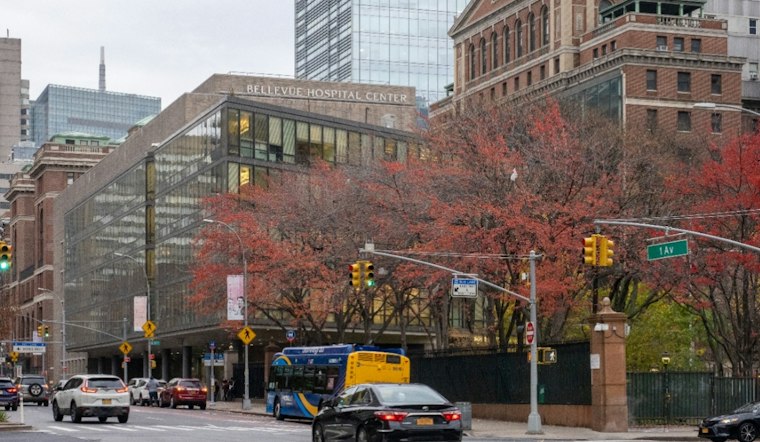
Bellevue Hospital's adult psychiatric units are currently running at 98% occupancy, officials said, and now the hospital is getting help to ease that squeeze. The City Council has backed a renovation and expansion of Bellevue's adult inpatient psychiatric wards with $25.6 million, adding 40 new beds and pushing capacity from 164 to 204.
As reported by Gothamist, the funding will renovate all 12 of Bellevue's adult inpatient psychiatric units, tearing out walls, floors and windows to build what CEO Eric Wei described as a more healing environment. Wei said renovated units already feel calmer, with less anxious staff and patients, and that the fuller overhaul will bring more natural light, better sightlines for staff monitoring patients, and room for more recreational and therapeutic programming. The renovations are expected to take about three-and-a-half years, with the Council investing $10.6 million this fiscal year and another $15 million the following year.
A Freshman Council Member's First Big Local Win
Council Member Virginia Maloney, who took office this year representing Manhattan's District 4 — an East Side stretch that includes Kips Bay, Murray Hill, Tudor City, Peter Cooper Village and Stuyvesant Town, according to the New York City Council — spoke at a press conference in Bellevue's atrium to announce the funding. She said the investment will help ensure New Yorkers experiencing mental health crises get care, adding that people in crisis deserve a bed and healthcare. Her district includes Bellevue, alongside a dense concentration of medical institutions and residential blocks.
Mitchell Katz, president and CEO of NYC Health + Hospitals, which runs Bellevue, noted that the public hospital system provides about 20% of medical care in New York City but shoulders 60% of the city's behavioral health care. That imbalance traces back to economics: inpatient psychiatric care is less lucrative than many other hospital treatments, so private hospitals in the city tend to prioritize it less, leaving public institutions like Bellevue to absorb the volume. Bellevue is already the largest provider of inpatient psychiatric care among acute care hospitals in New York City.
A Statewide Reversal After Years of Bed Cuts
Bellevue's expansion lands amid a broader statewide push to rebuild psychiatric bed capacity after years of cuts. New York lost more than 700 state-operated psychiatric hospital beds between 2014 and 2021 under earlier cost-cutting and deinstitutionalization policies, according to the Manhattan Institute, before state leaders reversed course in 2022. Since Hochul took office, about 300 beds have been restored in the state psychiatric-center system.
The state also widened the legal door for getting people into treatment. In May 2025, New York amended its Mental Hygiene Law, effective that August, to expand criteria for involuntary psychiatric removal and admission to include people whose severe mental illness leaves them unable to meet basic needs like food, clothing, shelter or medical care.
City Money Targets Public Hospitals
The Bellevue project also fits within Mayor Eric Adams' $650 million initiative announced in January 2025 targeting street homelessness and severe mental illness, according to a mayoral transcript posted on NYC.gov.
Court-Ordered Treatment as a Companion Strategy
Assisted Outpatient Treatment, known as Kendra's Law, allows judges to mandate community-based treatment plans for people who struggle with voluntary adherence.
Bellevue itself carries deep institutional weight in this fight. The hospital has already renovated some of its adult inpatient psychiatric units, laying groundwork for the fuller overhaul now underway.
Whether Bellevue's three-and-a-half-year construction timeline can keep pace with immediate crisis demand on First Avenue remains an open question, as does whether the hospital system can recruit enough specialized psychiatric nurses and staff to actually operate the 40 new beds once the work is finished.



