

























































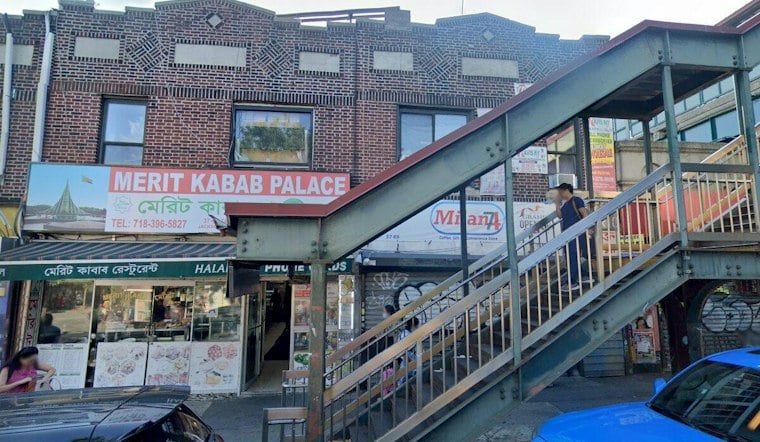
A man spent about two hours wandering along the elevated No. 7 tracks in Queens early Friday, forcing the MTA to cut power to the third rail in two separate sections and triggering a suspension across a wide swath of Queens that rippled out to an estimated 24,000 commuters before police finally took him into custody near Junction Blvd. station.
The ordeal began just before 5 a.m. when a garbage-train operator reported seeing a man walking on the tracks, describing him as a bald Black man dressed in all black and carrying a flashlight, according to the New York Daily News. Police were notified through the MTA Rail Control Center, and within minutes a second train operator reported spotting the man walking Queens-bound on the Manhattan-bound tracks toward the 33rd St.-Rawson St. station. By around 5:25 a.m., an NYC Transit supervisor said the man had reached 40th St.-Lowery St. station, and police arrived at the 46th St. station roughly five minutes later.
Trains Held as Power Gets Cut
As the man kept moving, the MTA ordered trains to hold between Queensboro Plaza and 90th St. stations and, per the same account, cut power to sections of the line while he walked between Queensboro Plaza and Junction Blvd. stations. Police separately requested that power be cut to a section of third rail, and the MTA Rail Control Center severed power to another stretch between 69th St. and 103rd St. The third rail carries a lethal jolt of 600 DC volts, underscoring the stakes of the hours-long pursuit.
No. 7 line service was suspended across a wide swath of Queens between 5:30 a.m. and 7 a.m., and the shutdown ultimately stretched for an hour and a half as police chased the man along the elevated structure. An MTA worker spotted him walking on the Flushing-bound track at 74th St.-Broadway station by 6 a.m., where he reportedly sat on a thin cover above the third rail. He was later identified by police as 55-year-old Norman Baker, who they said is likely homeless.
A Chase Along the Elevated Line
Baker kept moving fast, according to a transit worker, and by shortly before 6:15 a.m. he was walking along the center track at 82nd St. as police pursued him on foot. Transit workers and officers briefly lost sight of him after the chase passed through the 90th St.-Elmhurst Ave. station. NYPD Emergency Service Unit officers did not arrive until around 6:30 a.m., some 90 minutes after the department was first notified, and officers waiting at Junction Blvd. station reported they could see Baker walking toward them along the tracks.
By 6:45 a.m., police said Baker had made it past Junction Blvd. station and was hanging from the elevated structure while speaking with ESU officers before being taken into custody minutes later. He was taken to a nearby hospital, police said. In total, Baker is reported to have covered four miles along the elevated tracks. An NYPD spokesperson said he faces charges of reckless endangerment and criminal trespass; under New York law, reckless endangerment in the second degree applies when a person recklessly engages in conduct that creates a substantial risk of serious physical injury to another, according to New York State Penal Law § 120.20.
MTA Says It's Investigating
The MTA said it is investigating the trespass, and spokesperson Kayla Shults said track intrusions have a huge impact on service, adding that the agency is looking into what happened on the 7 line. The disruption delayed or canceled 82 subway runs, according to a source cited by the Daily News.
Friday's incident adds to a growing body of data on how often people wind up on live subway tracks. The MTA recorded 1,297 unauthorized track entries in 2025, a 22% increase from the 1,062 recorded in 2019, according to thecityreporter.nyc. About 6% of all subway delays last year were blamed on a person or debris on the tracks, the outlet reported. More recent numbers show some fluctuation rather than a steady climb: the first four months of 2026 saw 491 track intrusions, down slightly from 505 over the same stretch in 2025 and from a high of 537 in the same period of 2022.
MTA Pursuing AI Detection Technology
Back in 2022, the MTA's Track Trespassing Task Force had already flagged a 20% rise in intrusions between 2019 and 2021, with January 2022 producing a peak of 160 incidents in a single month, the highest total in three years at that point, followed by 100 in April, per the agency's own report. Of the 537 intrusions recorded in the first four months of 2022, a majority involved someone voluntarily stepping onto the tracks, and people experiencing mental illness accounted for roughly 20% of cases, the MTA found. MTA Chair and CEO Janno Lieber said at the time that such intrusions put riders' and transit workers' lives in danger while disrupting travel for hundreds of thousands of New Yorkers.
In response, the agency said it planned to advance high-tech projects including Track Intrusion Detection Systems and front-facing cameras on trains. That effort has since moved forward: in April, the MTA put out a solicitation for design-build services to design, furnish, demonstrate and test a Track Intrusion Detection System prototype at two NYCT stations, using what the agency described as an artificial intelligence-supported approach to right-of-way intrusion detection and awareness. The prototype is slated for controlled field testing at one underground station and one elevated platform station, with an estimated contract value between $10 million and $50 million over a 730-day term. Per thecityreporter.nyc, the MTA is aiming to award that contract by the end of this year.
The risks tied to track access have also driven recent changes for transit workers themselves. On Sept. 24, the MTA required subway track flaggers to ride a nearby train to their worksite rather than walk through tunnels, a rule change that followed the Sept. 3 death of worker Moet McCullum, who was fatally struck by an oncoming train in the Bronx while preparing to set up warning lights, according to the New York Daily News. The same report noted that the Federal Transit Administration had threatened to prohibit all subway track work unless NYC Transit took steps to stop workers from fouling the tracks while trains were running.
Friday's shutdown also echoes an earlier disruption on the same line: in a separate incident, a straphanger was struck and killed by a train in Queens at the Junction Blvd. station, which left No. 7 trains running locally between 74th St-Broadway and Mets-Willets Point with delays, per amNY. During that disruption, the MTA encouraged Queens commuters to use the E, F, M or R trains as alternatives.





