

























































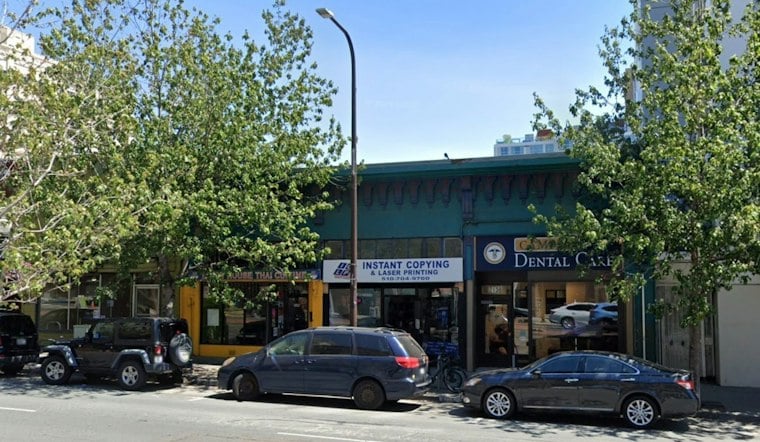
Foundation work is underway at 2140 University Avenue in downtown Berkeley, where UC Berkeley is building two new laboratory buildings meant to keep the region's booming genome-editing industry from packing up and moving to Emeryville or Alameda. The site sits within the university's broader Innovation Zone project in Alameda County, and it's the most tangible sign yet that a years-long planning effort is finally turning into steel and concrete.
According to San Francisco YIMBY, the site was cleared in stages: University Hall demolition began in summer 2024, and crews took down the Ernest Heron Building and the Martha Sell Building before the parcel was fully cleared by fall 2025. UC Berkeley Capital Strategies is overseeing development of the Innovation Zone, and construction is reportedly furthest along in the first phase along Addison and Oxford streets. The publication reports that Turner Construction is serving as general contractor, with the first phase expected to finish in 2028 and a second phase wrapping in 2029.
The anchor project is a home for the Innovative Genomics Institute and Bakar Labs, which is intended to advance health and agricultural applications of genome-editing technology while giving startup companies room to grow, according to UC Berkeley Capital Strategies. IGI researchers will use CRISPR genome editing to push forward work in human therapeutics, agricultural engineering, and other fields, the same office notes. Weiss/Manfredi Architects is the lead design architect on the project, with DGA serving as executive architect.
A Seven-Story Lab Building Aimed at 2028-29
The IGI-Bakar Labs building is planned as a seven-story, roughly 169,000-gross-square-foot facility at Oxford Street and University Avenue, per Bakar Labs. Construction began in spring 2026 and is expected to run roughly three years, the same capital strategies office reports, with the building expected to open during the 2028-29 academic year according to UC Berkeley News. The finished building is meant to hold wet and dry labs, administrative offices, meeting rooms, collaboration space, and a shared courtyard, per Bakar Labs.
UC Berkeley's Board of Regents approved the building during a regularly scheduled meeting in Los Angeles on July 17, the affiliated Bakar Labs site notes. Planners say the building will be fully electric, with rooftop solar panels and low-carbon concrete built into the design, according to the same source. That environmental push fits a broader pattern on campus: UC Berkeley's recent construction has leaned heavily into student housing, academic hubs, and green-energy expansion, per Berkeleyside's map of the university's ongoing building boom.
A Second Building for Energy and Materials Research
Sitting alongside the genomics building is Bakar Labs for Energy and Materials, a five-story facility intended to support innovation in clean energy, advanced manufacturing technology, and energy-efficient transportation, according to San Francisco YIMBY's reporting. That building is expected to include wet laboratories, event spaces, and community rooms, with Gensler handling its architecture. Berkeleyside separately describes the Energy and Materials building as a five-story, 145,000-square-foot structure capable of supporting up to 75 startups, with completion expected in 2028.
Together, the two buildings are sometimes referred to as forming a six-story complex intended to promote research into health and agricultural applications of genome editing technology, per San Francisco YIMBY. The stakes for getting this right are significant: Bakar Labs companies have collectively raised more than $630 million and created over 400 jobs since the incubator launched in 2021, according to Bakar Labs, while the Innovative Genomics Institute has spawned 26 companies that have drawn $4.8 billion in startup funding, per UC Berkeley News.
Why Berkeley Is Racing the Clock
City and university officials have framed the buildout as an economic necessity rather than a vanity project. Insufficient lab space has pushed some startups to look at Emeryville and Alameda instead of staying in Berkeley, according to Berkeleyside, a dynamic that risks costing the city jobs and economic activity it has spent years cultivating. Berkeleyside's reporting also notes that companies incubated at Bakar Labs are expected to graduate from early-stage space into larger-scale operations once the new buildings open, addressing a bottleneck that has limited how far homegrown biotech firms can scale locally.
Earlier planning documents described a very different building on this site. A 2023 proposal outlined an eight-story, roughly 310,000-square-foot North Building for the Innovative Genomics Institute, according to Berkeleyside, while a February 2024 description from sfyimby.com characterized the same North Building as 11 stories and roughly 189 to 194 feet tall, with about 310,000 square feet of lab space, calling it potentially the tallest building in the city. That same 2024 account described a proposed five-story South Building rising 92 to 100 feet with 176,000 square feet of lab space. The current seven-story, 169,000-square-foot design reflects how the project's scope has shifted since those earlier concepts were floated; whether those larger designs were formally superseded is not addressed in current university materials.
State environmental-review records tie the project to State Clearinghouse No. 2023100861, according to filings from the California Environmental Quality Act clearinghouse. That record places the project site within Berkeley's City Environs land-use zone, according to the state environmental-review database. For now, the visible progress remains foundation work, with the bulk of the building still years from opening its doors to researchers and the startups the university hopes to keep close to home.


