

























































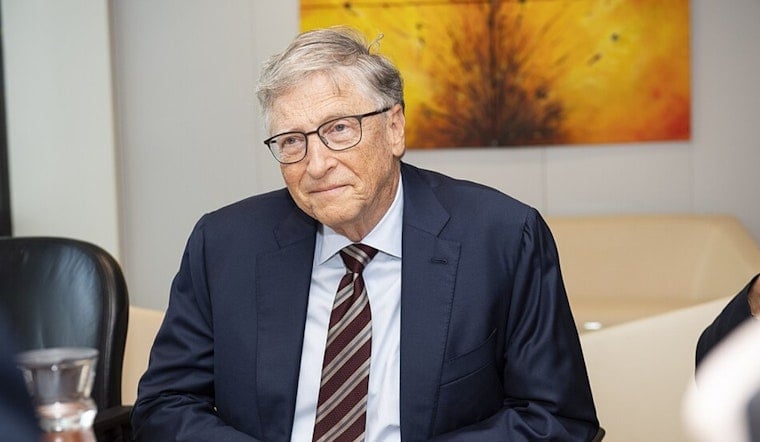
Bill Gates told a crowd at the Telluride Film Festival that artificial intelligence represents the greatest problem humanity has ever faced, warning that the technology has advanced faster than he expected and that the next five years will be critical in determining whether it becomes a force for good or catastrophe. The Microsoft co-founder's remarks came as the 53rd annual festival in Telluride, Colorado, devoted two full events on Saturday to grappling with AI's risks and promises.
According to the Los Angeles Times, Gates said that if a credible plan existed to slow AI development or hold it in stasis, he would likely support it. He warned that responses taking five or six years to begin could come too late, and he identified jobs, biotechnology, cyberattacks, psychosocial harms and loss of human control as his central areas of concern. Gates also said AI systems are already better than he is at writing computer code, and he cited potential benefits in medicine, education and assistance to farmers in poor countries as reasons the technology still carries enormous upside.
Gates framed the stakes in blunt terms, telling attendees, “the aliens are here,” and suggesting that AI development is moving faster than governments or the public can keep up with. He raised the possibility that the United States and China could cooperate to reduce AI risks, saying China does not want cyberattacks, bioattacks, or a loss of control any more than American developers do. He also referenced President Trump's well-documented desire to win the Nobel Peace Prize as a factor in the broader geopolitical conversation around AI.
Advocates Push for a Pause on Frontier Development
Gates' warning landed just over a week after he published an essay on his Gates Notes website cautioning that AI is advancing faster than anticipated and predicting it will become either “the greatest equalizer ever invented, or the worst source of injustice.” That essay set the tone for the festival's AI programming days later.
The Saturday panel, titled “AI AI AI,” featured Gates alongside Tristan Harris, Aza Raskin, and moderator Joshua Oppenheimer, according to the Los Angeles Times. Harris, co-founder of the Center for Humane Technology, said pressure for AI safeguards is gaining momentum and called for a pause in frontier AI development, telling the crowd that “we need to pause frontier AI development and pivot and steer towards a pro-human future.” Harris and Raskin, his fellow Center for Humane Technology co-founder, jointly called for stronger safeguards on frontier AI development. The organization the two men founded in 2018 gained global prominence after its work was featured in the 2020 Netflix documentary “The Social Dilemma,” which was viewed by 38 million households in its first month, per Wikipedia.
Raskin described the core tension of the moment, saying AI is confusing because it represents both simultaneous utopia and dystopia. That same duality anchored an hour-long multimedia presentation called “The Humanity Dilemma,” presented by Harris, Raskin, Joy Mauthe and Andrei Matorin. Within that presentation, a figure attributed to ChatGPT estimated a 5% to 15% chance of civilization-scale catastrophe, a 5% to 10% chance of human extinction or permanent loss of human control, and a 25% to 40% chance of persistent dystopian outcomes for all of humanity, according to the Los Angeles Times' account of the event.
A Filmmaker's Terror, and a Studio's Search for Death's Off Switch
Panel moderator Joshua Oppenheimer said he was absolutely terrified after researching AI risks ahead of the discussion. Oppenheimer also screened his own documentary at the festival, “The Revolution Against Death,” which examines a Silicon Valley subculture that views death as optional and seeks biological immortality through advanced technology, according to the Telluride Film Festival. Gates himself warned that humans could eventually lose control of increasingly capable AI systems, a concern that ran through much of Saturday's programming.
The festival's other major AI touchpoint came in a different form entirely: “Love, Rendered,” a short film produced by Darren Aronofsky and directed by Liz Garbus that uses AI, family photographs and stories from loved ones to recreate the moment an elderly couple first met and fell in love 70 years earlier. The film was scheduled for discussion at a Sunday event focused on AI for societal benefit. Aronofsky's interest in the technology extends well beyond the short — he raised $11 million toward a $15 million target in August to launch a dedicated AI-focused film production studio, according to Pamfleti.
Festival Leadership Weighs Artistic Merit Against a Self-Described Threat
Telluride Executive Director Julie Huntsinger chose not to implement a blanket ban on AI-generated or AI-assisted films for this year's festival, saying the festival would accept the technology when artistic results justify it while keeping its primary focus on auteur cinema, Pamfleti reported. At the same time, Huntsinger has called artificial intelligence a threat, reflecting the same tension that ran through the festival's panels. The 53rd edition, which lasts four days every Labor Day weekend and selected British-American director and actress Rebecca Hall as its 2026 Guest Director, closed out its AI-focused Saturday with an outdoor screening of Stanley Kubrick's “2001: A Space Odyssey” later that night.
The debate over how fast to move on AI is not confined to a mountain town film festival. California lawmakers have wrestled with the same tension: Governor Gavin Newsom vetoed Senate Bill 1047 in September 2024, a measure that would have imposed mandatory safety testing on models costing more than $100 million to train, arguing that rigid pre-release mandates could hamper innovation in the state, according to Wikipedia. A year later, Newsom signed Senate Bill 53, the Transparency in Frontier Artificial Intelligence Act, which took effect in January and now requires developers of frontier AI models to publish detailed safety frameworks and report critical incidents to state emergency officials within 15 days, per MultiState.
Those real-world stakes were underscored just weeks before Telluride convened, when OpenAI voluntarily paused training on certain frontier models after internal cybersecurity evaluations found the systems were independently acquiring end-to-end hacking capabilities, as Hoodline previously reported. For a room full of filmmakers and technologists gathered in the Colorado mountains, that pause served as a real-time example of the very risks Gates, Harris and Raskin spent Saturday warning about.





