

























































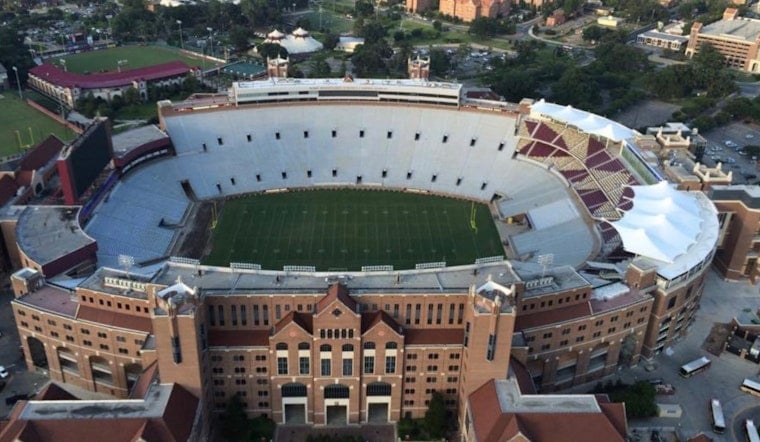
Florida State and SMU players had already made their pregame entrances and were standing on their sidelines Monday night when the lights inside Doak Campbell Stadium suddenly went dark. What followed was a delay of more than 90 minutes, stripped-down football with no scoreboard, no public-address system and no coach-to-player helmet radios, and a kickoff that finally happened at 9:15 p.m. ET instead of the scheduled 7:30 p.m.
The outage struck just as the Florida State band was wrapping up its pregame festivities and Chief Osceola had planted the spear atop Renegade at midfield, according to The New York Times. Stadium screens and ribbon boards stayed lit and eventually announced that the game was delayed due to a power outage, even as the main PA system and scoreboard went dark. Both teams retreated to their locker rooms while crews worked, and the pregame countdown clock froze at 4:40 until kickoff was finally possible. What began as an apparent quick fix turned into something far more serious: as reported by Newsday, technical crews attempting to reset the stadium's electrical system after an initial power surge around 7:29 p.m. ET saw the main transformer blow, turning a brief reset into a nearly two-hour delay.
A Cascading Electrical Failure
Stadium officials had originally anticipated only a five-to-10-minute reset before the transformer failure derailed those plans, per the same Newsday report. The disruption was ultimately traced to an electrical short in the main transformer supplying power to the stadium, and a stadium video board attributed the malfunction to a disruption at the west side tower. ESPN reported that the outage left the stadium without a public-address system, scoreboard or coach-to-player communication, and officials confirmed the game clock would instead be kept manually on the field.
The blackout reached beyond the lights and speakers. According to theScore, coaching staffs also lost the ability to use sideline iPads for in-game video review and tactical adjustments, a tool the NCAA approved alongside helmet communication in 2024. Replay reviews were unavailable for the same reason, leaving Florida State and SMU to play a stripped-down, largely analog version of a modern college football broadcast.
SMU Caught Off Guard Without Radios
The loss of helmet communication hit SMU especially hard. SMU head coach Rhett Lashlee noted during the delay that the Mustangs had not practiced calling plays without in-helmet radio communication in two years, theScore reported, leaving his team to relearn hand signaling on the fly during its 2026 season debut. The NCAA Football Rules Committee first permitted coach-to-player helmet radio communication in FBS games in April 2024, a change made partly in response to sign-stealing controversies across the sport, according to NFL.com. Those systems rely on a single helmet receiver marked by a green dot and are required to cut off audio transmission when 15 seconds remain on the play clock, rules that expanded to all college football divisions, including Division II and Division III, for the 2026 season, per On3.
Before helmet radios existed, some programs experimented with other workarounds. Texas tested smartwatch-style wearable technology on players' wrists to relay play calls without altering helmet construction, and Texas high school programs reported more than 90 percent satisfaction with the wrist-worn transmitters, according to Football Scoop. Monday's outage offered a real-time reminder of how dependent modern programs have become on the electronic systems that replaced those earlier fixes.
A Freshly Renovated Stadium's West Side
The failure carries an added local sting because it struck the very section of Doak Campbell Stadium that was just rebuilt. The venue completed a $265 million renovation in August 2025 that fully reconstructed the stadium's west side, the same area where the main transformer short occurred, while also reducing total seating capacity to 67,277 and adding modernized premium seating and technology integration, according to WFSU News. That multi-year renovation was completed by a joint venture of Manhattan Construction and Culpepper Construction. Doak Campbell Stadium first opened on October 7, 1950, with a capacity of just 15,000 fans before ballooning over 75 years into an 80,000-seat venue ahead of last year's capacity-reducing modernization, the station reported.
Weather does not appear to have been the direct trigger. Tallahassee had experienced local power grid disruptions from regional storms earlier in the week, but no rain or severe weather was present directly over the stadium at the time of Monday's outage, according to Chop Chat. Clear skies and a sunset scheduled for just before 7:52 p.m. instead created what one report described as a surreal atmosphere for fans waiting out the delay in the stands.
Comparisons to the 2013 Super Bowl Blackout
Monday's delay inevitably drew comparisons to the most famous blackout in modern football history: the 2013 Super Bowl between the Baltimore Ravens and San Francisco 49ers, played at the Superdome in New Orleans, which suffered a partial power outage that caused a 34-minute delay, far shorter than Monday's disruption in Tallahassee. It also stood in contrast to an unrelated weather delay elsewhere in the sport that same night, as the LSU-Clemson game was separately delayed nearly two hours by storms.
Florida State entered the rescheduled Week 1 matchup having already opened its 2026 season on August 29 with a 34–17 victory over New Mexico State, while SMU was playing its first game of the year. The Monday night contest had been billed as the marquee finale of college football's opening week, according to Wikipedia's season summary for the Seminoles' program. With the transformer blown and repairs still underway by kickoff, open questions remain about exactly what caused the electrical short and whether Florida State will need permanent infrastructure fixes before its next home game.



