

























































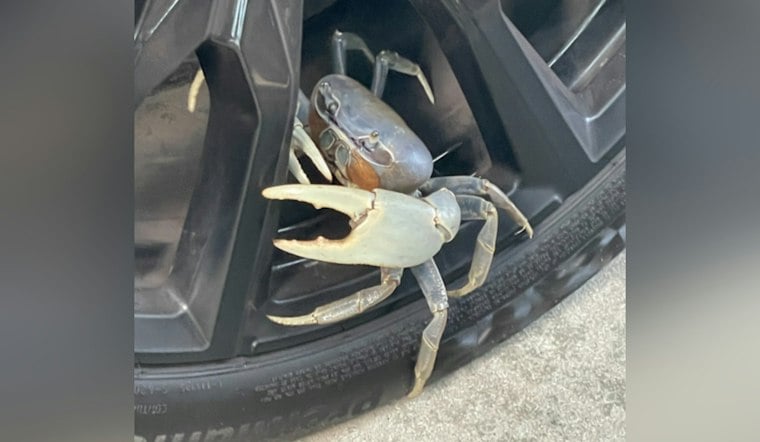
A burrowing, six-inch crab that has no business being this far north keeps turning up along North Carolina's Crystal Coast, and wildlife officials still can't say for certain how it's getting there. Blue land crabs, native to warmer waters from Brazil to South Florida, have racked up 27 confirmed sightings in North Carolina since they were first spotted in the state in 2023, concentrated near Emerald Isle and Wilmington.
The species has also generated roughly 200 unconfirmed reports, and August alone produced five confirmed sightings, the most in any single month since that first 2023 discovery, according to the News & Observer. The N.C. Department of Environmental Quality is asking residents who spot the crabs to report them with a photo or video, per the same account. Female blue land crabs tend to be white or ash gray, while males turn gray or blue, and adults can grow up to six inches across.
A Species Built to Wander, and to Wait Out Storms
Blue land crabs dig burrows as deep as six feet to reach groundwater, a habit that can destabilize soil and damage lawns, golf courses, agricultural fields, and coastal drainage systems, according to NC Sea Grant. Biologists with the NC Department of Environmental Quality note the crabs are most often seen above ground after heavy rainstorms flood their burrows and push them onto roads, lawns, and driveways. They're also unusually long-lived for a crab, taking about four years to reach sexual maturity and living up to 11 years, per the state agency.
The crabs are omnivores that mainly eat plants, fruits, and leaves, occasionally supplementing their diet with beetles and other insects, per the News & Observer's report. North Carolina's first confirmed sighting occurred in July 2023 along Bogue Sound near Emerald Isle, which prompted state marine fisheries officials to set up a formal tracking system, according to NC Sea Grant.
Natural Drift or a Human-Assisted Ride North?
Bronwyn Williams told the News & Observer that the patchy, scattered pattern of sightings suggests humans may be moving blue land crabs north themselves, even as she said the crabs may also be expanding their range naturally. Waters around the Carolinas have warmed by at least 1 degree Fahrenheit over the past century, and blue crab larvae need water above 68 degrees Fahrenheit to survive, per the same report — a threshold that researchers at the University of Florida IFAS describe as the primary limiting factor for whether the species can establish reproducing populations, since larvae experience total mortality below 20 degrees Celsius, or 68 degrees Fahrenheit. A single female can lay between 300,000 and 700,000 eggs per spawn, according to the same research.
Vero Beach, Florida, was long recognized in a 1962 scientific record as the northernmost limit of the blue land crab's native range along the Atlantic coast, according to the Eagle Hill Institute. That baseline underscores just how far the crabs have pushed beyond their traditional territory in recent years.
Neighboring States Are Watching the Same Trend
North Carolina isn't alone in tracking the crabs' northward creep. In South Carolina, where sporadic sightings began in 2008, state officials launched a public tracking portal in 2022 that had gathered more than 330 reports and over 165 confirmed sightings across the coast by late 2025, according to the Post and Courier. Georgia's Department of Natural Resources issued a public alert in December 2023 urging coastal residents to report sightings after receiving initial reports along its own coastline, per the Atlanta Journal-Constitution.
Despite the burrowing damage and the surge in sightings, wildlife agencies in Georgia and the Carolinas have stopped short of formally labeling blue land crabs invasive, since that classification requires proven scientific evidence the species harms native wildlife or ecosystems, according to Garden & Gun. In Florida, where the crabs are native, the state's Fish and Wildlife Conservation Commission instead manages them as a regulated game species, capping harvests at 20 crabs per person daily and closing the season from July 1 through October 31 to protect spawning females.
Whether North Carolina's crabs represent a genuine, climate-driven range expansion or a series of human-assisted relocations remains an open question for researchers, and it may hinge on whether local winter water temperatures ever climb high enough to let larvae survive and reproduce on their own.





