

























































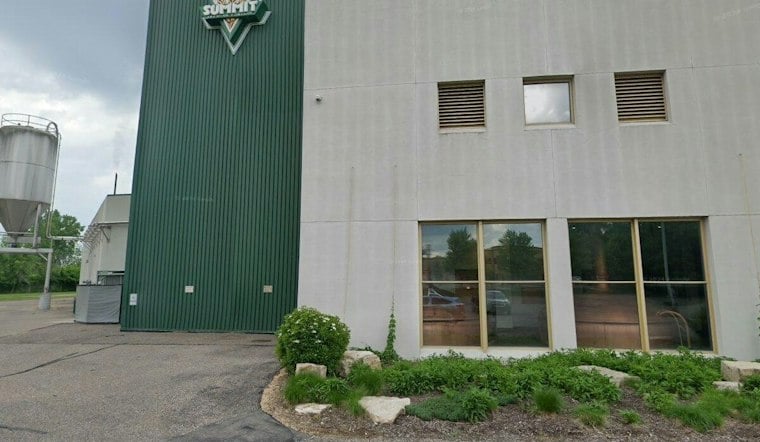
BMO Bank is asking a court to appoint a receiver for Summit Brewing Co. and permit the sale of the company's St. Paul property and other collateral after an alleged loan default. The bank filed the lawsuit on September 10 and is seeking more than $8 million, according to the Minnesota Star Tribune's account of the complaint. The requests remain unresolved, so the filing does not itself establish that Summit will lose the property.
What BMO says Summit owes
BMO alleges that Summit owes at least $8.22 million. The claimed balance includes about $7.88 million in principal, more than $313,000 in interest and approximately $32,000 in legal, real estate and other fees, the Minnesota Star Tribune reported.
According to BMO's allegations as described by the Star Tribune, the debt stems from two loans issued near the end of 2024: a $6.88 million term loan and a $1.25 million revolving line of credit. Summit pledged the buildings, machinery and equipment at 900 and 910 Montreal Circle as collateral. BMO also claims a security interest in most of the brewery's other property, including inventory, accounts, vehicles, trademarks, trade names and software.
The dispute over the missed payment
BMO alleges that Summit did not repay the revolving loan when it came due in 2025. The bank says the loan documents made that failure a default under the larger term loan as well.
The bank later agreed to delay collection efforts under a forbearance arrangement that ran through July 31. BMO says the agreement required Summit to repay the debt by that date and to record at least $645,000 in earnings during the first six months of 2026. The bank also halted additional borrowing under the revolving line, according to the Star Tribune.
BMO says Summit wrote on June 15 that it expected to miss the earnings target and would not have enough liquidity to repay the revolving loan on time. The bank further alleges that Summit warned it could begin liquidating if the parties did not reach a resolution. The letter was not included in the court filing, according to the Star Tribune.
Summit's history and recent scale
Mark Stutrud founded Summit in 1986 after leaving a career in social work. The company sold its first two kegs of Summit Extra Pale Ale on September 24 of that year, according to Summit's history of the brewery.
Summit moved into its 4.2-acre St. Paul complex in 1998. The site was described as St. Paul's first new brewery built from the ground up since before Prohibition by Happy Harry's Bottle Shop.
What could affect future use of the property
The available verified information does not establish the current assessed value, tax classification or specific land-use designation for 900 and 910 Montreal Circle. According to the City of Saint Paul, zoning determines whether a site can be used commercially or residentially and how densely it can be developed—factors that could affect any future reuse of Summit's property.
What zoning could mean for the site
The City of Saint Paul says zoning determines whether land may be used commercially or residentially and how densely it may be developed. That means any future use of Summit's property would be affected by the site's applicable zoning, although the verified information available here does not identify the specific zoning designation or any redevelopment plan for the area.
The brewery produced about 125,000 barrels in 2016 and generated between $25 million and $30 million in revenue, while employees held an estimated 30% ownership stake, according to Market Watch. Summit had expanded production through a $13 million project in 2013, but later withdrew from several states and cut 10% of its workforce in 2017 as competition, including from Surly Brewing Co., reduced its market share.
A difficult market for Minnesota breweries
Summit was ranked 34th among the 50 largest U.S. craft breweries by 2024 sales volume, according to Beer Street Journal's account of Brewers Association data. The broader Minnesota market has faced weaker production, higher costs and a crowded field. The Star Tribune cited lower alcohol consumption among younger people, ingredient costs, tariffs, rents and property taxes as pressures on local brewers.
Five of Minnesota's six largest breweries recorded production declines between 2024 and 2025, Axios Twin Cities reported. Closures also exceeded openings in the state in 2025: MPR News reported at least eight to nine closures by midyear, compared with seven closures during all of 2024, citing industry data.
Nationally, 481 craft breweries closed and 300 opened in 2025, while craft production fell 5.1%, according to Brewers Association figures cited by BrewDensity.
The lawsuit does not determine whether Summit will lose the property. The brewery could still pursue a restructuring agreement or a buyer, while BMO's requests for a receiver and authority to sell the property and other assets remain unresolved.



