

























































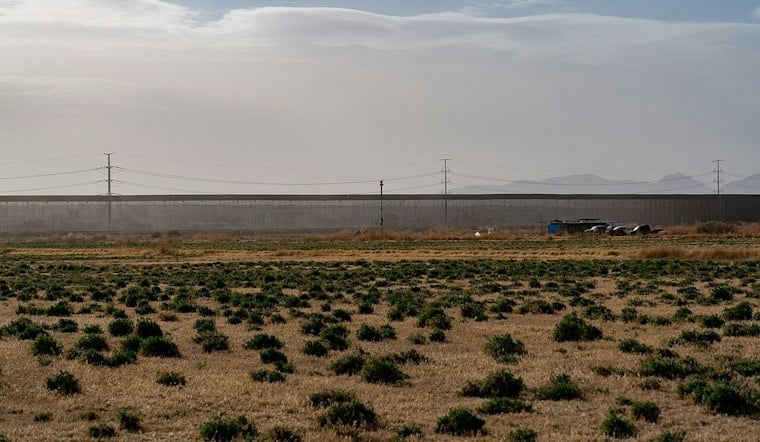
José Morales Bernal entered the United States through southern New Mexico on April 8, 2024. He was found dead 360 feet from the nearest of three surveillance towers—about the length of a football field—but landfill employees, not Border Patrol, spotted him first.
The episode is among the cases examined by MIT Technology Review in collaboration with Times of San Diego. Their reporters compared nearly 4,000 locations where human remains were found with the locations of almost 600 border surveillance towers. They counted more than 1,050 deaths within the towers' advertised range from 2015 through early 2026, and found deaths within the range of nearly two-thirds of the towers analyzed.
Morales died of environmental exposure, according to an autopsy cited in the investigation. Border Patrol arrived 45 minutes after landfill workers called for help — by which point it was too late. In the same year Morales died, 18 other people died within range of the same three Anduril towers meant to watch that stretch of the New Mexico border, the investigation found.
A System Built to Watch, Not Always to Act
The tower network is one component of a broader border-surveillance buildout that has expanded over roughly 25 years. The system includes fixed and autonomous towers as well as blimps, drones, seismic sensors and tunnel-detection robots, according to the investigation.
The newest installations are autonomous towers made by defense contractor Anduril. They combine cameras with artificial intelligence, send live video to control rooms and can push alerts to government-issued smartphones used by agents in the field. CBP describes the intended benefit as “persistent surveillance” and “situational awareness”—detecting activity and helping agents decide where to respond.
But the investigation found more than 110 deaths within the range of autonomous towers since 2021. Former agents and officials also told reporters that CBP does not formally review whether a tower should have detected a person before a body was found or why agents did not reach that person sooner.
What official data shows about results
Government figures provide a broader, but not definitive, view of the technology's results. According to the U.S. Government Accountability Office, Border Patrol reported 5,826 rescue events involving 42,340 rescued migrants and 704 migrant deaths in fiscal year 2023. Those figures cover the southwest border as a whole and do not establish how surveillance changed response times or outcomes specifically in southern New Mexico.
As an earlier benchmark, CBP said it had placed about 60 autonomous towers in Texas and southern California for real-world testing and had recorded several operational successes. Those official accounts describe activity detected and enforcement actions, but they do not by themselves show whether agents reached people faster or whether tower coverage reduced deaths.
Deaths Kept Happening Even Where Coverage Was Heaviest
The investigation identified a similar case outside New Mexico. Graciela Gómez Hernández died on a mountainside east of San Diego in September 2025, within a mile of a tower and, according to the investigation, within view of a federal camera; her remains were recovered nearly three weeks later.
The people found dead within range of the towers the investigation analyzed ranged in age from 0 to 70, per the reporting.
More Towers Are Coming Regardless
The network is still growing. CBP had 803 surveillance towers in 2023, and the government estimated that its tower plans would cost $6.2 billion over their operating lifetimes, according to the investigation. The agency now plans to spend another $1 billion on 1,497 additional towers by 2034.
Illinois Congresswoman Delia Ramirez, cited in the investigation, argued that the technology isn't delivering on its promise: AI-powered surveillance tools, she said, “are not making us safer.” CBP spokesperson Hilton Beckham, also cited in the investigation, offered a different view, saying autonomous towers use artificial intelligence to detect and classify people, vehicles and animals and then alert Border Patrol agents in the field.
The available record therefore contains two measures of the system's performance: documented deaths near towers and official counts of detections, apprehensions and rescues. Whether those measures translate into faster intervention and fewer deaths remains unresolved as CBP prepares to add nearly 1,500 more towers by 2034.



