

























































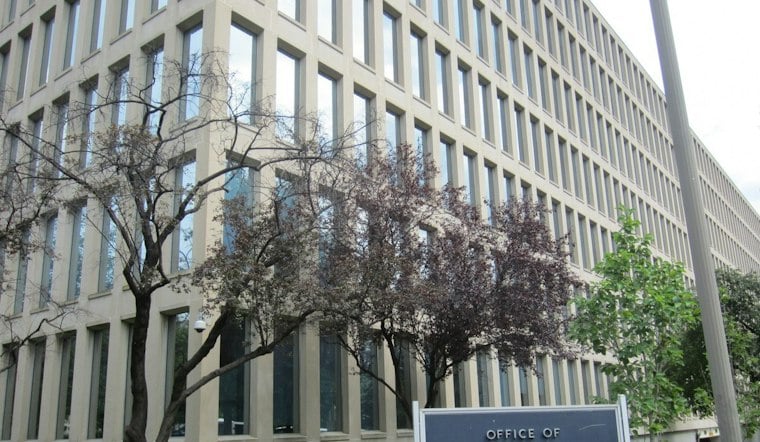
A federal judge in Boston has blocked the Trump administration from continuing to ask job applicants for career civil-service positions to explain how they would help implement President Trump's executive orders, ruling the question likely violated both federal hiring law and the First Amendment. The prompt had appeared on job listings for roles as varied as air traffic control specialist, crane operator, and nuclear materials courier, according to U.S. District Judge George O'Toole.
The ruling, issued on Friday, came in a lawsuit filed by three federal employee unions against the U.S. Office of Personnel Management and its director, Scott Kupor, whose confirmation and background Hoodline previously reported. As Reuters reports, the case, filed in the U.S. District Court for the District of Massachusetts, named OPM leadership as defendants and sought an immediate injunction against what plaintiffs called political screening prompts. The American Federation of Government Employees, one of the plaintiff unions, argued the question unlawfully politicized hiring for career government workers.
How the Essay Requirement Took Shape
The blocked prompt was Question Three among four standardized 200-word essay questions established under OPM's May 29, 2025 Merit Hiring Plan, according to the Military Transition Toolkit. The plan required candidates to identify specific executive orders or policy initiatives significant to them and explain how they would assist in implementing them, the outlet notes. OPM issued that requirement through a May 2025 implementation memo directing executive agencies to apply President Trump's January 2025 executive order, as Reuters reported. Applicants who submitted responses were also required to sign a certification under 18 U.S.C. § 1001 attesting their essay was self-authored without AI or consultant help, exposing them to potential federal criminal penalties for false statements, the same outlet notes.
By September 2026, the contested question had appeared on more than 70,000 federal job listings on USAJobs, including nearly 100 percent of Department of Labor postings, 75 percent of Justice and Energy Department listings, 60 percent of attorney postings, and 50 percent of IT positions, according to Government Executive.
Months of Delay Before a Ruling
The unions did not get a quick answer. In June 2026, the three plaintiff unions filed a writ of mandamus with the 1st U.S. Circuit Court of Appeals asking the appellate court to order Judge O'Toole to rule, after three months passed without a decision following a March 11, 2026 hearing, Government Executive reported. Unions argued that every day the question remained online further chilled applicant speech and affected application decisions, according to the outlet.
Judge O'Toole's Friday preliminary injunction relied heavily on a sworn declaration from a federal employee and union member who testified she felt compelled to submit essay responses opposing her own political beliefs, fearing that skipping the prompt or answering candidly would sabotage her job application, Government Executive reported. O'Toole found that applicants reasonably interpreted the question as an attempt to determine their political views and wrote that the plaintiffs are likely to succeed in showing there was no legitimate governmental interest in asking about applicants' political beliefs, according to Reuters. He halted use of the question after finding that it likely lacked a legitimate governmental interest, the outlet reports.
OPM's Defense and the Legal Backdrop
OPM has defended the essay question as optional and said hiring decisions could not be based on political beliefs, per Reuters; the agency did not respond to a request for comment on the ruling, the outlet notes. The dispute centers on whether asking candidates how they would advance presidential executive orders is a legitimate assessment of professional alignment or an unconstitutional political test. Federal civil service law, under 5 U.S.C. § 2302(b)(1) and § 2302(b)(3), addresses political affiliation discrimination and coercing political activity as prohibited personnel practices enforced through the U.S. Office of Special Counsel, according to the U.S. Office of Special Counsel. The Civil Service Reform Act separately bars employment decisions for covered civil-service jobs based on political affiliation, Reuters notes.
Judge O'Toole, appointed to the federal bench by President Bill Clinton in 1995, previously presided over the 2015 trial of Boston Marathon bomber Dzhokhar Tsarnaev, according to The Marshall Project. The case comes as the federal civilian workforce has already faced administration-wide hiring freezes and workforce contraction.
Alongside AFGE, the National Association of Government Employees and the American Federation of State, County and Municipal Employees are also plaintiffs in the case, Reuters reports. It remains unclear how OPM and executive agencies will handle applications already submitted with essay responses.



