

























































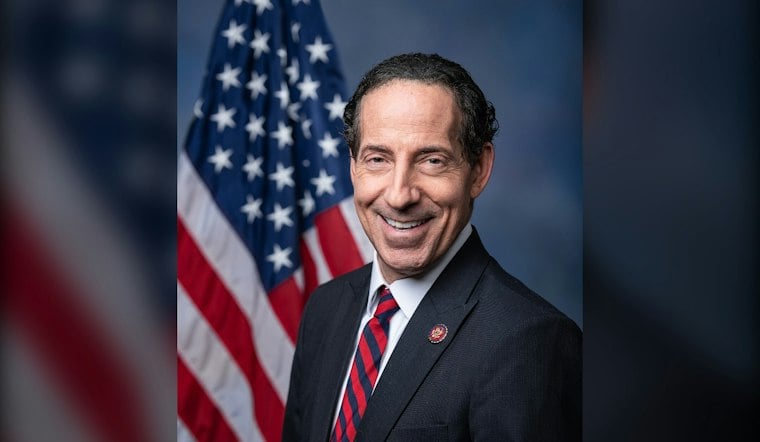
Representative Jamie Raskin introduced a six-page bill Wednesday that would direct the Smithsonian Institution to permanently collect and display artifacts documenting what he calls the rise of government propaganda under President Trump, including the towering presidential portraits hung outside federal agencies and the warning signs the administration wants posted near the National Museum of American History. The Maryland Democrat's proposal arrives after months of escalating friction between Capitol Hill Democrats and the White House over control of the Smithsonian's public image.
Formally titled the Preserving and Remembering the History of Trump and other Tyrants Act, the bill directs the Smithsonian secretary to collect and exhibit Trump's portraits that have been hung outside federal agencies, along with signage or artifacts tied to the administration's planned warning signs accusing the Smithsonian of ideological capture, according to Axios. The proposed exhibit would also include narratives from Americans who resisted the rise in authoritarianism, and signage stating that Trump ordered the installation of the warning signs without congressional authorization, per the same report. As Forbes reports, the legislation would establish a permanent exhibit at the National Museum of American History documenting both the propaganda and the public opposition to it.
Raskin said his legislation will, in his words, “forever preserve” Trump's “manifestations of authoritarian narcissism and propagandistic assault on American history and American democracy,” according to Axios. The bill stands almost no chance of passing in a Republican-controlled Congress, the outlet notes, but it could preview how Democrats would scrutinize Trump's use of taxpayer dollars to promote his image should they regain control of Congress in November.
Warning Signs and a $84,000 Price Tag
The conflict traces back to a plan the Trump administration unveiled in September, under which Interior Secretary Doug Burgum outlined spending roughly $84,000 on 12 warning signs for National Park Service sidewalks outside the National Museum of American History, each estimated at $7,000, in a September 3 letter to Senate Appropriations leaders cited by WUTC. The signs are meant to caution visitors against what the administration describes as radical ideologies on display inside the museum.
That plan followed Executive Order 14416, “Restoring Trust in the Smithsonian Institution,” which Trump signed on July 24, 2026, after a Domestic Policy Council report accused Smithsonian leadership of ideological capture and of using exhibits to advance radical social justice agendas, according to a White House presidential action. That order built on groundwork Trump laid in March 2025, when he signed Executive Order 14253, “Restoring Truth and Sanity to American History,” launching a multi-agency review of national history programming, per the same White House record.
The administration's reach extends beyond the Mall. The federal government installed 30-foot-tall portrait banners of Trump outside multiple agency buildings across Washington in 2026, including at the Department of Justice in February and the Department of the Interior in June, Forbes reported separately. Those banners, along with the Smithsonian sidewalk signage, are the specific artifacts Raskin's bill seeks to collect and preserve inside the museum itself.
Why the White House Can't Simply Rewrite the Exhibits
The Smithsonian's unusual legal structure explains why the administration has focused on surrounding sidewalks and funding pressure rather than ordering exhibit changes directly. Established by an 1846 Act of Congress as an independent trust instrumentality governed by a Board of Regents, the institution operates outside executive branch departments, a structure that legally prevents the president from directly firing museum leaders or altering exhibit contents, as Hoodline previously reported.
That statutory shield hasn't stopped turnover at the top. Smithsonian Secretary Lonnie Bunch, the institution's first Black leader, announced his retirement in September after months of sustained political criticism from the White House. Bunch had served the Smithsonian for more than three decades, including as secretary since 2019, according to Axios, and his successor will helm the world's largest museum, education and research complex through continued pressure under Trump and its aftermath.
A Pattern of Clashes Over Smithsonian Control
Wednesday's bill is not Raskin's first move against what Democrats view as White House overreach into the Smithsonian's affairs. In May, Raskin said he voted against the amended H.R. 1329, objecting to provisions concerning control of women's-history portrayals and site selection for the planned Smithsonian American Women's History Museum, according to a statement posted to Raskin's congressional website.
Earlier this month, Raskin and Representative George Whitesides also petitioned the Government Accountability Office and the U.S. Office of Special Counsel to investigate potential Hatch Act and spending violations tied to taxpayer-funded ads featuring Trump ahead of the midterm elections, per a House Judiciary Committee Democrats press release. The Smithsonian itself has separately navigated the pressure by leaning on its own authority: the Board of Regents designated the 145-year-old Arts and Industries Building as the permanent home for the National Museum of the American Latino, using an existing Smithsonian-owned structure to bypass required congressional site approval, as Hoodline reported.
The White House did not respond to Axios' request for comment on Raskin's new bill. The Smithsonian has been targeted more broadly by Trump's government-wide DEI purge, Axios notes, a campaign that now stretches from agency banners and sidewalk signage to the leadership suite of one of the nation's most prominent cultural institutions.



