

























































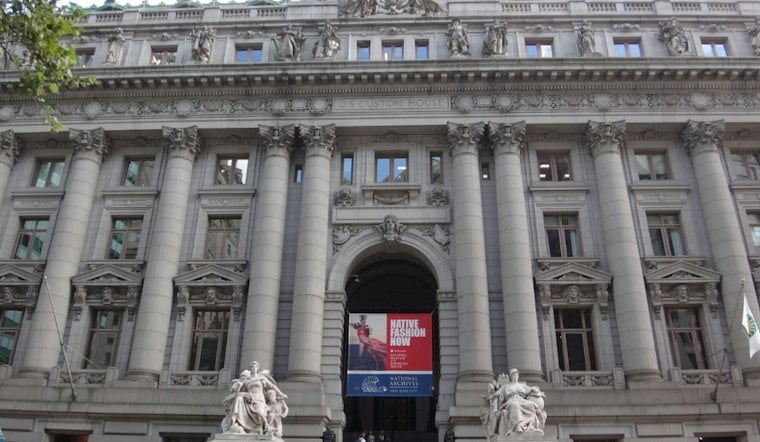
A presentation at the Smithsonian's George Gustav Heye Center in Lower Manhattan has become part of a broader dispute over how the institution presents American history. The National Museum of the American Indian branch uses the Haudenosaunee title Hanadahguyus for George Washington, translated as “Town Destroyer,” and describes the Revolutionary War as disruptive and dangerous for Native communities.
The presentation drew attention after a Fox News Digital reporter visited the Manhattan branch this month. The report described a placard saying conditions were peaceful until white men began their revolution, referring to the period from 1779 to 1804, and a middle-school educational video that calls American colonists trespassers and squatters and characterizes the independence movement as disruptive and dangerous. Fox also said the presentation did not discuss raids on American settlements that preceded the military campaign it describes.
According to George Washington's Mount Vernon, the name Conotocarious, translated as “Town Destroyer,” was first used to describe George Washington during the Allegheny Expedition, more than two decades before the Revolution.
The Sullivan Campaign and a Disputed Death
The museum's treatment of Washington emphasizes the destruction of Haudenosaunee towns during the Revolutionary War. According to the account of the Sullivan Expedition cited here, Washington's May 1779 instructions to Major General John Sullivan called for “the total destruction and devastation” of Haudenosaunee settlements, and the campaign destroyed 40 Native towns and their crop stores. Fox News Digital also reported that American settlements on the New York and Pennsylvania frontiers had been raided by Indians and American loyalists in 1778, while noting that Iroquois nations had fought other Native tribes over access to animal pelts between 1609 and 1701.
Also featured in the exhibit is the death of Lenape Chief White Eyes, which the museum text describes as probably a murder by an American soldier. That framing is not without documentary backing: research compiled by Scholars Crossing indicates White Eyes died in November 1778 while aiding Continental forces, and while U.S. military leaders initially attributed his death to smallpox, Congressional Indian agent George Morgan later disclosed that White Eyes had been murdered by American militiamen in what amounted to a cover-up. Fox News Digital's report characterizes White Eyes' death as historically contested.
Museum Store Titles Add to the Scrutiny
The same Fox News Digital report also examined the museum store, citing titles including An Indigenous Peoples' History of the United States, a book on two-spirit gender identity, Stealing America: The Hidden Story of Indigenous Slavery in US History, An Afro-Indigenous History of the United States, and a children's picture book about former Interior Secretary Deb Haaland. The report highlighted passages in the first title that criticize Americans' devotion to the Constitution as cult-like and describe the federal government as continuing ethnic cleansing against Native people, while characterizing the country's founding as rooted in white supremacy and genocide.
The Manhattan branch, formally known as the George Gustav Heye Center, has occupied its space inside the 1907 Custom House since 1994, following a $24 million renovation jointly funded by New York City, New York State and the Smithsonian, according to Fractured Atlas. The building itself was named for Alexander Hamilton, the nation's first Treasury secretary, and originally served to collect trade duties.
A Broader Federal Pressure Campaign
The Manhattan dispute is unfolding amid a broader fight over the Smithsonian's independence and presentation of American history. On July 24, President Trump signed Executive Order 14416, titled “Restoring Trust in the Smithsonian Institution,” which cited a Domestic Policy Council report accusing the museum network of “ideological capture” and authorized federal officials to use funding and administrative mechanisms to push for exhibit changes, according to the Federal Register. The order followed an August 2025 letter from senior White House aides directing a review of eight major museums and requiring curators to submit exhibition plans and carry out content changes within 120 days to emphasize American exceptionalism, as reported by CBS News.
The executive order goes further than internal review demands. It directs the Department of the Interior and the National Park Service to install temporary signage and exhibits on public walkways outside the National Museum of American History, intended to present alternative historical resources during the country's 250th anniversary year. That directive prompted pushback from Capitol Hill: leaders of the Senate Interior Appropriations Subcommittee wrote to Interior Secretary Doug Burgum on August 6, demanding details on how the administration planned to implement the counter-signage plan, according to a letter from the Office of U.S. Senator Lisa Murkowski.
According to the EveryLibrary analysis cited here, the Smithsonian was established by an 1846 Act of Congress as an independent trust instrumentality governed by a Board of Regents, outside executive branch departments. That structure places the Smithsonian outside direct presidential control, while federal appropriations and other funding mechanisms remain part of the administration's leverage.
What the Smithsonian’s structure means
According to the Smithsonian Institution’s Office of General Counsel, the institution is a trust instrumentality created by Congress in 1846, not an executive branch agency, although it receives federal appropriations and trust-fund income. The Smithsonian Institution Archives’ transcription of the founding act says the institution’s business was to be conducted by a Board of Regents. Federal law also describes the National Museum of the American Indian as a living memorial to Native Americans and their traditions, with purposes including the study, collection, preservation and exhibition of Native American history and culture, according to the U.S. Code. A comparable but distinct precedent came in January 1995, when the Smithsonian canceled the original Enola Gay exhibition at the National Air and Space Museum in Washington after political pressure, according to the Smithsonian Institution Archives.
Leadership Fallout at the Top
The dispute has already reshaped Smithsonian leadership. Secretary Lonnie G. Bunch III announced on September 8 that he would step down at the end of the year, according to Al Jazeera. The Smithsonian did not respond to Fox News Digital's request for comment as of September 14, per that outlet's report.
The Manhattan museum's exhibits fit into a pattern the Trump administration has flagged elsewhere in the Smithsonian system: the National Museum of the American Indian in Washington has separately attracted criticism over its presentation of American history, per the same Fox News Digital reporting. An August cooling-related closure affected the National Museum of the American Indian in Washington.




