

























































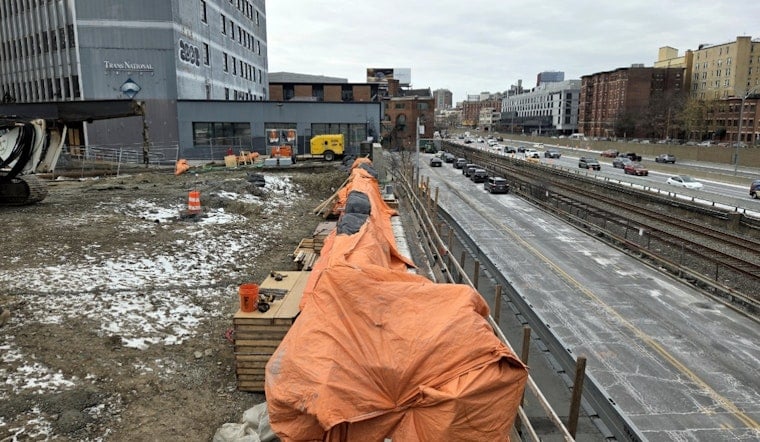
The overpass that has carried traffic between Boylston Street and Storrow Drive since 1965 is now in the second phase of a multi-year rebuild, with MassDOT crews reshaping the Fenway-Kenmore corridor as part of an $84 million project to rebuild and widen the aging structure. The work, which began in September 2025, is remaking not just the bridge itself but the tangle of roads, rail lines, and parkland beneath it.
According to WBZ NewsRadio, the project will introduce a new multimodal Charlesgate Bridge featuring bike lanes and a shared-use path, redesign the traffic patterns on Boylston Street, and reconfigure the intersection surrounding the overpass. The station reports the effort is being completed through seven phases and is slated to end in winter 2029. As part of the redesign, crews will remove and relocate one offramp that currently runs over the Muddy River to Charlesgate West.
A Bridge Built to Solve One Problem, But Creating Another
The Philip G. Bowker Overpass was constructed in 1964 and opened to traffic the following year, named for Massachusetts State Senator Philip G. Bowker, according to Wikipedia. It was built during the mid-century highway era. That timing mattered: the overpass, along with the construction of Storrow Drive in the 1950s, severed Charlesgate Park, a green corridor originally designed in the 1880s by landscape architect Frederick Law Olmsted to connect the Back Bay Fens directly to the Charles River, per the Solomon Foundation. Civic organizations have spent decades since pushing state agencies to reconnect the parkland that Olmsted's original Emerald Necklace vision had linked together.
That advocacy has directly shaped the current rebuild. Early design and engineering work for revitalizing Charlesgate Park received $400,000 from the City of Boston's Community Preservation Act funding back in March 2019, following collaborative efforts by the Charlesgate Alliance and Emerald Necklace Conservancy, according to the Charlesgate Alliance. Design consultants worked on reclamation plans with the Charlesgate Alliance and Emerald Necklace Conservancy. Massachusetts Transportation Secretary Monica Tibbits-Nutt said at the project's October 2025 groundbreaking that removing the Bowker off-ramp over the Muddy River is meant to restore green space and return historic parkland to the community, as reported by The Boston Sun.
What's Being Planted and Built
Beyond the new bike lanes and shared-use path on the redesigned Charlesgate Bridge, the project will improve the greenway and Emerald Necklace networks and add substantial new plantings across the site, per the station's report. Crews plan to put in over 100 trees, 3,500 perennials and ferns, and 150 shrubs as part of the landscaping work tied to the rebuild. MassDOT engineering assessments had classified the Bowker Overpass structure, Bridge B-16-052, as structurally deficient and in poor condition before work began, unable to accommodate modern multimodal transportation needs — the underlying reason a full superstructure replacement was deemed necessary rather than incremental repairs.
Jonathan Gulliver said MassDOT has been working with advocacy groups to meet everyone's needs throughout the design process, according to the same account. That collaborative framing echoes the years of community input that shaped the park restoration elements layered into what began as a bridge maintenance project.
Traffic and Safety During Construction
Under MassDOT's operational guidelines for the project, vehicle traffic over the bridge must remain open throughout construction, with MBTA commuter rail disruptions restricted to non-peak hours, according to the agency's own project information. State engineers are using rolling roadblocks on Interstate 90 and selective nighttime closures on Ipswich Street to limit day-to-day disruption for drivers and rail riders alike.
The stakes around the overpass's condition aren't merely structural. Storrow Drive, which the bridge crosses, features vertical clearances as low as 9 feet in certain sections, a hazard that has led to recurring vehicle-versus-bridge incidents. In a 2024 Hoodline report, a tractor-trailer collided with the Bowker Overpass on Storrow Drive westbound during May 2024, shutting down lanes during morning rush hour and prompting MassDOT structural engineers to inspect the viaduct. More recently, an August 2026 crash involving a box truck occurred on Storrow Drive near Fenway.
A Larger Project Still to Come
The current approximately $84 million project covers replacing the superstructure and widening the bridge that spans Interstate 90, MBTA and CSX rail lines, and Ipswich Street, according to MassDOT's project records. But it's only part of the picture. MassDOT has also planned a separate Phase 2 project involving Bridge B-16-365, with design work in 2028. The broader Bowker projects are intended to improve pedestrian access to the Esplanade and restore additional open space along the Charles and Muddy rivers.
For now, the work moving through the Fenway-Kenmore area remains in what MassDOT has phased as Stage 1A, which began in late 2025 and is scheduled to continue through March 2026 as the first of seven planned construction stages. Commuters and neighbors can expect the multi-year project to keep reshaping the corridor in stages through its winter 2029 completion target, as crews balance active traffic flow with the broader goal of reconnecting Charlesgate Park to the rest of Olmsted's historic park system.




