

























































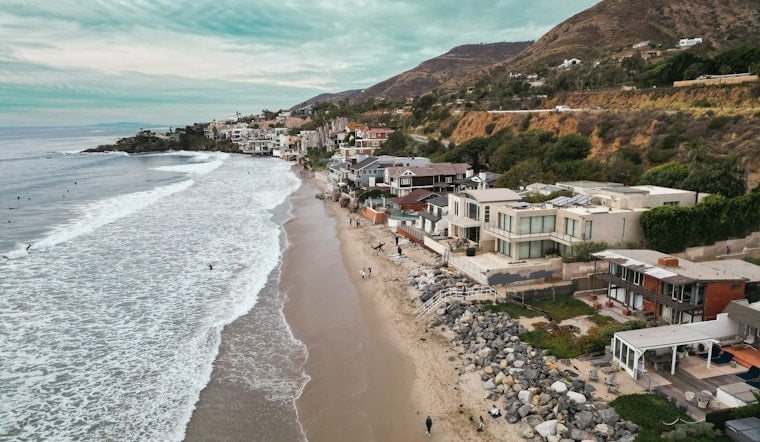
Milwaukee Brewers owner Mark Attanasio, accused of using heavy machinery to dig up public sand from Broad Beach for his own property, has agreed to donate a $2-million oceanfront parcel near Big Rock Beach to a public agency as part of a settlement with the California Coastal Commission. The proposed deal, which still needs commission approval, would resolve a dispute that began when Attanasio's construction crew allegedly carried excavated beach sand onto his land and left a large hole in the rocky intertidal zone that supports fish, sea stars and other species.
A Coastal Commission investigation found that unpermitted excavation degraded sensitive habitats and concluded that Attanasio's project partially blocked public beach access, according to a commission fact sheet cited by the Los Angeles Times. Attanasio's construction work kicked off both a lawsuit and the commission's investigation, and he has separately agreed to return the sand and restore the beach. Kenneth Ehrlich, the attorney representing Attanasio, has said he will not comment on the deal until it is approved.
The lawsuit that triggered the state's scrutiny came from Attanasio's own next-door neighbor. James Kohlberg, son of KKR co-founder Jerome Kohlberg, filed a 132-page complaint in Los Angeles County Superior Court in August 2024 alleging that Attanasio, his company 2XMD Partners LLC, and contractor JILK Heavy Construction violated the California Coastal Act by using heavy excavators in tidal zones to dig up sand for private development, according to The Guardian. The suit accused Attanasio of turning a public beach into his personal sandbox while leaking oil into tidal waters.
A Familiar Pattern of Coastal Violations
This was not the commission's first encounter with Attanasio. Regulators cited him in 2008 for a similar violation at another nearby Malibu property, where he was accused of installing an unpermitted sandbag seawall on public beach and planting invasive species on dunes, a notice that state officials attached to his 2024 violation proceedings, per the Los Angeles Times.
Ehrlich has said 2XMD Partners LLC acted in full compliance with permits granted by the City of Malibu and Los Angeles County in March 2024 for emergency seawall repairs meant to protect the property from ocean forces. Neighbors, however, claimed the heavy machinery used went well beyond what those permits allowed, violating tidal zone restrictions.
Why A Land Donation Instead Of A Fine
Under Section 30821 of the California Coastal Act, the commission holds statutory authority to impose administrative civil penalties of up to $11,250 per day for each violation that impedes public beach access, capped at a maximum five-year accrual period, according to Justia Law. That exposure gave the commission substantial leverage heading into settlement talks, but rather than collecting a cash fine, the agency opted to secure a physical piece of coastline for public use instead.
Lisa Haage, an official with the commission, said the donation is a better resolution than leaving settlement money sitting in a fund. She added that the commission is very excited to dedicate a whole parcel to the public, though she also noted that opening public pathways to Malibu beaches is always a challenge. Robert Moddelmog, enforcement counsel for the commission, said new acquisitions of eastern Malibu lots like this one are rare. Property donations, officials note, are not unheard of in Coastal Act settlement agreements.
A Parcel Shaped By Fire
The donated property, spanning 5,135 square feet with 70 feet of beach frontage, sits near Big Rock Beach, roughly 14 miles east of Attanasio's Broad Beach property. It once held a three-unit residential building that burned down in the January 2025 Palisades Fire, a blaze that scorched more than 23,000 acres and destroyed 6,837 structures across Los Angeles County, according to CAL FIRE. Attanasio is currently under contract to buy the property and will donate it to a public agency once the sale closes, with the land preserved for recreational use. Specific plans for the site will be decided only after that donation is finalized, and the commission is set to vote on the overall agreement on September 10.
Broad Beach's Long Fight Against Vanishing Sand
The underlying tension traces back to Broad Beach's chronic erosion problem. The beach has experienced significant sand depletion after being battered repeatedly by violent storms and high tides, prompting homeowners to establish the Broad Beach Geological Hazard Abatement District in September 2011 to coordinate and fund private beach nourishment and coastal armoring projects, per research published by UC Press. In 2015, high-profile Broad Beach residents including actors Dustin Hoffman, Ray Romano and Pierce Brosnan committed $31 million to a massive private restoration project aimed at importing sand and rebuilding eroded dunes.
Attanasio's own footprint in that exclusive enclave is substantial. He bought his Broad Beach mansion in 2007 for $23 million and later expanded his holdings by purchasing the adjacent vacant beachfront parcel in 2017 for $6.6 million, according to the Los Angeles Times.
Part Of A Bigger Fight Over Who Owns The Shore
The standoff echoes broader, statewide clashes over coastal access between wealthy landowners and the public, including venture capitalist Vinod Khosla's 15-year legal battle over public access at Martin's Beach in Northern California, as reported by Bloomberg. Under Article X, Section 4 of the California Constitution and the California Coastal Act of 1976, all land below the mean high tide line is classified as public, and private landowners cannot restrict access or develop sandy beaches without state permits, according to PBS SoCal.
The proposed resolution now awaits formal Coastal Commission approval at the upcoming vote. If finalized, it would mark one of the more unusual endings to a coastal enforcement case in recent memory, trading a potential six-figure daily fine for a stretch of oceanfront that the state says will belong to the public for good.





