

























































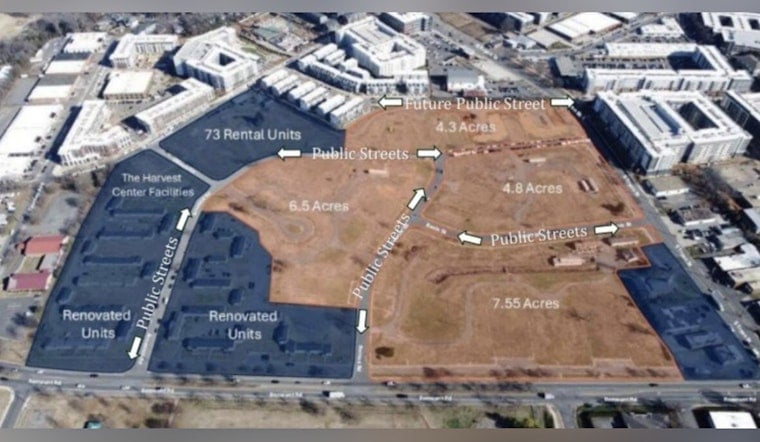
A developer's plan to reconnect one of Charlotte's last historic Black affordable housing communities to the surrounding South End street grid is now in front of city leaders, with a request for $4.1 million in bond funding to pay for sidewalks, drainage upgrades and hundreds of new trees at Brookhill Village. Griffin Brothers presented the infrastructure funding request to Charlotte City Council's Economic Development and Workforce Council Committee, seeking money that would extend Dunavant Street across South Tryon Street and add eight-foot ADA-compliant sidewalks throughout the 40-acre property.
The request, first reported by The Charlotte Observer, would tap into Charlotte's broader $425 million municipal bond package headed to voters in the November 2026 referendum, which includes $125 million earmarked for affordable housing and $280 million for transportation improvements, according to the City of Charlotte. Brookhill Village currently has small streets that do not connect to roads outside the development, per the Observer's reporting, a gap Griffin Brothers hopes the bond money will close along with updated curbs and drainage systems and more than 300 new trees planted throughout the site.
A Segregation-Era Community at a Crossroads
Brookhill Village dates to the 1950s, when it was built to provide affordable housing for Black Charlotteans during segregation, according to the Observer. The complex originally included 418 affordable housing units spread across 36 acres. The McCrorey Heights History Project documents that construction began in late 1950 under Charlotte builder C.D. Spangler Sr. using Federal Housing Administration Section 608 subsidies, while the Observer's reporting attributes the development to C.D. Spangler Jr. in 1950 — a discrepancy in the record that the history project says clarifies the elder Spangler, not his son, the former UNC System President, as the original developer, though the Spangler family still retains ownership of the land.
That distinction matters because of the property's unusual legal structure: a 99-year ground lease that expires in October 2049, at which point ownership of the land and any improvements reverts to the Spanglers, per the lease terms described by the Observer. That bifurcated arrangement — separate landowner and building leaseholder — has long complicated efforts to maintain or redevelop the site. A 2017 lawsuit detailed by WFAE saw landowner affiliate Brookhill Land sue former building leaseholder Brookhill Village Two, alleging lease default due to structural disrepair, illustrating how the split ownership discouraged long-term upkeep for decades.
Years of Failed Redevelopment Attempts
Griffin Brothers is not the first developer to try to save Brookhill Village. A $67 million redevelopment effort in 2020 led by developer Tom Hendrickson and South Tryon Community Development Corp. collapsed after Charlotte municipal leaders and LISC Charlotte denied a $13 million public financing request, according to The Charlotte Post. Lenders at the time cited the short remaining term on the ground lease as a key barrier to both private and public investment.
By the time Griffin Brothers took over the ground lease in 2022, the property had deteriorated badly. A community assessment cited by WCNC found more than 250 units vacant and severely deteriorated, leaving only about 120 residents still on site. The Observer reports Griffin Brothers now plans to tear down and renovate some of the most dilapidated affordable units as part of the current phase of work.
Preserving Affordable Rents Through 2049
To make the numbers work without displacing existing residents, Griffin Brothers hired Charlotte-based Quore Real Estate Advisors as development manager to structure public gap financing and execute a phased preservation plan, the same WCNC report notes. In July 2023, the Charlotte City Council approved $3.5 million from federal American Rescue Plan Act funds, matched by $3.5 million from Mecklenburg County — a combined $7 million — to preserve 100 affordable housing units at Brookhill Village through an affordability covenant lasting through the end of the ground lease in 2049, per the City of Charlotte.
The Harvest Center has built and now manages 89 of those affordable-housing units, with 11 additional units in progress that will bring the total to 100, according to the Observer. Rents for those preserved units range between $350 and $550 per month, with 78 units set aside for existing legacy households and 22 allocated to transitional housing programs, per Quore Real Estate Advisors. The Observer reports that units are occupied mostly by people earning 30 percent of area median income, where the threshold for a family of four sits at $33,650. Alongside the housing work, the Harvest Center is constructing $7 million worth of onsite support facilities — including a resource center, gymnasium and commercial kitchen — plus resource buildings for its own corporate offices, work that WCNC says will support individuals and families transitioning out of situational homelessness.
Commercial Rezoning Fuels the Rest of the Site
The other half of Griffin Brothers' strategy relies on private revenue. Charlotte City Council approved rezoning 24 of the property's 40 acres for event, hospitality and commercial spaces, according to the Observer, and the company has broken ground on 74 townhomes intended for short-term rentals. About 3.5 acres will be allocated to event space, where Griffin Brothers has signed a lease with a music festival producer for a permanent venue, and both music festival producers and community groups have expressed interest in using it.
A racket sport group has agreed to build padel courts and a clubhouse on the property, while Oasis Wellness Sanctuary plans to develop a holistic wellness center there, the Observer reports. John Lineberger said the development is projected to draw more than 200,000 visitors annually, with many expected to come from out of town — underscoring why Griffin Brothers views connecting Dunavant Street and adding sidewalks as essential infrastructure rather than a cosmetic upgrade.
Timeline and Surrounding Market Pressure
The infrastructure proposal is set to be reviewed again in October, and if the committee advances it, the request would go before the full Charlotte City Council for a vote on October 12, according to the Observer. The stakes are heightened by the neighborhood's runaway rents: average market rents in Charlotte's South End reached $2,161 per month in August, compared with a citywide average of $1,686, Hoodline previously reported, a gap that illustrates the economic pressure bearing down on one of the last remaining pockets of deeply affordable housing near the corridor.





