

























































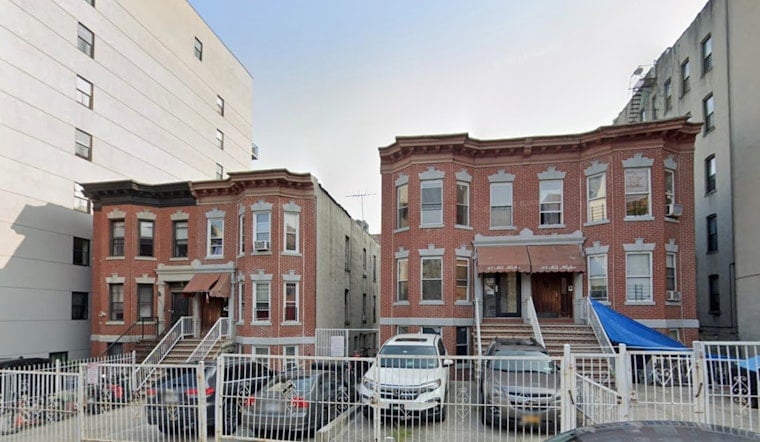
A 15-story residential tower is headed for 29 Mount Hope Place in the Bronx, where a two-story residential building has stood for more than a century. Municipal permit filings describe a 246-unit rental building rising 150 feet between Walton Avenue and Jerome Avenue, just steps from the 176th Street subway station served by the 4 train.
The filings, first reported by New York YIMBY, list Joel Brach of Buildhouser Inc. as the owner behind the applications. Nikolai Katz Architect is named as architect of record for the concrete-based structure, which is expected to include 99 residences alongside a cellar and a 20-foot-long rear yard, according to the same filings. The proposed units at 29 Mount Hope Place average 633 square feet, a scope that points toward rental housing rather than condominiums, per the filings' unit breakdown.
A Multi-Parcel Land Assembly Takes Shape
Buildhouser acquired the 29 Mount Hope Place parcel for $3.5 million from Emanuel Gutzmer in November 2025, shortly after acquiring the adjacent parcel at 25 Mount Hope Place for $2.5 million the previous month, according to PincusCo. Demolition permits for the two-story building that previously occupied the site were filed in January 2026. StreetEasy records show the original structure at 29 Mount Hope Place dates back to 1901, underscoring the scale shift now underway along the block as older walk-ups give way to high-density towers.
The assemblage extends beyond this single lot. Buildhouser secured a $21.1 million construction loan from NorthEast Community Bank in April 2026 for its sister site at 23 Mount Hope Place, where the developer had previously submitted plans for another 15-story residential tower, Traded reported. Together, the acquisitions and financing point to a coordinated, multi-site expansion by Buildhouser in the immediate vicinity of the 176th Street subway stop.
Ground-Floor Retail and Affordability Rules
Beyond the residential units, permit filings indicate the building will incorporate 2,060 square feet of ground-floor commercial space alongside its 155,940 square feet of residential space, according to Marketproof. No estimated completion date has been announced for the project.
The site falls within the 92-block zone governed by the 2018 Jerome Avenue Neighborhood Plan, which mandates that new residential projects reserve 20% to 25% of floor area for income-restricted housing under Mandatory Inclusionary Housing rules, Hoodline has reported. The rezoning, adopted by the City Council that year, unlocked high-density residential development along corridors once dominated by auto-industrial uses.
Why Rentals Dominate the Local Housing Stock
The push toward rental construction reflects the makeup of the surrounding district. Bronx Community District 5, which includes Mount Hope, has a homeownership rate of just 4.45%, with more than 95% of area residents living in rental housing, making it among the most rental-dominant districts in New York City. Federal economic and Census data also rank the district among the ten lowest-income community districts citywide, with 19% of residents facing income deprivation and 13% experiencing severe housing cost burdens as of this year, per research published in MDPI.
Same Architect, Same Corridor
Nikolai Katz Architect is not new to this stretch of the Bronx. The firm filed 133 new building and major alteration projects across New York City over a three-year span ending in August, representing nearly 7,800 residential units and 5 million square feet, according to PincusCo. Two blocks away at 1712 Jerome Avenue, the same firm filed permits last month for a nine-story, 73-unit building, part of a wider cluster of high-density filings near the 176th Street transit node.
The Jerome Avenue rezoning that made these projects possible was paired with a $189 million municipal capital commitment for local transit, park upgrades, and school construction across Mount Hope and adjacent neighborhoods, intended to help the area's infrastructure absorb new residents. Whether 23 and 29 Mount Hope Place will ultimately be combined or run as separate buildings, and how the required affordable set-asides at 29 Mount Hope Place will be structured, remain open questions as the project moves through the permitting process.





