

























































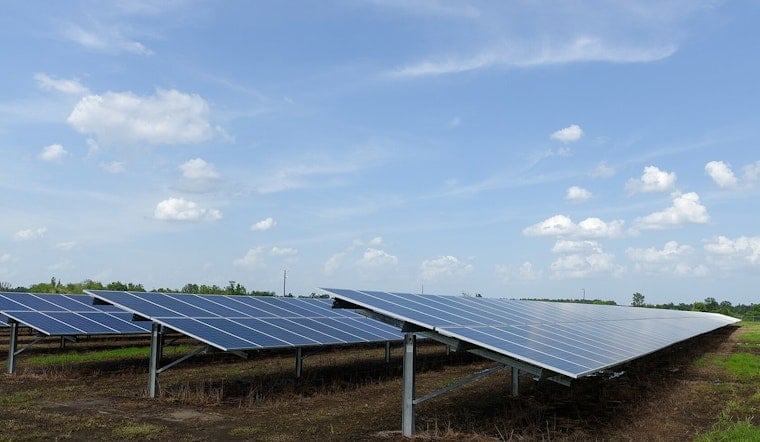
California farmers stuck with fields too dry to plant now have a cheaper way to turn that land into solar power. The state Legislature has passed Assembly Bill 1156, which allows landowners in water-strapped regions to convert fallowed farmland into solar arrays without paying steep exit fees tied to decades-old farmland protection contracts, and the measure now awaits Governor Gavin Newsom's signature.
The bill targets Central Valley and Central Coast lands facing strict groundwater pumping limits, according to the Los Angeles Times. It passed the state Senate in a 21-14 vote and eliminates conversion fees for landowners in those targeted regions who want to shift from farming to solar. Under California's Williamson Act, standard contract cancellations normally require landowners to pay a fee equal to 12.5% of a property's full, unrestricted fair market value, according to the California Department of Conservation. The Williamson Act dates back to 1965, when the state began offering tax breaks to growers who agreed to keep their land in farming.
A Legal Shift From Rescission to Suspension
Beyond waiving fees, the bill reshapes the underlying legal mechanism itself. AB 1156 modifies the Williamson Act conversion process from permanent contract rescission to temporary contract suspension, and it expands solar-use easements to explicitly cover battery energy storage systems and related clean energy facilities, per Agri-Pulse. Previous solar easement rules, established in 2011, were narrow and rarely used, the outlet reported.
Assemblymember Buffy Wicks authored the bill, saying it gives farmers and local communities in water-constrained regions another option for land that can no longer be productively farmed, according to the Los Angeles Times. Assemblymember Steve Bennett, who voted for the bill, said it promotes solar energy and enables farm owners with inadequate water to find another use for their land. Bennett added that some transformation of agriculture is appropriate given California's water shortage and clean-energy pressures, per the same report.
Groundwater Limits Are Squeezing Growers
The pressure driving the bill traces back to California's groundwater rules. California's Sustainable Groundwater Management Act, adopted in 2014, addresses chronic overpumping by tightening limits each year until 2040 in many areas, forcing some farmland to remain dry and unplanted. Farmers who exceed those pumping limits face fines, and global warming is worsening droughts throughout the West, according to the Los Angeles Times report.
The scale of the problem is significant. The Public Policy Institute of California has estimated that as much as 900,000 acres of San Joaquin Valley farmland may need to remain dry by 2040. Farmland values across sampled crop acreage in the San Joaquin Valley dropped by between $8,000 and $50,000 per acre over the eleven years leading up to 2025 because of the pumping restrictions, according to the Tule Basin Land & Water Conservation Trust. That financial squeeze helps explain why solar lease revenue has become appealing to landowners with fields that no longer pencil out as farmland.
Farm Groups Warn of Lost Soil, Lost Jobs
Not everyone welcomes the shift. The California Farm Bureau and other agricultural groups oppose the bill, warning it could convert some of the state's best farmland to industrial use. The groups said in a letter that the bill's latest version discards an earlier plan that included more agricultural-land protections, according to the Los Angeles Times. That opposition echoes a broader coalition — including the Farm Bureau, American Farmland Trust and the California Cattlemen's Association — that argued earlier this year that waiving cancellation fees risks permanently shifting prime farmland to industrial energy development, according to the California Farm Bureau.
Rural counties, however, came around to supporting the measure after amendments preserved local authority over contract non-renewals and stripped out a proposed power for the California Energy Commission to suspend contracts on its own. The Rural County Representatives of California, which advocates for 40 rural counties, dropped its opposition and endorsed the bill in May 2025 once those changes were made. Separate amendments also require solar developers converting farmland to enter community benefit agreements funding farmworker job training, groundwater recharge projects and economic assistance for displaced agricultural workers, according to Capitol Weekly.
Part of a Bigger Push for Clean Power
The bill fits into California's broader clean-energy timeline. Solar development on farmland would help the state reach its goal of 100% clean electricity by 2045, and clean-energy advocates and bill supporters back the shift as an answer to both the water crisis and the climate mandate. California reached 16,942 megawatts of grid-connected battery storage capacity as of November 2025 — a 2,100% surge since 2019 — fulfilling roughly one-third of the total storage the state will need by 2045, according to the Office of Governor Gavin Newsom. The state must build about 6 gigawatts of new solar-plus-storage capacity annually through 2045 to hit that mandate, roughly double the 3-gigawatt average pace achieved between 2019 and 2023, per estimates from the California Energy Commission.
The trend is already visible on the ground in the Central Valley. In January, Hoodline reported on solar's massive land grab after the Westlands Water District's board approved the Valley Clean Infrastructure Plan, a proposal spanning roughly 136,000 acres to host up to 20 gigawatts of utility-scale solar and battery storage on fallowed farmland. Westlands is the nation's largest agricultural water district and has around 200,000 acres sitting fallow in a typical year.
Not every water-stressed acre is destined for solar panels, though. A recent policy brief noted that low-water, SGMA-ready winter forage crops like wheat can require as little as 4 inches of supplemental irrigation, giving some growers an agricultural alternative to complete fallowing or converting to solar, according to Valley Ag Voice. Whether solar leases or lower-water crops ultimately generate enough long-term economic benefit to offset lost farm jobs remains an open question as the state's agricultural landscape keeps shifting under pressure from both drought and clean-energy demand.




