

























































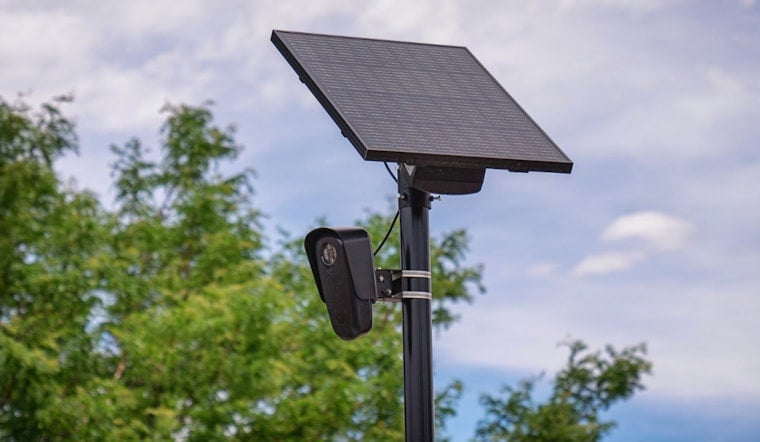
Catawba's police chief wanted to keep the town's license plate cameras running after a 60-day trial, pointing to a recent murder investigation as proof the system worked. The town council said no anyway, voting down not just the full program but a stripped-down version that would have kept just one camera running for roughly $3,000.
The five cameras that had been installed across Catawba would have cost the town about $15,000 to keep permanently, according to WSOC-TV. Catawba Police Chief Brian Bixby had advocated for keeping the Flock system in place, but the Catawba Town Council denied the police department's funding request outright, and then rejected a scaled-back proposal to maintain a single camera, per WHKY.
Chief Bixby's case for the cameras wasn't hypothetical. Catawba County Sheriff's deputies used Flock cameras to help find the car belonging to murder suspect Leroy Loper in August, in connection with the disappearance of 58-year-old Robin Doyle near Claremont. Loper, 54, is accused of killing Doyle and burying her body in the woods, and he faces charges of murder, first-degree kidnapping, and concealment of death, according to WCNC.
A Statewide Pattern of Pushback
Catawba isn't an outlier — it's the latest entry in a growing list. At least 10 other North Carolina municipal governments, counties, and public institutions had already voted to terminate or reject Flock deployments by September, including Dare County, Macon County, Davidson County, Asheville, Chatham County, Hillsborough, Pittsboro, and Greenville, per the Hickory Daily Record's reporting compiled by advocacy site DeFlockILM. Local governments across the state have cited public pushback, Fourth Amendment concerns, and data privacy issues during contract renewal discussions.
Asheville's city council voted 5-2 in late August to terminate its $73,000 contract for 11 Flock cameras, directing the city manager to suspend data access and request physical removal of the hardware, according to Carolina Public Press. That decision followed heated public hearings where residents objected to citywide surveillance tools. Dare County commissioners voted unanimously on September 1 to remove all 14 of its county-operated Flock cameras, following a similar 5-0 vote by Macon County commissioners in July to defund and strip down its 12-camera network — even though the Macon County sheriff had reported between 1 million and 3 million monthly plate scans from the $47,000 system.
A False Flag That Fueled the Debate
The privacy concerns driving these votes aren't purely theoretical. In Atlanta, a college student's newly registered vehicle was stopped twice in two days after Flock cameras flagged her temporary license plate for an insurance issue rooted in out-of-date database records, Atlanta television station WSB-TV reported. Renee Jones told the station that Atlanta police said her daughter's car was flagged for an insurance issue, and the family later learned the alert stemmed from a recent vehicle purchase that hadn't updated across systems in time. The student's family received a ticket despite showing proof of insurance, and they plan to fight it in court while pushing for better alignment so mistakes like theirs can be recognized before officers pull someone over. Flock has since changed how its database works, though the system also locks out officers whose activity on it appears abnormal.
State Law Moves the Opposite Direction
While towns and counties pull back, North Carolina's state government has moved to expand license plate reader use on its own turf. State lawmakers enacted a budget provision in July that permanently authorized the State Bureau of Investigation to facilitate placing automated license plate readers on state highway rights-of-way managed by NCDOT, following a pilot program that had already recorded more than 152 million plate scans, according to the Carolina Journal. The General Assembly had first authorized the NCDOT pilot in 2023 before writing it into permanent law this year.
Public records reviewed by DeFlockILM also revealed a permitting wrinkle: while static plate reader poles had obtained the required state right-of-way encroachment permits under N.C. Gen. Stat. § 136-93, Flock's pan-tilt-zoom Condor live-video cameras had not received the mandatory NCDOT encroachment approvals. North Carolina law requires formal encroachment agreements before erecting structures in state-maintained highway rights-of-way, a gap that adds another layer to the legal questions swirling around the technology's rollout.
A Vendor Facing Scrutiny From Coast to Mountains
Under North Carolina General Statutes § 20-183.30, law enforcement agencies running ALPR systems must report their policies to the State Bureau of Investigation, but no dedicated federal statute governs license plate surveillance the way the Driver's Privacy Protection Act governs DMV records. That patchwork of state rules, rather than any uniform federal standard, is what's shaping decisions in town halls from the coast to the mountains.
Flock Safety, founded in Atlanta in 2017, reached an estimated valuation of $8.4 billion in April and now operates more than 100,000 license plate cameras across 5,000 law enforcement agencies and 6,000 communities nationwide, capturing over 20 billion vehicle scans monthly. That scale is exactly what's fueling both sides of the debate: police chiefs like Bixby see a tool that helped locate a murder suspect's car, while town councils increasingly see a surveillance network whose data practices and errors they can't fully control. States across the country have raised concerns about privacy and abuses of the surveillance system, and Catawba's town council chose to side with caution over convenience.


.jpg)