

























































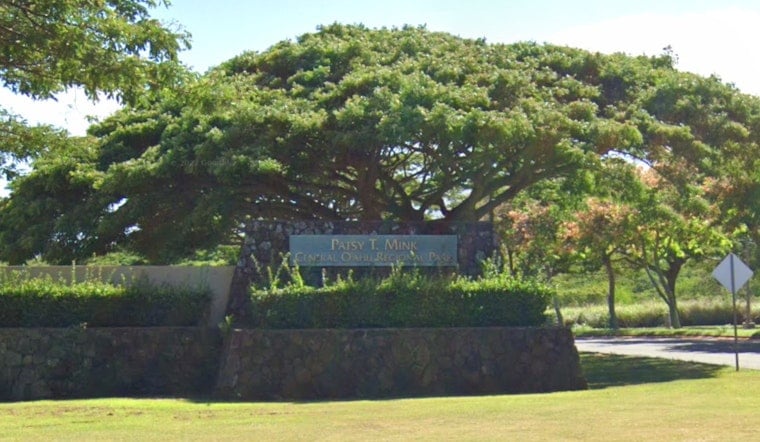
The fields at Patsy T. Mink Central Oʻahu Regional Park in Waipiʻo are open to the public again, six months after a portion of the 269-acre complex was turned into an emergency dumping ground for storm debris. City officials, joined by a newly appointed state senator, marked the full reopening on Thursday, celebrating the end of a cleanup that involved soil testing, regraded fields, and a repaired irrigation system.
The Honolulu Department of Parks and Recreation announced the completed restoration in a post from its Honolulu DPR account, noting that both the parks department and the city's Department of Environmental Services celebrated the milestone at the former debris site near the corner of Kamehameha Highway and Ka Uka Boulevard. Environmental Services Director Roger Babcock joined parks staff and newly appointed State Senator Danielle Bass at the event, where attendees tried out the refurbished turf for football, volleyball, and soccer, according to the department's announcement.
The park's passive field became an unlikely piece of disaster infrastructure back in March 2026, when the city designated it a temporary debris storage site under emergency proclamations following the destructive Kona Low storms. The designation followed the city's Disaster Debris Management and Operation Plan, published in April 2025, and turned a field normally off-limits to organized activity into a staging ground for roughly 3,000 tons of storm wreckage hauled in mainly from the hardest-hit North Shore.
A Record Flood and an Emergency Fix
The scale of the disaster behind that decision was staggering. Back-to-back Kona Low storms in March 2026 produced Oahu's worst flooding in 20 years, damaging 12,434 properties across the island and causing more than $1 billion in total damages statewide, according to Cotality. Nearly 20% of properties within the storm's flood footprint suffered damage, the analysis found.
Honolulu Emergency Management Agency damage reports confirmed that at least 260 Oahu homes were left completely uninhabitable, with the heaviest destruction concentrated on the North Shore, where at least 20 properties were declared total losses, Honolulu Civil Beat reported. That scale of destruction is what generated the mountain of debris that needed somewhere to go, and Central Oʻahu Regional Park's open passive fields, on land that first opened in July 2001 on former pineapple agricultural acreage, offered emergency crews the room to process it.
Mayor Rick Blangiardi said city teams and private contractors served residents and cared for the park throughout the operation, which lasted more than 18 days. Nate Serota said the park helped remove storm debris and support community recovery during that stretch, according to the department's announcement.
Neighbors Raised Contamination Concerns
The plan to stage flood debris so close to homes did not sit well with everyone in Waipiʻo at first. When the city designated the park as an emergency collection site in late March 2026, local residents expressed immediate concerns about potential soil and water contamination in the surrounding neighborhoods, according to KHON2 News, with some questioning why toxic runoff would be staged near residential areas.
State Senator Danielle Bass, who represents the Central Oʻahu area and took office in August 2026 after Governor Josh Green appointed her to succeed the retiring Senator Michelle Kidani, raised those resident concerns about debris storage at the park, per the department's announcement. In response, the city applied a set of environmental protections during the operation: filter socks to prevent runoff, temporary dust fencing, and 24/7 monitoring of the site.
An independent laboratory tested the soil both before and after the cleanup, and the results showed no harmful contaminants, according to the parks department. Babcock said the soil cleanup met all Department of Health requirements and that the park would be returned to the public better than before.
Six Months of Repair Work
Once the debris was cleared, crews spent months on restoration: repairing the irrigation system, regrading the site with clean soil, reseeding the grass, and eventually removing the temporary fencing that had ringed the site. The full restoration process took roughly six months from the initial March 2026 designation to Thursday's reopening.
The debris itself did not simply disappear from Oahu's waste stream. It was hauled to Waimanalo Gulch Sanitary Landfill in Kapolei, the island's primary municipal solid waste facility, along with various commercial recyclers, according to the department's announcement and confirmed by WM Solutions. The landfill operates under city oversight and federal environmental regulations.
The physical cleanup at the park ran alongside a broader state recovery effort. The Hawaii Emergency Management Agency launched a Disaster Recovery Case Management Program through 2-1-1 and stood up local recovery centers offering direct FEMA and SBA assistance to flood-affected residents, a response Hoodline detailed in an earlier report on state caseworkers as damage estimates climbed after the storms.
A Storied Park, Interrupted Again by Weather
Central Oʻahu Regional Park is no ordinary field complex. Its 20-court tennis facility was named Public Park of the Year by Tennis Industry magazine in December 2017, a recognition of its role as a major venue for statewide tournaments, and the park itself was renamed in 2007 to honor the late U.S. Representative Patsy T. Mink, the Hawaii congresswoman best known for co-authoring Title IX.
Even after the debris cleanup wrapped, the park's return to normal wasn't entirely smooth. Less than a month before the September reopening, outdoor sports fields across Oahu, including at Central Oʻahu Regional Park, were forced to temporarily close again due to heavy rain from Tropical Storm Lala, according to the Honolulu Department of Parks and Recreation, as city crews responded to hundreds of fallen-tree and drainage calls during that August storm.
With the fields, tennis courts, and irrigation system now restored, the department says the full park area is safe and open for public use. Residents with concerns about park conditions are asked to report them through the HNL 311 application or by contacting the Honolulu Department of Parks and Recreation at [email protected] or 808-768-3003. More information on the temporary debris storage operation is available at honolulu.gov/env/tdsr.





