

























































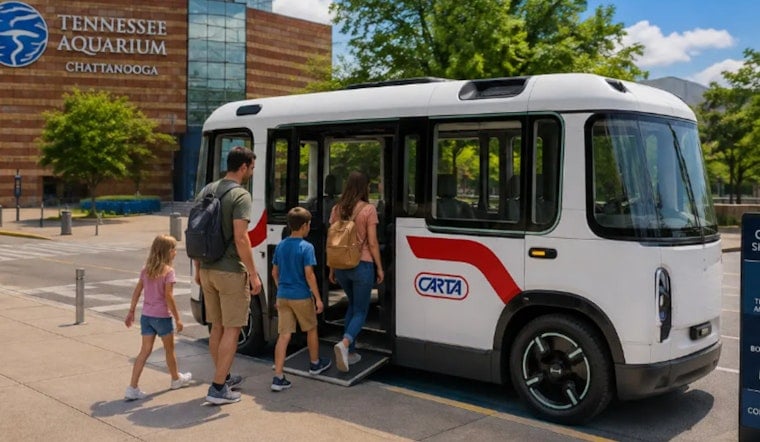
Chattanooga's downtown shuttle fleet, some of it more than 30 years old, is finally getting replaced — and its successor will drive itself. The Chattanooga Area Regional Transportation Authority has been awarded a $25 million federal grant to swap its aging Downtown Electric Shuttle vehicles for a fleet of autonomous shuttles, marking the largest competitive grant the transit agency has ever received.
The award, confirmed by the Federal Transit Administration, represents the maximum allowable size under the U.S. Department of Transportation's fiscal year 2026 BUILD program, according to 6AM City. CARTA competed against transit and infrastructure projects nationwide for a share of a $1.73 billion USDOT allocation, per the outlet, underscoring how competitive the win was for a mid-sized Southern city's transit system.
The new shuttles won't be run by CARTA alone. Autonomous transit operator Beep will manage the first generation of vehicles from a newly built command center, with initial service launching using two passenger-carrying shuttles and a third held in reserve for testing and training, according to WTVC. The station reports CARTA eventually plans to grow the fleet to as many as six autonomous shuttles as the program matures.
Human Operators Stay Onboard for Now
Despite the autonomous label, riders won't be stepping onto driverless vehicles right away. CARTA CEO Charles D. Frazier has said human safety operators will remain onboard for several years during initial operations, a setup he compared to the elevator attendants of an earlier technological era, per the same 6AM City report. Those operators will be able to manually take control of the shuttle during unpredictable traffic conditions, the outlet notes.
What sets Chattanooga's approach apart from commercial robotaxi programs elsewhere is the city's own fiber network. The shuttles will communicate directly with traffic signals and crosswalks over EPB's community-wide, 100% fiber optic infrastructure, according to WTVC. That vehicle-to-everything connectivity means the shuttles can pull in real-time traffic light and hazard data that extends well beyond what their onboard sensors alone could detect, the station reports.
A Downtown Garage Becomes a Living Classroom
The physical hub for the new system will rise inside a building CARTA riders already know well. A Mobility & Innovation Command Center and a public Live-Learning Lab will occupy the first floor of CARTA's Shuttle Park South garage, with renovations expected to begin within the next 18 months, 6AM City reports.
The project also has an educational component. The University of Tennessee at Chattanooga is partnering with CARTA to build curricula for high school and college students aimed at careers in autonomous vehicle maintenance, command center oversight, and onboard safety management. UTC Chancellor Lori Bruce has said the initiative will turn the city into what amounts to a live classroom for automated transportation technology, according to the same 6AM City coverage.
Why Chattanooga Was Ready
Chattanooga didn't land this grant out of nowhere. The city has operated as an urban smart-mobility testing ground since 2019, when UTC's Center for Urban Informatics and Progress built the MLK Smart Corridor, a one-mile testbed equipped with LiDAR sensors and edge-computing nodes, according to the University of Tennessee at Chattanooga. That corridor has already hosted federal and private research projects studying dynamic traffic optimization and pedestrian safety, the university says.
The shuttle system being replaced has deep roots of its own. CARTA launched its free Downtown Electric Shuttle in 1992 as a downtown redevelopment and air-quality initiative, connecting the Chattanooga Choo Choo to the Tennessee Aquarium, according to CARTA. Some of the electric vehicles still running that route today are more than 30 years old.
What Riders Can Expect, and When
Riders won't need to reach for their wallets under the new system. Fare-free rides will continue on the autonomous shuttles, with operating costs covered through parking revenue generated by CARTA's municipal lots and garages rather than sales taxes, per 6AM City.
The timeline stretches out over several years. CARTA expects engineering and vehicle procurement to begin in 2027, with public passenger service launching roughly two years later once safety validation is complete, according to WTVC. Testing and safety verification must be finished before passenger service can be authorized, the station reports. As reported by the U.S. Department of Transportation, the shuttles are designed to connect with traffic signals and roadway infrastructure to provide safer, smarter transportation as the program moves from testbed to daily service downtown.





