

























































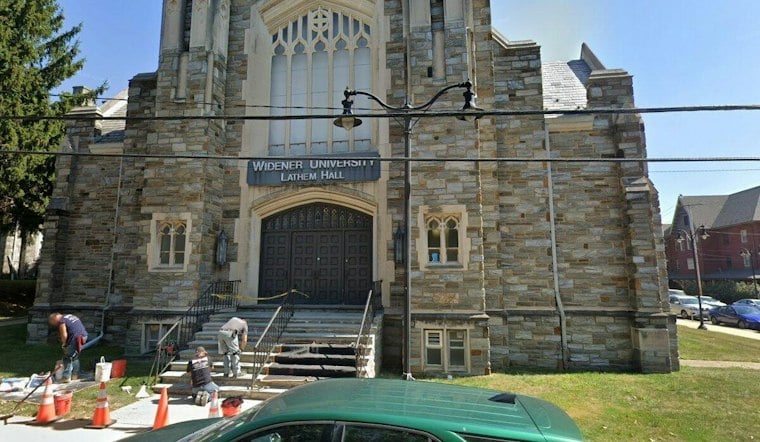
Democratic members of Congress gathered at Widener University in Chester, Pennsylvania, to hold an unofficial hearing on election security and federal changes to how Americans vote, just hours after the U.S. Supreme Court refused to lift a lower-court block on new mail-ballot restrictions. The session carried no legislative weight, but it landed at a pointed moment in the fight over the 2026 midterms.
Reps. Mary Gay Scanlon and Joe Morelle, the ranking Democrat on the House Administration Committee, hosted the event, according to WHYY. Morelle opened the session by calling for congressional resistance to threats facing democracy, the outlet reported. Reps. Madeleine Dean, Chrissy Houlahan and Norma Torres joined Scanlon at the so-called shadow hearing, which was organized by committee Democrats outside the panel's formal process and involved no votes or official committee action.
The timing was no accident. On September 14, 2026, the Supreme Court denied a Department of Justice emergency request to lift an injunction blocking new Postal Service regulations that would have restricted mail ballot delivery ahead of November, according to the ACLU of Massachusetts. That order built on a preliminary injunction issued a day earlier by U.S. District Judge Carl Nichols, a Trump appointee in Washington, D.C., who ruled the Postal Service lacked statutory authority to refuse ballot deliveries or demand state voter rolls, per Campaign Legal Center.
A Directive to Track Eligible Voters
According to the hearing testimony described by WHYY, the Trump administration had directed the federal government to compile a list of eligible voters and directed the Postal Service to deliver ballots only to voters on that list. Omar Noureldin testified that two judges appointed by presidents of both parties found the rule and executive order unlawful, the outlet reported. The administration has appealed the first judge's decision to the Supreme Court.
Pennsylvania joined more than 20 states in suing to stop the new federal mail-voting requirements. That effort traces back to April 2026, when a coalition of more than 20 state attorneys general, joined by Pennsylvania Governor Josh Shapiro, sued the federal government, arguing that executive branch mandates on mail voting violate the Elections Clause of the U.S. Constitution, according to Votebeat. A White House spokesperson, Lauren Bis, said in an email that the administration's proposals are commonsense measures meant to protect mail-ballot security and ensure only Americans vote, per the same account carried by WHYY.
Citizenship Proof and the SAVE Act's Stalled Path
Much of the hearing centered on the SAVE America Act, which requires documentary proof of U.S. citizenship when registering to vote in federal elections. The bill passed the House 218–213 on February 11, 2026, and also mandates strict photo ID for voting, according to the Bipartisan Policy Center. It remains stalled in the Senate for lack of Republican support, WHYY reported.
Scanlon said the SAVE America Act would prevent hundreds of thousands of American citizens from voting, warning it could affect married women, younger voters, older voters and rural voters. Election law expert Amy Widestrom testified that a Pennsylvania REAL ID would not satisfy the proposed citizenship-document requirements — a gap explained by PennDOT standards showing REAL IDs can be issued to non-citizen lawful permanent residents, meaning the credential proves lawful presence rather than citizenship, according to the Pennsylvania Department of Transportation. A separate multi-step audit of Utah's roughly 2-million-voter registration list, conducted from April 2025 to May 2026, identified just 27 confirmed instances of non-citizen registration, per the Bipartisan Policy Center's review.
Armed Agents at the Polls Raises Legal Alarms
Trump administration officials had discussed possibly sending ICE agents and other federal officers to polling locations in November, WHYY reported, and Donald Trump did not rule out sending federal agents to polling places. Sen. Markwayne Mullin said immigration agents could deploy to polling sites for threats not necessarily related to the election itself, while White House press secretary Karoline Leavitt said in February 2026 there were no formal plans to station ICE agents outside polling locations.
Morelle told the hearing that being armed at a polling place in America is a federal crime. Federal law backs that up: 18 U.S.C. § 592 makes it a felony, punishable by up to five years in prison and disqualification from federal office, for any civil or military officer to deploy troops or armed men at a polling place, according to the Office of the Law Revision Counsel.
Pennsylvania's Own Safeguards
Marian Schneider testified that elections in the United States and Pennsylvania are secure, according to WHYY's account of the hearing. Pennsylvania's mail-in system rests on Act 77 of 2019, a bipartisan state law that the Pennsylvania Supreme Court affirmed as constitutional in August 2022, according to Common Cause Pennsylvania. Pennsylvania's voting system also includes paper ballots that provide redundancy, and counties are required to perform a statistically grounded post-election tabulation audit, the hearing testimony noted.
Lauren Cristella called on Pennsylvania voters to become poll workers or witness the election process in person. The nonpartisan Committee of Seventy hosts election academies that walk residents through the chain of custody and the system's built-in redundancy — an effort the group launched with the Philadelphia City Commissioners in March 2026, offering public tours of ballot processing facilities, according to Metro Philadelphia.
Even as the SAVE America Act sits stalled, House Republicans have pursued another path: a July 2026 budget resolution framework including $10 billion in federal election grant incentives for states that voluntarily adopt strict proof-of-citizenship and photo ID rules, per the Bipartisan Policy Center. The Chester hearing was intended to help lawmakers develop proposals on election security, voting rights, electoral reforms and government ethics, falling under the jurisdiction the House Administration Committee holds over federal election legislation — even though, as an unofficial gathering, it produced no votes and no binding action.
The Chester hearing follows months of related debate over federal election proposals.




