

























































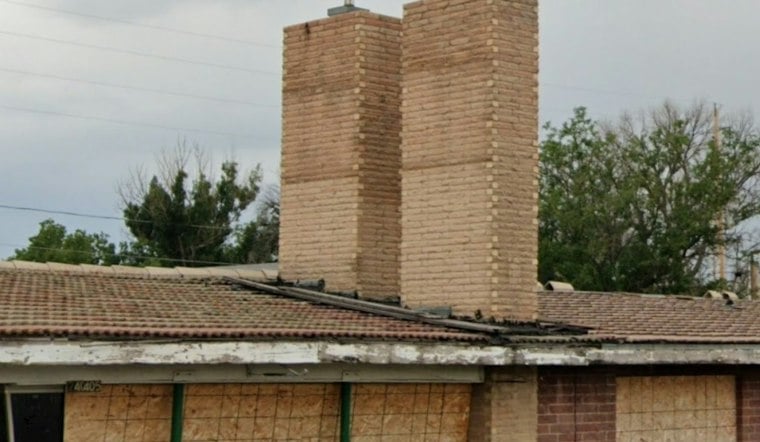
A stretch of Cheyenne's East Lincolnway lost one of its last visible links to the Lincoln Highway era this week, as the Twin Chimneys Motor Court was demolished in about three hours to clear the site for a coffee drive-thru; its twin chimneys alone took about 30 seconds to demolish. The motor court, known for its red exterior, green roof, and distinctive twin stone chimneys, had stood at 2405 East Lincolnway for almost 90 years before crews took it down.
The demolition was reported by Cowboy State Daily, whose Kerry Drake detailed how the property, which offered lodging and covered parking for travelers along the historic route, included rooms dating to the 1930s and a reception area renovated during the mid-century era. According to the outlet, the lot will be cleared of all traces of Twin Chimneys within about three days. Chuck Harter carried out the demolition of the chimneys themselves, the report notes.
7 Brew Coffee, the drive-thru chain building the new stand, already operates one shop in Cheyenne on Dell Range Boulevard, per Cowboy State Daily's reporting. That existing location opened as a 616-square-foot modular kiosk built in 2025 under a 15-year net lease, according to a LoopNet listing. Denver-based contractor McCarty & Sons, which both demolishes old buildings and builds 7 Brew stands in the region, handled the Twin Chimneys teardown, the article states, and the chain describes itself as a high-speed, upbeat drive-thru coffee stand known for fast service.
A Rapidly Expanding Chain Backed by Private Equity
7 Brew's regional push doesn't stop in Cheyenne. Cowboy State Daily reports that the chain's expansion plan also includes new drive-thru coffee stands in Laramie, Wyoming, and Loveland, Colorado. That growth has been fueled in part by institutional capital: in 2024, private equity firm Blackstone Inc. acquired a growth equity stake in 7 Brew Coffee, according to Wikipedia, helping accelerate the chain's growth from 38 stands in early 2023 to more than 700 locations across 38 states by 2026.
That kind of capital allows the chain to move quickly, deploying stands like the one planned for the Twin Chimneys site. The speed of that process is precisely what worries preservation advocates watching Cheyenne's Lincoln Highway corridor lose its remaining mid-century roadside architecture one lot at a time.
A Preservationist's Case for What Was Lost
Megan Stanfill, executive director of the Alliance for Historic Wyoming and the organization's Wyoming director of the National Lincoln Highway Association, told Cowboy State Daily that old buildings should have a chance to be saved. She suggested the twin chimneys themselves could have been preserved as a landmark even if the rest of the structure came down, and said conversations about adaptive uses usually happen too late in the process.
Still, Stanfill acknowledged that the demolition went through the proper city channels and said property owners have to do what is best for them, according to the same report. Among the items found in the rubble was a Desert Storm plaque that had belonged to Kenneth Joseph Fletcher, who was associated with the 744th Transportation Company, Cowboy State Daily reported.
Vintage Postcards and a Vanishing Roadside Legacy
Before the demolition, eBay sellers, numbering five according to the outlet's reporting, had been offering vintage Twin Chimneys advertising postcards priced from $4.95 to $15.99 or best offer. A listing for one of the postcards appears on eBay.
The motor court sat along the historic Lincoln Highway, a private transcontinental road not funded by the federal government when construction began in 1913. Federal highway officials later designated the route across most of Wyoming as U.S. Route 30, and the route passed through Cheyenne, according to Visit Laramie. The route also had Lincoln Highway markers in 1928, and Boy Scout posts are noted along it, the same source notes.
Boom, Bypass, and a Mixed Record of Survival
Wyoming's roadside motor-court landscape has left scattered survivors: motor courts still stand in Evanston and Fort Bridger, Cowboy State Daily reports, and the Sands Hotel remains a surviving motor court example in Cheyenne, while a separate Lincoln Highway motor court has new owners currently working on its restoration.
Cheyenne's Lincolnway corridor has already seen one especially painful loss along these lines. The Hitching Post Inn, once known as Wyoming's Second Capitol, was destroyed by a 2010 fire, according to Cowboy State Daily's earlier reporting on the hotel's history. The hotel's history was covered in that earlier reporting.
Not every Cheyenne landmark has met that fate. In 2023, local investors chose to restore rather than demolish the decaying 88-room Central Plaza Hotel, originally built in 1961 as The Downtowner, successfully reopening it despite 58 structural experts recommending total demolition, Cowboy State Daily reported at the time. That hotel originally catered to Union Pacific railroad workers and stands today as evidence that adaptive reuse can prevail along Cheyenne's historic core when private investors step in.
Preservation Groups Look Ahead Amid a Highway Revival
The Alliance for Historic Wyoming is now working on a traveling exhibit about the Lincoln Highway across the state, which it hopes to complete by 2027. The timing coincides with what Cowboy State Daily describes as a nationwide revival in Lincoln Highway travel, even as Route 66 celebrates its own centennial. For readers interested in the Alliance's preservation efforts, Stanfill provided the organization's phone number, 307-333-3508, according to the report.
For now, the corner of East Lincolnway where travelers once pulled in under twin stone chimneys for a night's lodging is being cleared for a very different kind of quick stop. Cowboy State Daily's Kerry Drake, who covered the demolition for the outlet's business section, notes that the transformation captures a pattern playing out across Wyoming's old highway towns, where mid-century roadside architecture is disappearing well before anyone gets the chance to weigh in on saving it.





