

























































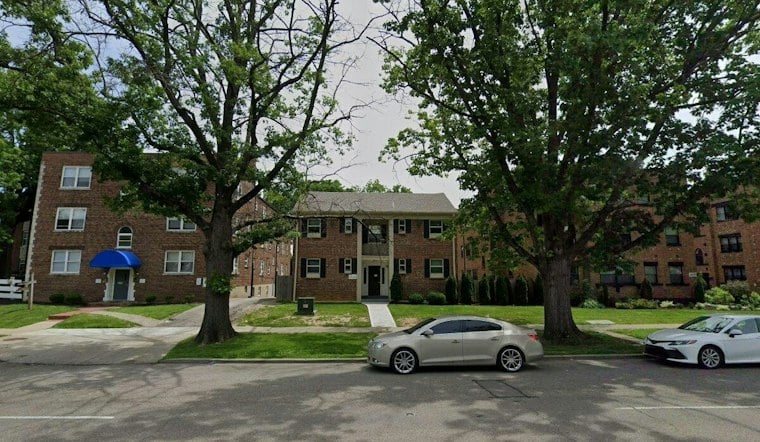
A Cincinnati police cruiser slammed into an apartment building on Victory Parkway in Evanston around midnight, leaving behind minor structural damage but, remarkably, no injuries to officers or residents. The impact struck Victory Apartments, a residential complex along one of the neighborhood's busiest corridors.
Law enforcement confirmed that no one was hurt in the crash, according to WKRC, which first reported the incident. Police say the building sustained only minor damage from the collision, a relatively contained outcome given the potential for a much worse scene when a patrol vehicle strikes an occupied residential structure.
Details on what led up to the crash — including whether the officer was responding to an emergency call, and whether road conditions played any role in the midnight collision — have not been released. Those questions remain open as the department reviews the incident.
A Corridor the City Has Been Trying to Calm
The crash unfolded on a stretch of roadway that Cincinnati has spent the past year trying to make safer. The City of Cincinnati Department of Transportation and Engineering repaved and restriped Victory Parkway through Evanston, cutting travel lanes down to one per direction with a center turn lane and adding bike lanes specifically to reduce speeding through the residential corridor. Evanston itself is a historic, centrally located neighborhood of roughly 8,700 residents — including students from nearby Xavier University — bordering Walnut Hills and Avondale, per the city's 2019 neighborhood work plan.
Victory Parkway functions as a key arterial connecting Evanston to surrounding neighborhoods and downtown, which is part of why city planners targeted it for traffic calming in the first place. The area falls under Cincinnati Police District 2, which absorbed additional territory after the department eliminated District 5 in a 2023 restructuring, as Hoodline has previously reported.
What Happens Next With the Cruiser and the Case
Because no injuries occurred, the incident is expected to be processed as a property-damage matter rather than an emergency call, consistent with how the Cincinnati Emergency Communications Center routes non-injury crashes through non-emergency police dispatch or the city's 311 Community Responder program. Internally, department policy requires any officer equipped with a body-worn camera who is involved in a collision to activate it if physically able, capturing a 30-second pre-activation buffer, while a supervisor completes a Form 90S crash review and preserves the footage for Fleet Management and legal analysis.
Separately, Cincinnati Police Department policy mandates daily inspections of patrol vehicles before and after every shift, checks that cover tire pressure, mechanical equipment, and general roadworthiness. Ohio law also shapes how any review of the officer's conduct will unfold: under Ohio Revised Code § 4511.041 and § 4511.45, emergency vehicles operating lights and sirens are exempt from many standard traffic rules, but officers remain bound by a duty to drive with due regard for the safety of others.
Part of a Rougher Year for Cincinnati's Police Fleet
The Evanston crash adds to a string of recent incidents involving Cincinnati-area police vehicles, though this one stands out for its lack of injuries. Just over a month earlier, two Cincinnati officers were hurt when their marked patrol car was involved in a collision in the East End neighborhood. Back in February, a Cincinnati cruiser became snagged on a fleeing suspect's trailer and rolled onto its side during a multi-agency pursuit, sending an officer to the hospital, according to Police1.
The contrast is sharper against a case just days earlier and outside Cincinnati proper: on September 5, a stolen police cruiser in Dayton crashed through an occupied home following a high-speed pursuit, injuring two residents and seven officers, as Hoodline reported in its coverage of the Miami Township case. Police vehicles striking residential structures remain rare enough to draw scrutiny whenever they happen, and the Evanston outcome — a damaged building wall but everyone accounted for and unhurt — is being treated as the far less severe version of that same rare event.





