

























































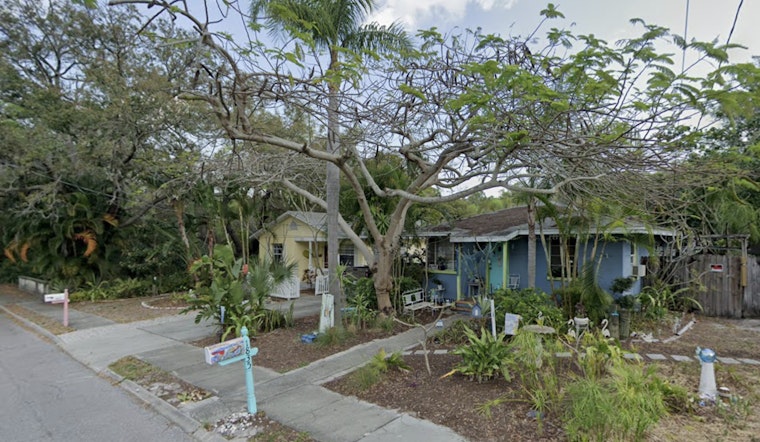
A 67-year-old Clearwater man trimming a tree while standing on his own roof was pinned in place Friday morning after a heavy branch fell and struck him, according to officials. Emergency responders arrived at 1839 Springtime Ave. at 9:14 a.m. to find the homeowner trapped on the residential roof, unable to free himself from the fallen limb.
Clearwater Fire & Rescue firefighters cut away and removed the branch that had pinned the man, then freed the trapped homeowner and lowered him to the ground, as reported by Tampa Free Press. Officials classified the patient as a trauma alert, a designation that under Pinellas County Emergency Medical Services protocols triggers direct air transport to a Level 1 trauma facility rather than a nearby community hospital, according to Pinellas County. That classification is meant to get critically injured patients into specialized surgery within the so-called golden hour.
Airlifted Across the Bay for Trauma Care
A medical helicopter transported the man directly to Tampa General Hospital, which operates Tampa Bay's first and only Level 1 Trauma Center verified by the American College of Surgeons for both adult and pediatric care, according to Tampa General Hospital. The hospital serves as the primary regional trauma referral hub for 23 surrounding West Central Florida counties, maintaining round-the-clock access to trauma surgeons and specialized critical care operating suites not necessarily available at smaller local ERs. The flight was carried out through the hospital's Aeromed Regional Transport Program, which completed 1,900 air transport missions in 2025 across central and south Florida and has logged more than 50,000 transports since the service began in 1989.
Officials did not release the man's identity, and no update on his current medical condition has been made public. He received treatment at Tampa General Hospital, per the original report, though the extent of his injuries remains unknown at this time.
A Technical Rescue on a Sloped Roof
Freeing a man pinned on an angled rooftop by a heavy limb is not a routine call. Clearwater Fire & Rescue maintains a specialized Technical Rescue Team and Special Operations unit equipped with lifting struts, air bags, and rigging gear built for complex extrications, according to the City of Clearwater. The department's special operations teams train routinely in heavy load stabilization, and this year updated their specialized extrication equipment to include HydraFusion struts capable of lifting up to 20,000 pounds per strut during complex rescue scenarios.
The physics behind the accident help explain why such heavy-duty gear was needed. A live hardwood branch measuring six inches in diameter and eight feet long can weigh over 100 pounds, generating sudden crushing force and unpredictable recoil once it's cut free from a tree, according to research cited by Seattle Tree Care. Rather than dropping straight down, heavy limbs often bounce and swing, which can pin a person against a roof surface instead of simply falling clear.
DIY Tree Work Carries Outsized Risk
The Clearwater incident fits a broader pattern documented by safety researchers. Roughly 80% of all reported tree trimming and removal injuries in the United States involve homeowners attempting DIY tree care rather than hiring professional arborists, according to Consumer Product Safety Commission data cited by Timberland Tree Care, which notes that thousands of emergency room visits occur annually because of tree trimming accidents. Even for trained professionals, the work is dangerous: tree care carries a fatal injury rate more than five times the national average for all U.S. occupations, with 846 professional tree trimmers dying on the job between 2012 and 2022, per Bureau of Labor Statistics data cited by the same tree care safety organization, with falls accounting for roughly 31% of fatal incidents.
Federal workplace safety guidance identifies falls from elevated positions and contact with overhead power lines or heavy falling limbs as the leading causes of catastrophic injury during tree trimming, per hazard assessments from the National Institute for Occupational Safety and Health and OSHA. ANSI Z133 standards call for fall-arrest harness systems during high-elevation cuts, equipment not typically used by homeowners working on their own roofs. Age can compound the danger, too: a Consumer Product Safety Commission hazard screening report found that nonfatal injuries and fatalities among adults 65 and older frequently involve severe blunt force trauma from tree trimming debris and elevated falls, pointing to heightened risk for older adults facing heavy overhead impacts.
It remains unclear whether the Clearwater homeowner was using power equipment or working near any utility lines when the branch fell, and officials have not addressed those questions publicly. The incident adds to a string of recent emergency calls handled by Clearwater Fire & Rescue, whose crews also battled a Pinebrook Drive house fire earlier this year and responded to a shooting at Royal Breeze Apartments in February.





