

























































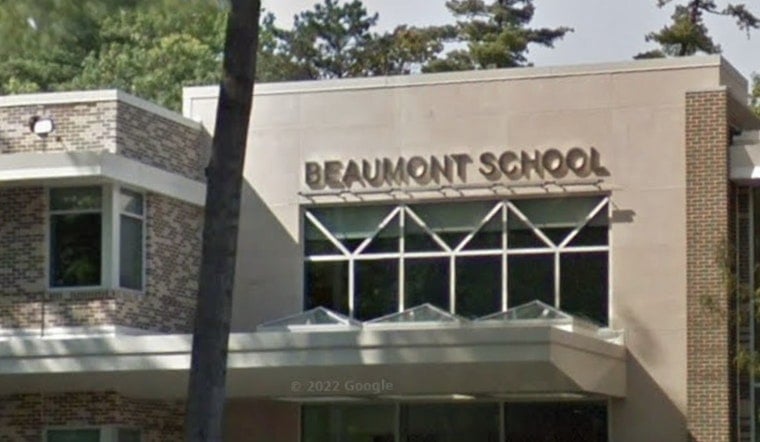
The Cleveland Heights Landmark Commission voted 5-1 to recommend a certificate of appropriateness allowing Beaumont School to demolish the 1903 Painter Mansion, a landmarked Jacobean Tudor Revival estate the school has wanted to remove from its Fairmount Boulevard campus for years. The vote reverses the commission's own 2019 rejection of a similar request and sends the matter to the Cleveland Heights Planning Commission, though it remains unclear what further input that body will have.
Beaumont School, an all-girl STEM school, has said it wants to build a regulation running track on the eastern side of its campus, where an undersized track currently sits, according to Cleveland.com. The mansion has sat unoccupied since 2019, after the school primarily used it as office space, and a 2020 facility assessment by Bialosky Architects found the building in very poor condition, with exposed walls and ceiling plaster containing hazardous asbestos, per that same assessment.
A Reversal From 2019's Unanimous Denial
The outcome marks a striking shift from seven years ago, when both the Landmark Commission and the Cleveland Heights Planning Commission voted down a nearly identical demolition request. The Planning Commission's unanimous denial came on April 10, 2019, following the Landmark Commission's own rejection weeks earlier on March 13, 2019, according to historical reporting from FreshWater Cleveland. At the time, Beaumont School President Wendy Hoke said comprehensive restoration and code compliance would cost close to $8 million, while basic preventative upkeep alone was running about $30,000 a year.
Those costs have kept climbing. The 2020 Bialosky assessment put rehabilitation and mothballing at more than $4 million, and Beaumont officials now say that projected cost has grown to $4.6 million in 2025 dollars. Cleveland Heights city officials were unavailable for comment as of Tuesday, and recordings and minutes from the Landmark Commission meeting had not yet been posted to the city website.
A Boutique Hotel Idea That Didn't Pencil Out
Before landing on demolition, Beaumont commissioned a marketing study from Robert A. Simons LLC, a Beachwood-based firm that examined the property's highest and best use, including conversion into a boutique hotel. The firm's financial analysis concluded a boutique hotel was not feasible under any plausible scenario, and Robert A. Simons LLC ultimately recommended demolishing the mansion for Beaumont's own purposes, the school's application indicates.
What The City Would Require Before Any Wrecking Ball Swings
The Landmark Commission's recommendation does not clear the way for outright demolition. It calls for selective demolition or deconstruction rather than a full teardown, requiring that significant parts of the mansion be preserved and incorporated into Beaumont's campus plan, with the option of retaining part of the structure as a folly or similar design feature. The recommendation also requires preserving and marking the building's foundation or footprint, complete building-history documentation and photographic records shared with a publicly available repository, and a good-faith effort to secure funding before any demolition proceeds. It further includes designation of the property as an official City of Cleveland Heights landmark.
Those conditions echo the city's broader legal framework for landmarked properties. Chapter 143 of the Cleveland Heights Codified Ordinances mandates a four-month negotiation window between city officials and property owners following demolition disputes, aimed at exploring preservation alternatives before any final permit can proceed, according to city code. That means the Landmark Commission's vote, whatever the outcome at the Planning Commission, is not the final word on the mansion's fate.
From Gilded Age Estate To School Property
The mansion's roots trace to Cleveland architect Frank Skeel, who designed it in 1903 for banker John Vickers Painter, according to Cleveland Historical. Construction was finished in 1905 by his son, financier Kenyon Painter, after the elder Painter's sudden death; Kenyon Painter later expanded the building to roughly 24,000 square feet in 1929. The estate was long recognized as the last intact Gilded Age residence still standing on its original grounds in Cleveland Heights, a status that led to its designation as an official city landmark in 1979.
Kenyon Painter's own history took a darker financial turn in the 1920s and 1930s. He served as a director and major stockholder of Cleveland's Union Trust Company before facing a $3 million lawsuit in Cuyahoga County Common Pleas Court in 1933 after the bank collapsed during the Great Depression, per Cleveland Historical's account. The Painter family sold the mansion to the Ursuline Sisters in 1942, who used it as Beaumont School until 1958. Beaumont School purchased the mansion and surrounding property in 2009 and later renamed the building Lennon House following a capital campaign gift from the family of Swagelok founder Fred Lennon.
What The Estate Once Held
Beyond the mansion itself, original owner Kenyon Painter built a private zoo, aviary, and trophy rooms on the grounds in the early 1900s, and his specimen collections went on to help found the collections of the Cleveland Metroparks Zoo and the Cleveland Museum of Natural History, according to Cleveland Historical. Surviving elements of that era include a carriage house, two trophy rooms, and a perimeter stone wall along North Park Boulevard and Fairmount Boulevard that still stands today.
The fight over the Painter Mansion arrives amid a broader financial squeeze on the region's private schools. Annual tuition at private single-sex high schools in Greater Cleveland, including Beaumont, has reached up to $42,000 as of this year, underscoring the cost pressures facing institutions like Beaumont as they weigh multimillion-dollar preservation bills against classroom and athletic needs, as previously reported by Hoodline. The debate also follows on the heels of a separate Cleveland Heights decision to raze the 1970s-era Coventry School building and expand PEACE Park, another case where the city has had to balance demolition requests against preservation goals.




