

























































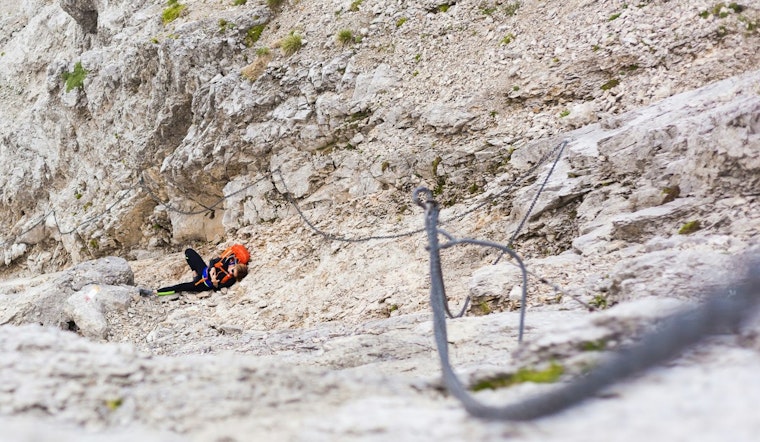
A climber fell around 11 a.m. Monday while descending from the summit of Crestone Needle with a group of five people, and was found unconscious but still breathing by nearby climbers who called 911. The peak, located in Saguache County within the Sangre de Cristo range, is known for technical Class 4 scrambling and steep drop-offs that make it one of the state's most demanding fourteeners. Rescue crews worked for hours to reach the injured climber, ultimately extracting him safely by 3:44 p.m.
According to CBS Colorado, the climber's group members and other nearby climbers witnessed the fall and provided assistance while waiting for help to arrive. Custer County Search and Rescue coordinated with Saguache County Search and Rescue to reach the climber, and the Colorado Search and Rescue Association began coordinating the hoist rescue as crews performed a technical rope rescue on the exposed terrain. CommonSpirit Flight For Life helped the technical rope rescue team stationed at Cottonwood Lake begin the ascent. Authorities have not released details about the climber's condition following the extraction.
Why Two Counties Responded Together
The joint response between Custer and Saguache counties is not unusual for this stretch of the Sangre de Cristo range, where the mountain ridge splits the two jurisdictions. Because of that geography, the two counties' sheriffs' offices and search and rescue teams operate under formal memorandums of understanding, according to Custer County Search and Rescue, allowing responders to cross county lines based on access to the mountain rather than being confined to rigid jurisdictional boundaries.
Following the rescue, Custer County Search and Rescue issued an advisory encouraging witnesses of the fall to seek mental health support and practice self-care, noting the severe emotional trauma that can result from witnessing high-altitude accidents, as reported by the Denver Gazette. The same report notes that the standard south face route up Crestone Needle was historically classified as a Class 3 climb, but route degradation prompted peak experts and rescue agencies to reclassify it as Class 4, requiring hands-on scaling over steep rock with severe exposure.
A Peak With a History of Rescues
Data backs up the mountain's reputation. A geospatial analysis of Custer County Search and Rescue missions from 2015 through 2020 found that 46.3% of all rescue deployments in the Crestone Group occurred on Crestone Needle specifically, according to the Rocky Mountain Field Institute.
The peak's difficulty is not a recent discovery. Crestone Needle was the last of Colorado's 14,000-foot peaks to be summitted, first scaled in 1916 by mountaineer Albert Ellingwood after previously being written off as unclimbable due to its sheer conglomerate rock walls, per the Global Summit Guide. The nearby Crestones Traverse, which connects Crestone Peak and Crestone Needle, is rated Class 5 with extreme exposure, according to 14ers.com, making it one of the state's most dangerous 14er linkups where off-route travel can lead to treacherous or cliffed-out terrain.
A Strained Volunteer System
Monday's fall adds to a summer marked by repeated high-altitude technical rescues across Colorado, including a rescue on the Blanca–Little Bear traverse on August 2. Hoist operations like the one that pulled the injured climber off Crestone Needle involve the Colorado Hoist Rescue Team and Colorado Army National Guard aviation units, among other cooperating agencies.
These extractions depend heavily on volunteer labor. Colorado's backcountry search and rescue operations rely on roughly 2,500 unpaid volunteers across 50 dedicated teams. In late 2025, the agency raised the state's Backcountry Search and Rescue Program fee on licenses and registrations from $0.25 to $1.25.





