

























































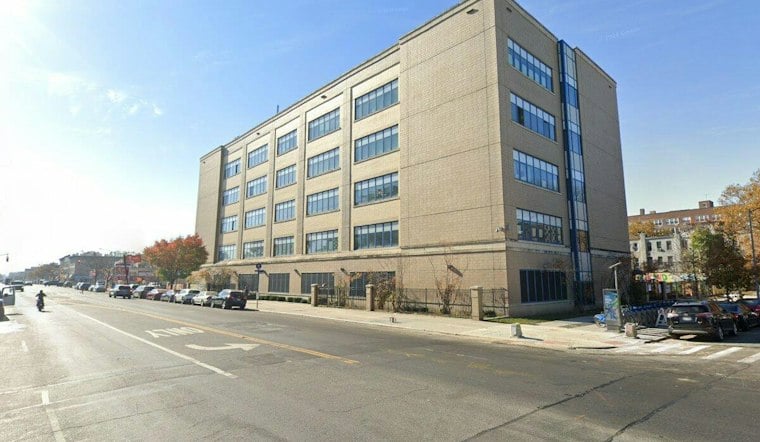
A stretch of Coney Island Avenue that runs past two co-located Kensington schools is getting a major street safety makeover, with a planted median, curb extensions and new one-way side streets designed to protect the more than 700 students who pass through the area every school day.
The upgrades target Coney Island Avenue between Turner Place and Hinckley Place, right in front of P.S. 889 and M.S. 890, according to News 12 New York. City data cited by the outlet shows roughly 700 students are in the area during arrival and dismissal times, and the speed limit on roads near the two schools has already been reduced from 20 mph to 15 mph. The station also reports that Coney Island Avenue near the schools received a traffic light within the past two years.
Under the plan, left-turn lanes on that block of Coney Island Avenue would be swapped out for a planted concrete median that gives pedestrians a refuge point mid-crossing, according to a proposal detailed by karmabrooklyn.blogspot.com. The same proposal describes painted curb extensions meant to daylight three corners at both intersections adjacent to the school block, shortening crossing distances and making pedestrians more visible to drivers. News 12 describes the median as something that will break up the crosswalk on that stretch of road.
One-Way Conversions Aim to Untangle Side Streets
The proposal also calls for converting Turner Place to one-way eastbound traffic and Hinckley Place to one-way westbound traffic, per the blog's account of the plan. A draft version of the proposal indicated the work would begin in August, though it's unclear whether construction on that timeline has actually started. NYC DOT has said it expects the broader project to be completed by the end of 2026, per News 12's reporting.
The Department of Transportation has framed the changes as a package deal for both safety and traffic flow. The agency said the changes aim to make pedestrian crossings safer, shorter and more visible while improving traffic flow, according to the station's report. That framing echoes complaints from residents who've watched the corridor get more congested as more families and students rely on it.
Residents and Business Owners Weigh In
Rachel Goldstein, a resident quoted in the News 12 report, said the road safety changes have been a long time coming and called the safety project an improvement. Not everyone frames the corridor's problems the same way, however — business owners in the area have said traffic congestion affects their operations, and Val Avrason told the outlet that traffic makes it impossible for businesses to operate.
The News 12 report also states that 65 people were injured along Coney Island Avenue between Hinckley Place and Turner Place from 2021 through 2025, a figure attributed to the station's own reporting rather than independently verified crash data.
Part of a Citywide Push Around Schools
The Kensington project is one piece of a much larger rollout. New York City has expanded its school safety zones citywide, and according to School Transportation News, the city has already installed 15 mph School Slow Zones at more than 200 school locations, with plans to expand to roughly 800 zones by the end of December. About 700 existing 20 mph School Slow Zones are being reduced to 15 mph citywide, while roughly 100 new zones are being established at schools that previously had 25 mph limits, the outlet reports. City officials have said a pedestrian struck at 25 mph is more than three times as likely to suffer a serious injury as someone struck at 15 mph.
New York State's own guidance backs the lower threshold: the New York State Department of Transportation says state Vehicle and Traffic Law prohibits school speed limits below 15 miles per hour. The city's broader slow zone expansion also includes 800 additional school locations posted with 15 mph limits this year, bringing the citywide total to approximately 1,300, per School Transportation News.
Lessons From Past Redesigns
New York City has leaned on school-zone safety work since its 2014 Vision Zero Action Plan identified children and seniors as two of its primary vulnerable populations, according to Vision Zero for Youth. The city's School Safety unit has also simplified signage near schools, cutting what used to be fifteen or more signs leading to each school down to just two or three.
A comparable redesign on Third Avenue in the Bronx, which included lane right-sizing, curb extensions and left-turn traffic calming, reduced total crashes by 18 percent in its first year, the same source notes. Similar treatments on Oceania Street in Queens paired a protected bike lane with leading pedestrian intervals, revised parking rules, slow zones and high-visibility crosswalks. The city has said it plans safety redesigns near more than 300 schools during 2026, including pedestrian and bicycle improvements and permanent upgrades to school Open Streets, according to School Transportation News.





