

























































Restoration work at Fort Snelling's Round Tower has surfaced a piece of the site's more recent commemorative history: a time capsule sealed into the structure in 1970 was found inside a six-foot-thick wall earlier this year. The capsule had been placed during a ceremony marking the fort's 150th anniversary, but its existence was not documented in records later consulted by the restoration team.
The discovery came as crews worked on the historic structure, according to FOX 9. Brian Liesinger said the team found no records indicating that a capsule had been installed. Fort Snelling has occupied the site since construction began in 1820, and the 1970 sealing appears to have been the tower's last major renovation before the current project.
After identifying the capsule, Fort Snelling staff opened it and created a successor capsule for 2026, the station reported. The new capsule was placed inside the Round Tower wall for a future generation to find.
What Went Into the New Capsule
The replacement capsule includes a photo of the current Fort Snelling team, a nod to whoever eventually finds it decades from now. It also holds a stick of hardtack along with its recipe — the dense, dried bread ration once used by the U.S. Army that can keep for months or years and needs to be reconstituted with water or another liquid before eating.
Staff also tucked in a pin celebrating America's 250th year, tying the Round Tower project to the nationwide Semiquincentennial marking the 250th anniversary of the Declaration of Independence in 2026. The team withheld some additional items from public description specifically to preserve the surprise for whoever opens the capsule next, meaning its future discovery date remains unknown.
Minnesota's Oldest Standing Structure
The Round Tower holds the distinction of being Minnesota's oldest standing structure, built in 1820 with limestone walls as part of the original post then known as Fort St. Anthony. According to MNopedia, its 25-foot-high walls and musket slits facing both inward and outward were designed to make it a last-ditch defensive stronghold, and the post was renamed Fort Snelling in 1825 to honor commandant Colonel Josiah Snelling.
Over its two centuries, the tower cycled through a long list of uses beyond its original military purpose, serving at various points as an arms storehouse, guardhouse, prison room, washhouse, and coal storage facility, per MNopedia's history of the site. An 1869 fire led to modifications that widened its musket slits into windows and added a crenellated parapet, and the building briefly operated as a museum starting in 1941 before archaeological excavation began in 1965 and the Minnesota Historical Society restored it in 1966 to its 1820s military appearance.
A Milestone Marked With a Postage Stamp
The original 1970 capsule was sealed as the capstone of Fort Snelling's sesquicentennial celebration, a 150th-anniversary milestone significant enough that the U.S. Postal Service issued a commemorative six-cent Fort Snelling postage stamp on October 17, 1970, according to historical stamp records. Local collectors and state officials had campaigned for that stamp for more than a decade before it was finally issued.
Fort Snelling's national significance was already well established by then. The site was designated Minnesota's first National Historic Landmark on December 19, 1960, and was formally listed on the National Register of Historic Places, according to Wikipedia's history of the fort — landmark status reserved for properties of exceptional significance to the nation.
Layers of History at Bdote
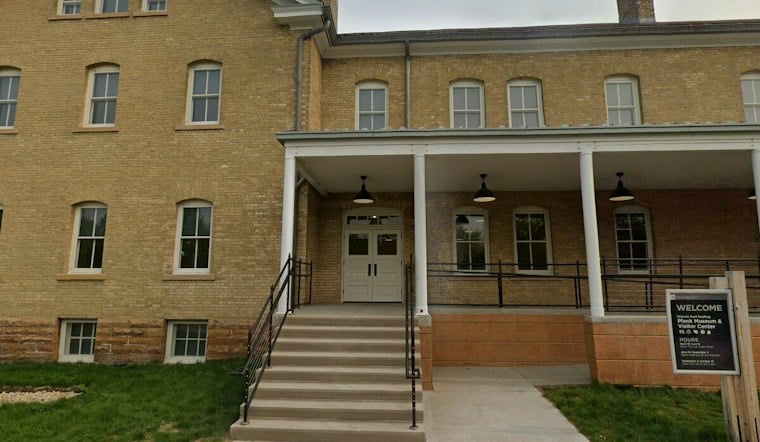
The Round Tower's restoration is part of a much larger investment in the site. The Minnesota Historical Society completed a $34.5 million revitalization of Historic Fort Snelling in May 2022, funded through $19.5 million in state bonding and $15 million in private donations, which demolished a failing 1980s underground facility and opened the Plank Museum and Visitor Center inside a converted 1904 cavalry barracks, Bring Me The News reported.
Fort Snelling sits atop bluffs at the confluence of the Mississippi and Minnesota rivers. The fort is also associated with Dred Scott and his freedom litigation.
Today, administrative control of the grounds is split between the Minnesota Historical Society and the Minnesota Department of Natural Resources, per MN Trips.
A Dakota homeland known as Bdote
Administrative control of the grounds is split between the Minnesota Historical Society and the Minnesota Department of Natural Resources. The Minnesota Historical Society describes Historic Fort Snelling as a National Historic Landmark on Dakota homeland known as Bdote, a place with history spanning 10,000 years, according to the society. The society also notes that many Dakota people consider Bdote a sacred place of creation and describes the area's continuing Dakota cultural significance. That perspective adds context to the military, legal and commemorative history presented at the site.
Reopening Set for Early October
The Round Tower restoration is nearly finished, and the building is expected to reopen to the public in early October, according to the FOX 9 report. Hoodline previously reported on a memorial service at nearby Fort Snelling National Cemetery, underscoring how the historic grounds continue to hold layered meaning for Minnesotans well beyond this latest discovery.





