

























































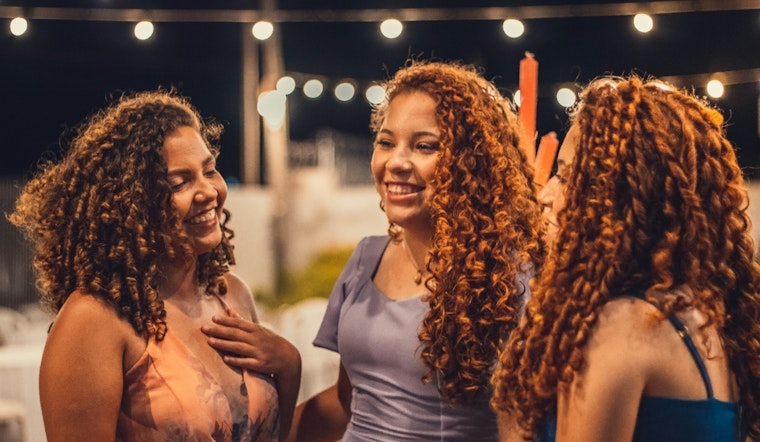
Tens of thousands of hair lovers packed Randall's Island Park on Saturday, July 25, for the return of Curlfest, the festival celebrating natural hair, Black beauty and culture that skipped its 2025 edition entirely. This year's lineup featured beauty brand activations, speakers on the Empowerment Stage, live performances on the main stage, and a marketplace of Black- and African-owned businesses, according to The Knockturnal. According to NYC Parks, organizers must obtain a permit for any event with more than 20 attendees.
A Year-Long Pause, Then a Comeback
Curlfest's absence in 2025 wasn't a choice made lightly. Curly Girl Collective co-founder Simone Mair explained in a June 2025 interview with Essence that the festival paused because of funding shortages tied to broader economic pressures and corporate rollbacks in diversity, equity and inclusion initiatives. As reported by 6abc, the festival simply took a year off before returning in 2026, first held back in 2014 and now bringing tens of thousands of hair lovers to Randall's Island each time it runs.
Mair told 6abc that Curlfest was born after the founders decided to hold the event in a park, a modest idea that snowballed into one of the country's largest celebrations of textured hair. The festival and its parent organization, Curly Girl Collective, describe their mission as making natural hair accepted in the mainstream, and the two remain, in the group's own words, grassroots operations even as they've grown. Co-founder Charisse Higgins has said the Collective began after a friend cut off her hair just to fit in, while co-founder Melody Henderson has described the whole project as being built out of passion, late nights and sacrifice.
Attendees Bring Their Kids for Representation
Nicole Eaddy, who traveled from Spartanburg, South Carolina, brought her daughter Ava to the festival, saying she wanted her child to experience community and positive Black representation. Ava, for her part, said she simply enjoyed the music and the people at Curlfest. Their trip reflects a pattern Hoodline has also seen closer to home, where a Bronx bookcafe's own natural-hair celebration turned braids into a block party just days earlier, and where a Kansas City event expected more than 1,500 kids at T-Mobile Center for a similar celebration of youth empowerment, according to Hoodline's prior coverage.
A Record-Breaking Afro and an 8-Foot Sculpture
Among this year's standout attendees was Jess Martinez, recognized for a record-breaking afro. The Rockland, New York resident officially set the Guinness World Record for the largest afro on a living female on October 23, 2025, with the style measuring 29 centimeters tall, 31 centimeters wide, and 190 centimeters in circumference, per Guinness World Records. At Curlfest, Martinez said natural hair is professional, and described her ongoing work to change the image of natural Black hair in the workplace.
Elsewhere on the festival grounds, hair artist Susan “Susy” Oludele unveiled an 8-foot sculpture built from Bantu knots, the ancient African style of coiled hair buns, presenting Black hair as fine art in front of the crowd, The Knockturnal reported. The piece joined a vendor village stocked with Black-owned hair, beauty, health and fashion businesses, part of what organizers say has helped multiple companies achieve success since the festival's founding.
The Legal and Economic Backdrop
Curlfest's cultural celebration doesn't exist in a vacuum. New York enacted its own version of the CROWN Act in July 2019 under the Human Rights Law, and in November 2023 Governor Kathy Hochul signed legislation requiring all state cosmetology licensing programs to include mandatory training for textured hair, as Hoodline has previously reported. Nationally, 27 U.S. states and Washington, D.C., have passed a version of the CROWN Act to outlaw race-based hair discrimination in workplaces and schools, though federal legislation introduced in Congress remains pending, according to the Economic Policy Institute. The U.S. Equal Employment Opportunity Commission says employers can impose neutral hairstyle rules requiring hair to be neat, clean and well-groomed. That patchwork of protections helps explain why a Manhattan lawsuit accusing an Upper East Side Ulta of refusing Black customers' hair drew attention earlier this year.
The stakes go beyond legal protections, too. The global Black hair care market was valued at $8.9 billion in 2025 and is projected to expand to $17.1 billion by 2035, driven by rising demand for specialized moisture retention and scalp health products, per Globe Market Research. Protective hairstyles and textured-hair products are also part of the broader industry conversation. Curly Girl Collective's five co-founders — Higgins, Tracey Coleman, Gia Lowe, Henderson and Mair — share Caribbean heritage from Antigua, Barbados and Jamaica respectively, according to the Caribbean National Weekly, a lineage that shapes the festival's emphasis on global Afro-diasporic identity.
Curly Girl Collective started small, as a private email thread among friends trading natural hair tips back in 2010, before growing into a New York City event business in 2011. The first Curlfest in 2014 landed at Brooklyn's Prospect Park, where organizers expected roughly 500 people and instead saw attendance swell to nearly 2,000. More than a decade later, the festival's return to Randall's Island suggests that swell has only kept building. According to NYC DOT, the Harlem River Greenway is planned as a continuous seven-mile transportation corridor connecting Van Cortlandt Park to Randall's Island Park.




