

























































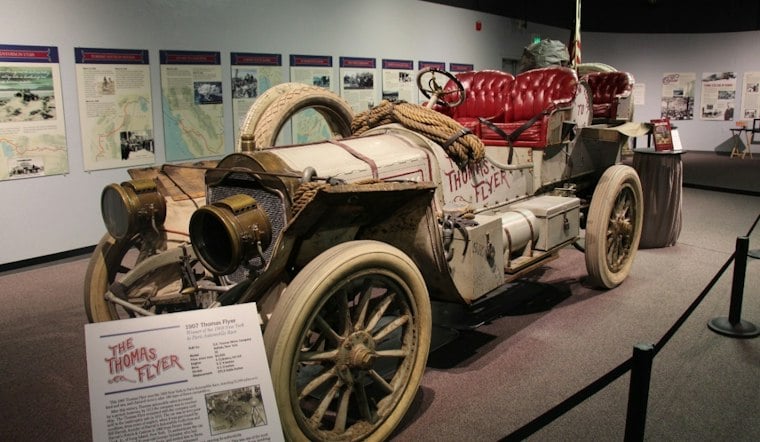
Daggett Days will use a 1907 Thomas Flyer to connect the Mojave community’s mining and transportation history with the car that won the 1908 New York-to-Paris Great Automobile Race. The vehicle is scheduled to be displayed in Daggett during the September 12–13 celebration, according to the Victorville Daily Press.
A car built for an extraordinary journey
The Thomas Flyer was one of six entrants representing four countries in the 1908 race. George Schuster drove the American car to victory after a 169-day trip covering nearly 10,376 miles, the Daily Press reports; a race history summarized by Wikipedia says the winning margin was 26 days.
The surviving automobile is not normally based in Daggett. Bill Harrah bought it in 1964 and used Schuster’s assistance to authenticate it, according to Supercars.net. It is now exhibited at Reno’s National Automobile Museum. The Historic Vehicle Association also documented the car for the National Historic Vehicle Register, with the resulting engineering record intended for the Library of Congress, according to Hemmings.
The weekend program
Jeff Mahl, Schuster’s great-grandson, is scheduled to speak Saturday at 9 a.m. at the Daggett Community Center, 35331 Afton St. The two-hour presentation costs $20 at the door, and reservations can be made at 760-254-3050, according to the Daily Press. Lunch will be available afterward at Jobby Hall’s Chevron gas station for $15.
Mahl’s presentation draws on Schuster’s 1908 race journal and artifacts including a sextant and compass. Mahl co-authored the 2023 book The Man and Car That Circled the Globe, and information about his living-history work and the book appears in a review at SpeedReaders.info.
Sunday’s program runs from 9 a.m. to 3 p.m. at 33703 Second Street. The Daily Press lists a parade, vendors, food, gold panning, axe throwing, inflatable games, children’s crafts, face painting, a train museum tour, a blacksmith demonstration, Doc’s Calico Marshals, and a Calico old-time gunfighter show.
Daggett’s transportation legacy
Daggett’s transportation story predates the Thomas Flyer by decades. The town was founded in the 1860s and took its current name in 1883, according to the Daggett Historical Society account cited by the Daily Press. Silver mining at Calico, about six miles north, helped make Daggett a transportation and supply center. A railroad completed in 1888 connected Calico with the Santa Fe Railway’s main line at Daggett; in 1891, the Silver King and Waterloo mines were sending more than 100 tons and 50 tons of ore per day, respectively, to be processed near Daggett.
By 1902, the town had three borax mines employing 200 people, along with stores, saloons, restaurants, a railroad, a drug store, a lumber yard, and the Stone Hotel, the Daily Press reports. The same account places San Bernardino County’s borax production at slightly more than $2 million that year and the estimated value of borax from the Calico Hills above $9 million; Calico’s silver output exceeded $20 million.
Daggett’s later transportation history includes the Route 66 inspection station mentioned in John Steinbeck’s 1939 novel The Grapes of Wrath and shown in the 1940 film adaptation, according to the Daily Press. The Stone Hotel, built in 1883 with thick stone and adobe walls, is also associated with naturalist John Muir and Walter “Death Valley Scotty” Scott, according to Route 66 Times.
From experimental solar power to a larger energy complex
Daggett’s industrial history later extended into solar power. SEGS 1 opened there in 1984 as the world’s first commercial solar power plant, followed by SEGS 2 and the experimental Solar One project in 1985; the projects were later decommissioned and demolished, according to the Daily Press. Clearway Energy Group completed a 482-megawatt solar facility paired with 280 megawatts of battery storage near the retired Coolwater gas plant in 2023, according to POWER Magazine and the California Community Choice Association.
What current records show
The available current record does not provide a population or housing count for Daggett, so it cannot establish how the community compares demographically with its historic mining and railroad role. It does document a present-day energy operation: Daggett Solar Power 2 & 3 received a GO 167-C compliance audit on May 12, 2025, according to the California Public Utilities Commission.





