

























































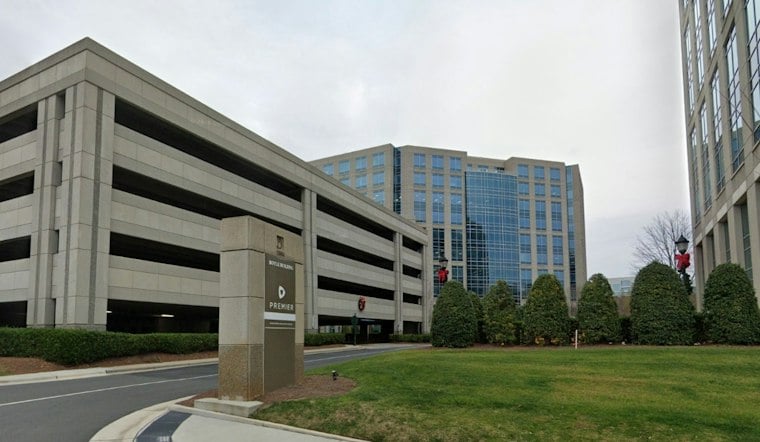
A 60,000-square-foot office in the heart of Ballantyne officially opened its doors this week as the new corporate headquarters for Daimler Truck Financial Services USA, with 276 jobs total, including 193 new local jobs and roughly 90 employees transferred from other locations in Michigan and Texas. The headquarters, located in the 10-story Boyle Building at 13034 Ballantyne Corporate Place, was celebrated with a facility tour and ribbon-cutting ceremony this week.
North Carolina Governor Josh Stein first announced the $7.8 million investment in May 2025, and the finished space now has room for 350 people. According to the Charlotte Observer, the headquarters created 193 new local jobs while roughly 90 employees transferred in from other locations, a slightly different tally than the state's earlier estimate of 83 transferred roles. The new office serves as the central hub for Daimler Truck Financial Services' North American operations, supporting customers and dealers across the U.S., Canada and Mexico.
A Hub Built Around Existing Manufacturing Muscle
Daimler Truck Financial Services USA provides financing and leasing solutions for Daimler Truck North America, serving owner-operators, fleet owners and municipalities. The financing arm's move to Charlotte places its administrative operations closer to Daimler's existing manufacturing footprint across the Carolinas, where Daimler Truck North America and Daimler Truck Financial Services together employ about 9,000 people. That footprint includes the Cleveland Truck Manufacturing Plant, the Mount Holly Truck Manufacturing Plant, Gastonia Components and Logistics, and Thomas Built Buses in High Point, according to Daimler Truck North America.
Kevin Bangston said Charlotte was chosen for its strong financial services sector, deep talent pool and vibrant business community, adding that the region gives the company access to the people and resources needed to continue growing, per the Observer's report. Daimler Truck North America, a subsidiary of Germany-based Daimler Truck Holding AG, is headquartered in Portland, Oregon, and designs and manufactures medium- and heavy-duty trucks, school buses, vehicle chassis and related technologies across 40 production sites and more than 100,000 employees.
Jobs Pay Well Above The County Average
The headquarters jobs carry an expected average annual salary of $133,940, well above Mecklenburg County's average annual salary of $86,830. State economic development officials had earlier projected the project would generate a potential annual local payroll impact exceeding $36.9 million, according to North Carolina Commerce.
The project received a Job Development Investment Grant approved in 2025, and the state's report indicates Daimler is set to receive more than $4.1 million in grant reimbursements over the next 11 years, based on new tax revenue generated by the jobs and capital investment. Over the grant's 12-year lifespan, the project is expected to contribute more than $1 billion to North Carolina's economy, per the state's figures.
Why Some Of The Grant Money Leaves Mecklenburg County
Mecklenburg County is classified as a Tier 3 area under North Carolina's economic-ranking system, a designation the state calculates annually for all 100 counties using four statutory metrics — unemployment rate, median household income, 36-month population growth, and per-capita assessed property value — as NC Commerce explains. Because of that Tier 3 status, the Job Development Investment Grant program directs a portion of the award to the Industrial Development Fund Utility Account, which supports infrastructure projects in rural areas aimed at attracting businesses.
In Daimler's case, that means a $1.3 million transfer to the Utility Account, which provides grants to local governments in North Carolina's 80 most economically distressed counties, according to the JDIG framework detailed by EDPNC. Tier 1 and Tier 2 counties are the ones eligible for those Utility Account grants, while companies expanding in Tier 3 counties like Mecklenburg keep 75 percent of their reimbursements directly.
Part Of A Broader Charlotte Winning Streak
North Carolina Secretary of Commerce Lee Lilley identified Scout Motors, Maersk and Capital Group as other companies contributing to regional growth, noting that Charlotte saw more than 6,000 new jobs announced through economic development and attracted $500 million in new investment over the past year. “Charlotte is on a real winning streak,” Lilley said, per the Observer's account of the ribbon-cutting.
Governor Stein has said North Carolina's highly skilled workforce attracts businesses and workers, attributing the state's business ranking to its workforce, business climate, schools, quality of life and people. North Carolina has ranked among the nation's top two states for business for six consecutive years. Charlotte's broader financial services sector supports over 104,000 jobs, making it the second-largest banking center in the U.S. by asset concentration and corporate home to Bank of America and Truist alongside major hubs for Wells Fargo and JPMorgan Chase, according to Capital Analytics.
Manufacturing Expansion Follows Close Behind
Daimler's Ballantyne move comes as its parent company signals continued domestic investment. Daimler Truck North America announced in August 2026 that it plans to begin construction on a new U.S. truck assembly facility by late 2026, intended to open in 2029 as its largest domestic manufacturing plant, according to Transport Topics. The same report notes the company is recalling 400 previously laid-off employees and adding 200 new positions at its Mount Holly assembly plant by late 2026 to establish a second shift.
The Ballantyne headquarters itself sits within a 535-acre business park offering 4.4 million square feet of Class A office space, one that is currently undergoing a redevelopment plan known as Ballantyne Reimagined aimed at converting suburban office space into walkable, mixed-use areas, according to Sasaki. Whether the company's new administrative proximity to its Carolinas plants will influence the site chosen for its 2029 manufacturing facility remains an open question, as does the full timeline for completing employee relocation from Michigan and Texas.




