

























































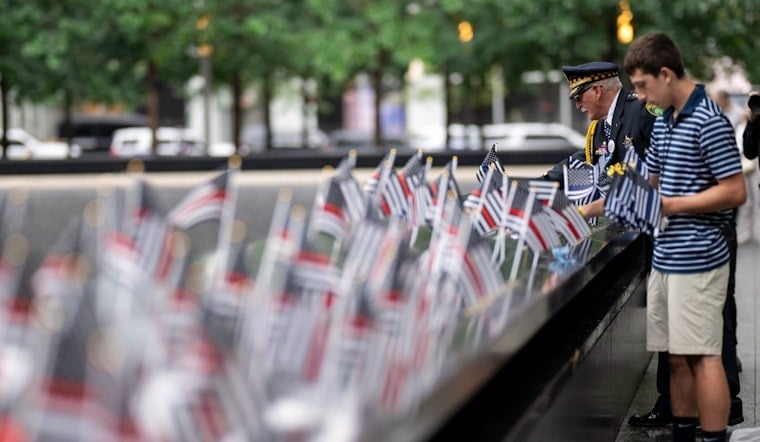
Liba Beyer has reflected on September 11, 2001, and later built a 20-year career at Human Rights Watch and, now, a teaching post at Columbia University.
Beyer, a Dayton woman, told the Springfield News-Sun about her experience on the morning of the attacks.
The World Trade Center's history includes the September 11 attacks.
According to the Springfield News-Sun's report, Beyer gave blood at a hospital after the attacks and walked 40 blocks to get there. The city's official response was much larger.
A Command Center for a City in Shock
New York stood up a massive coordinated relief operation in the weeks after the attacks. Officials established a 130,000-square-foot Family Assistance Center at Pier 94 on Manhattan's West Side, according to the 9/11 Memorial. The center was part of the city's broader response.
Beyer also reflected on New York City after 9/11.
From Relief Screener to Global Rights Advocate
Beyer, a graduate of Hillel Academy and Ohio State, went on to spend 20 years at Human Rights Watch, where she established and led the organization's first-ever global campaigns unit, overseeing donor engagement and advocacy strategies across 90 countries, according to Columbia University's School of International and Public Affairs. She holds a Master of Public Administration from New York University's Wagner School of Public Service and now serves as an adjunct associate professor teaching human rights campaigning at Columbia SIPA.
After two decades at Human Rights Watch, Beyer completed a P5 executive appointment with the United Nations High Commissioner for Refugees, Columbia SIPA notes. Her work has taken her to 53 countries, including protective-presence work in the West Bank, per the Springfield News-Sun. On April 25, the National Center for Civil and Human Rights in Atlanta launched a children's play space, according to the National Center for Civil and Human Rights.
Closer to home, Beyer has stayed active in local volunteer service.
Remembering, and a Recovery That Still Isn't Finished
Beyer continues to remember the events of that day.
The recovery she took part in that fall never fully ended. The disaster has had lasting health effects on responders and survivors.
Years after the attacks, work related to the dead and the sick from that morning continues.




