

























































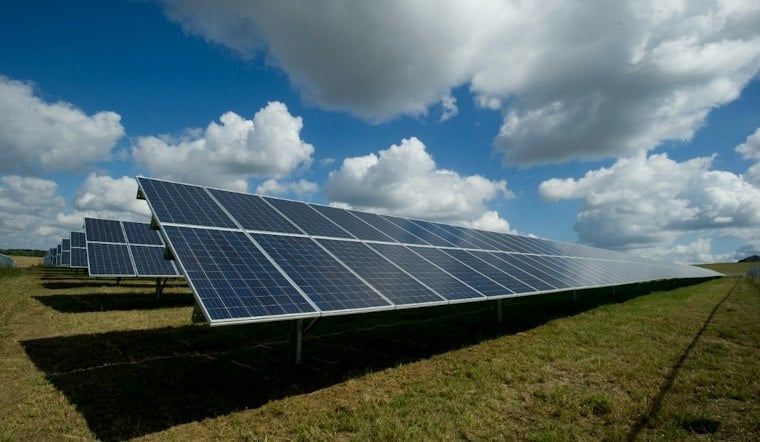
A capped landfill off Kendall Pond Road near Route 93 is now producing electricity for the Town of Derry. Officials held a ribbon-cutting on September 1 for the 2.25-megawatt Derry Landfill Solar array, which will supply electricity for municipal needs, including waste and waterworks facilities.
The array consists of 6,474 ground-mounted solar panels spread across approximately 7 acres of the former municipal solid waste site, according to Encore Renewable Energy, the Burlington-based developer that designed, built, and now operates the system. Derry selected Encore from seven competing companies through a competitive bidding process, and the system was energized; the town held the ceremony on September 1. As reported by the Eagle-Tribune, representatives from Encore, the town, the Derry NetZero Task Force, and U.S. Sen. Jeanne Shaheen's office took part in the event.
From Capped Landfill to Power Source
The site had remained capped, fenced off, and largely unused before the solar project was developed, according to the Eagle-Tribune. Derry retains ownership of the property and leases it to Encore under a 25-year contract, with the town receiving lease payments during that period, the newspaper reported.
Some of the array's power will serve Derry's waste and waterworks facilities, while the remainder will be exported to the New England grid, the Eagle-Tribune reports.
Derry in the New Hampshire Context
New Hampshire has more than 250 closed landfills, although many are not suitable for solar arrays, according to New Hampshire Public Radio, citing the state Department of Environmental Services. NHPR reported that Manchester already had a 3.3-megawatt array on its closed landfill, while Somersworth was building a separate 2.6-megawatt landfill project. Manchester's array was completed in 2022, making Derry's 2.25-megawatt system smaller than both projects in capacity. The available reporting does not provide comparable financing or electricity-use details for the Manchester and Somersworth projects. Derry's arrangement, by contrast, combines a 25-year lease with Encore and a power purchase agreement under which the town buys discounted electricity; some of that power serves town facilities and the remainder is exported to the regional grid.
Savings Projected in the Millions
Under the power purchase agreement, Derry buys electricity from the array at a discounted rate, with no upfront construction cost to taxpayers. The Eagle-Tribune reported projected savings of approximately $3.5 million to $4 million over the 25-year contract. Separately, Encore Renewable Energy has projected first-year taxpayer savings of $250,000 to $300, based on the system being energized before the September 1 ribbon-cutting.
Derry Town Administrator Mike Fowler praised Encore's value, experience, and technical expertise, according to the Eagle-Tribune. The volunteer task force, which includes engineers, business owners, and town representatives, spent six years planning and engineering the solar array, with a stated goal of reaching net zero for town facilities by 2025.
Years of Groundwork Before the Panels Went Up
The NetZero Task Force's work on the landfill array followed years of energy-efficiency projects. The group benchmarked energy use across 40 municipal and school buildings and estimated that efficiency measures were saving about $900,000 annually. It also helped build an 86-kilowatt solar array at the town transfer station in 2018, according to Green Energy Times.
The 2.25-megawatt system is projected to generate roughly the same amount of electricity that 500 average New Hampshire homes use in a year, according to Projects Weekly. Derry's array is smaller than Manchester's 3.3-megawatt landfill solar project and Fidelity Investments' 3-megawatt solar installation in Merrimack. Manchester's array was completed in 2022, per Encore Renewable Energy.
A Legislative Opening Made It Possible
A 2021 change in state law helped make a project of Derry's size possible. Gov. Chris Sununu signed House Bill 315 in August of that year, raising the net-metering capacity limit for municipal group-host projects from 1 megawatt to 5 megawatts, according to Rath, Young and Pignatelli, P.C. Before the change, net-metering facilities were generally capped at 1 megawatt unless hosted exclusively by political subdivisions.
High regional electricity prices have made power purchase agreements like Derry's especially attractive for municipalities, since average residential solar payback periods in the state stretch to 11 years, according to EnergySage.
High electricity prices and the state's net-metering rules helped shape the project's economics, while grid-connection delays remain a concern for renewable projects statewide. In Derry, however, the array is energized and supplying power under the town's agreement, completing a project that began with years of municipal planning.





