

























































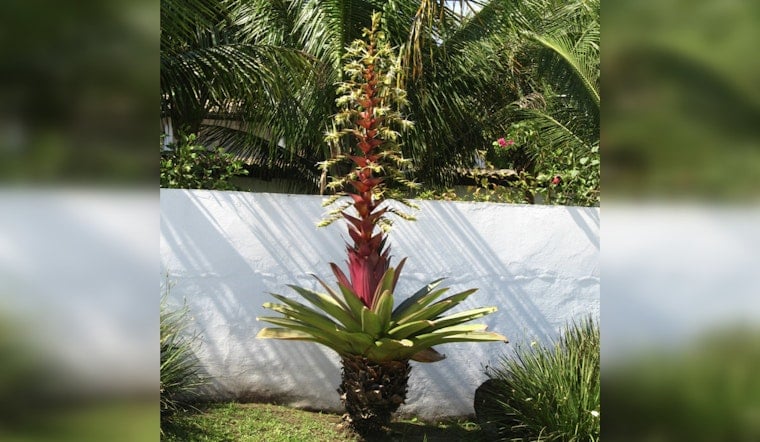
A nearly 8-foot-tall bromeliad once part of Dolly Parton's personal plant collection at her California home is now blooming for the final — and only — time at UNC Charlotte's Botanical Gardens, drawing hundreds of visitors eager to see it before it dies. Garden employees estimate the plant, nicknamed Dolly the Bromeliad, has only a couple of months left before reaching the natural conclusion of its life cycle.
The plant's arrival in Charlotte comes just weeks after the death of its namesake. Dolly Parton died on August 25, 2026, according to a fact confirmed in coverage from The Charlotte Observer. Estimated to be 15 to 20 years old, the bromeliad — scientifically known as *Alcantarea imperialis*, or the imperial bromeliad — is one of the world's largest bromeliad species, a plant that in the wild grows as a lithophyte on the steep granite slopes of Brazil's Serra dos Órgãos mountains, according to Wikipedia. Its leathery foliage can span up to 5 feet long, and its central rosette can hold nearly 8 gallons of rainwater, with a natural lifecycle lasting anywhere from 8 to 40 years before it sends up a single flower spike as tall as 10 feet.
That single bloom is the plant's last act. Bromeliads of this type are monocarpic, meaning they spend years, even decades, storing energy for one flowering event before dying — a biological fact that makes Dolly's current display at UNC Charlotte both rare and fleeting.
From Dolly Parton's Backyard to a Mountain Nursery
Before landing at UNC Charlotte, the bromeliad spent time as part of Dolly Parton's plant collection at her California home, per the Observer's reporting. It eventually ended up at Mountain Paradise Nursery in Creston, North Carolina, a mountain township in rural Ashe County. The nursery, operated by grower Tim Barker, specializes in breeding Sarracenia pitcher plants and other rare carnivorous species, according to a video shared by Jay Sifford on Facebook.
Barker later offered the bromeliad to other gardens at the International Carnivorous Plant Symposium and Expo, held in Kernersville in May 2026. Per UNC Charlotte Alumni, Barker transported the plant to the symposium lying sideways across bracing straps and cradled in a canvas sack inside his vehicle before ultimately deciding to entrust it to UNC Charlotte. Josh Munn, a horticulturist at the UNC Charlotte Botanical Gardens, transported the bromeliad the rest of the way in the back of a Subaru Forester. Munn told the Observer that the nursery wanted Dolly to go somewhere she would be enjoyed and looked at.
A Growth Spurt and a Colorful Final Display
Once settled in Charlotte, the bromeliad wasted no time putting on a show. Mariah Huffman, director of education and engagement at the UNC Charlotte Botanical Gardens, said the plant grew almost a foot in about a week. Now, its spikes are turning into light yellow flowers on a plant standing just under 8 feet tall, according to the Observer.
The display has already attracted hundreds of visitors, among them Levan McLain, who visited with her granddaughter, Mia. McLain planned to gift a photograph of the visit to her mother for her 83rd birthday, according to the Observer's report. Huffman said Dolly Parton and the botanical gardens both connect people, while Jeff Gillman, director of the UNC Charlotte Botanical Gardens, noted that celebrities having large plant collections is not unusual.
A Legacy Beyond the Final Bloom
Although the mother plant will die once its flowering cycle concludes, its story will not end there. Dolly the Bromeliad is expected to produce offsets, or “pups,” as well as viable seeds for new plants, meaning its genetic lineage — and its link to Parton — should continue on at the gardens for years to come.
The bloom arrives amid a broader run of rare botanical spectacles at UNC Charlotte. Four months earlier, in late April 2026, the Botanical Gardens' Titan Arum, or corpse flower, nicknamed Smellvis produced its debut 61-inch bloom in the greenhouse's Dinosaur Room, according to Inside UNC Charlotte. That corpse flower belonged to a lineage of blooms cultivated at the university dating back to 2007 with a plant named Bella, following a 2025 corpse flower bloom named Cadavera that drew more than 7,500 visitors to the campus gardens.
Where to See Dolly and What's Next for the Gardens
Dolly the Bromeliad is on display at the UNC Charlotte Botanical Gardens inside the McMillan Greenhouse's Carnivorous Courtyard, located at 9026 Craver Road on the university's main campus, with visitor parking available at nearby East Deck 1. During the height of public interest, the gardens extended viewing hours at the greenhouse to run from 8 a.m. to 8 p.m., well beyond the facility's typical 4 p.m. weekday closing time.
The Botanical Gardens and McMillan Greenhouse operate within UNC Charlotte's Klein College of Science, an academic division formed in 2023 that also houses departments including Biological Sciences, Chemistry, Mathematics and Statistics, and Physics and Optical Science. The gardens, now in their 60th year, will mark the milestone with an anniversary celebration on Friday, November 13, 2026.





