

























































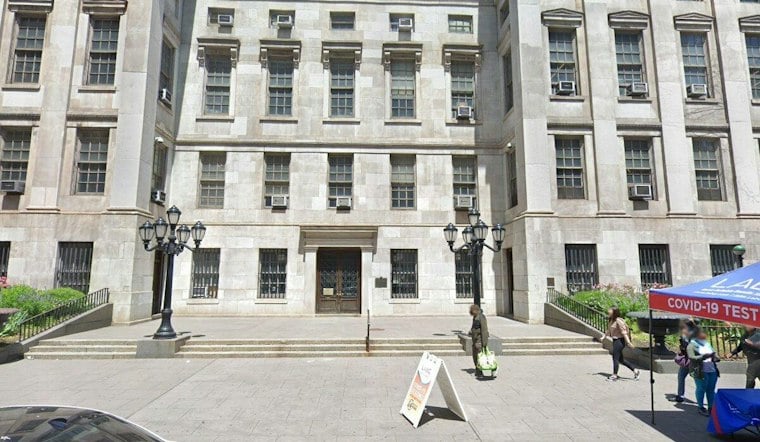
President Luis Abinader of the Dominican Republic made his first official visit to Brooklyn on Thursday, stopping at Borough Hall and a Downtown Brooklyn restaurant in a trip Brooklyn Borough President Antonio Reynoso framed as a celebration of the deep ties between the borough and the island nation. The visit landed squarely within Hispanic Heritage Month, which runs from September 15 through October 15 this year, and came as Reynoso estimated more than 100,000 Dominicans call Brooklyn home.
Reynoso, the first New York City borough president of Dominican descent, welcomed Abinader to Borough Hall as part of what he described as a celebration of the connection between Brooklyn and the Dominican Republic, according to News12 New York. Abinader presented Reynoso with a plaque recognizing his leadership and representation of the Dominican community, while Reynoso in turn handed the president a proclamation declaring Thursday Dominican Pride Day in Brooklyn. Reynoso said he hoped the visit would strengthen the relationship between Brooklyn and the Dominican Republic, and added that he hoped it would not be Abinader's last trip to the borough.
A President's Thanks to the Diaspora
Abinader told the crowd he was proud of what Dominicans have achieved in New York, and he thanked Dominicans in the city for supporting their home country through investments, money sent home and help for their families, per the same News12 account. That gratitude carries real financial weight: remittances sent to the Dominican Republic reached $8.43 billion between January and August 2026, with more than 80 percent of formal August transfers originating from Dominican workers living in the United States, according to the Central Bank of the Dominican Republic. Those flows now face a new complication: a 1% federal tax took effect this year on remittances sent in cash or by money order under the federal One Big Beautiful Bill Act, though digital transfers made through bank accounts or debit cards remain exempt, as reported by Global Finance Magazine.
Two attendees at Borough Hall, Egaudy Gomez and Robin Reyes, said they were proud and happy about Abinader's visit, the station's report noted. Later, Abinader stopped at Cibao, a Dominican restaurant in Downtown Brooklyn, where owner Tony Ramos welcomed him. Ramos said he was happy Abinader was representing Dominicans and wished him the best.
Diplomacy Beyond the Borough
Abinader's Brooklyn stop came during a New York trip built primarily around the 81st Session of the United Nations General Assembly, where he addressed the assembly on climate threats, food security and regional security concerns tied to neighboring Haiti, per UN News. While in the city, he also met with Governor Kathy Hochul and Representative Adriano Espaillat, according to the News12 report, with the three focusing on the partnership between New York and the Dominican Republic on emergency preparedness, disaster response and protection from extreme weather.
That partnership has taken tangible shape this week. The Dominican Republic sent a delegation of roughly 40 emergency management and public safety representatives to a five-day training summit in New York, a program the Office of New York State Governor Kathy Hochul says was held at the State Preparedness Training Center in Oriskany and run by the state's Division of Homeland Security and Emergency Services alongside the State Bridge Authority, covering tactical search and rescue and post-earthquake inspections. The cooperation builds on a bilateral Declaration of Intent that Hochul and Abinader signed in Santo Domingo in November 2025, establishing formal state-level cooperation on climate resilience, agricultural innovation, trade and disaster mitigation — a trip during which Hochul became the first U.S. governor in history to address the Dominican National Congress.
A Community Reshaping Itself
Espaillat, who became the first Dominican-American and first formerly undocumented immigrant elected to Congress when he was sworn in back in 2017, now chairs the Congressional Hispanic Caucus and represents a district spanning Harlem, Washington Heights, Inwood and parts of the northwest Bronx, according to the U.S. House of Representatives. Dominicans remain the single largest foreign-born group in New York City, with roughly 391,500 residents leading as the top immigrant origin group across 52 individual neighborhoods, per the NYC Department of City Planning.
Yet the city's Dominican population has been shifting. A study from the CUNY Graduate Center found the city's Dominican population fell nearly 13 percent between 2021 and 2024, dropping from 761,333 to 663,169 residents, driven by outward migration to other U.S. states rather than declining immigration from the island. Roughly 100,000 Dominicans left New York City between 2021 and 2023 alone, largely in search of lower living costs. Reynoso, who was raised by Dominican immigrant parents in Williamsburg's Los Sures neighborhood before serving two terms in the City Council, is the youngest person elected to a four-year term as Brooklyn borough president, according to the Office of the Brooklyn Borough President.
The relationship between New York and the Dominican Republic stretches back centuries, according to the Migration Policy Institute, which traces Dominican migration to the city as far back as 1613, when Santo Domingo native Juan Rodríguez became recognized as Manhattan's first non-Native American resident. Modern mass migration expanded after dictator Rafael Trujillo's death in 1961, a wave that eventually built the diaspora Abinader thanked in Brooklyn on Thursday.





