

























































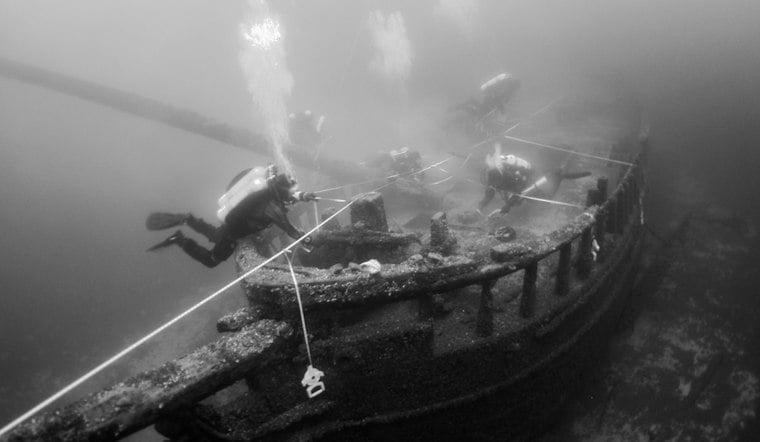
A 137-foot wooden schooner that vanished into Lake Michigan in 1887 has resurfaced as a milestone: the Wisconsin Historical Society has nominated the Frank D. Barker as the state's 100th shipwreck put forward for the National Register of Historic Places. The two-masted vessel sank near Door County after fog sent it off course into a limestone outcropping, and it lay hidden on the lake bed for 138 years before a local rafting guide spotted something odd in satellite imagery.
That discovery is what makes this nomination personal rather than purely bureaucratic. According to the Milwaukee Journal Sentinel, Matt Olson, a Sturgeon Bay native and co-owner of Door County Adventure Rafting, spotted the unusual shape in satellite images in July 2025 and led his own expedition using sonar and an underwater camera, as reported by jpost.com. Maritime archaeologists later confirmed the vessel's identity, according to smithsonianmag.com. The wreck sits about 24 feet underwater near Barker Shoal off Door County.
Fog, a Reef, and a Crew That Made It Out
The Frank D. Barker went down after fog caused the schooner to drift off course and strike a limestone outcropping near Rowleys Bay, the outlet notes. The captain and crew abandoned ship and took refuge on nearby Spider Island near Newport State Park, and everyone aboard survived, per the same account. Salvage attempts on the wreck reportedly failed multiple times in October 1887 and again in June, August, September and October of 1888, before the vessel was left to the lake for good.
Built in 1867, the schooner had Cleveland as its home port and spent its working life hauling iron, coal, crops and lumber through the Great Lakes grain trade. It had departed from Manistee bound for Escanaba to collect iron ore on September 30, 1887, not long before it went down. Records diverge on exactly who built the ship: kval.com reports it was built by Simon G. Johnson in Clayton, New York, while John Cantwell is also named as its builder, with Clayton, New York, given as the place of construction.
A Milestone a Century in the Making
Wisconsin already holds more individually listed shipwrecks on the National Register than any other state, and the Frank D. Barker's nomination cites both its contribution to Great Lakes commerce and its value as an archaeological site. Tamara Thomsen, a maritime archaeologist at the Wisconsin Historical Society, said the state remains dedicated to preserving and understanding its submerged cultural resources. Olson, who has now helped discover three shipwrecks nominated to the National Register, said he was pleased to contribute to preserving Door County history.
Olson's track record runs deeper than this single find. He also helped locate the Grey Eagle and the Sunshine, two schooners that sank in 1869, according to smithsonianmag.com. The Sunshine, a 97-foot scow-schooner, was listed on the National Register in 2023, per kval.com, alongside the 137-foot Grey Eagle, and both were nominated to the register that same year.
How a Wreck Becomes a Federal Listing
Wisconsin shipwreck nominations begin with listing on the state register before moving through a process overseen jointly by the State Historic Preservation Office and the State Historic Preservation Review Board, whose 16 members are appointed by the governor. From there, the National Park Service reviews state-approved nominations, a federal review that can take anywhere from six months to a year. A National Register nomination carries a federal level of enforcement and helps strengthen preservation laws that protect shipwrecks from looting and damage — Wisconsin already protects all underwater shipwrecks through state law, while neighboring Michigan relies on 13 underwater preserves and Isle Royale, and Florida often folds its wrecks into larger historic districts.
The protections matter because the lake itself is not gentle on old wood. Rowleys Bay is a “high energy area” where waves and ice tear apart wreckage over time, according to doorcountypulse.com. Door County alone is estimated to hold more than 240 shipwrecks, and across the wider lake, experts estimate roughly 600 vessels have sunk in Lake Michigan while only about 200 have ever been found, per smithsonianmag.com.





