

























































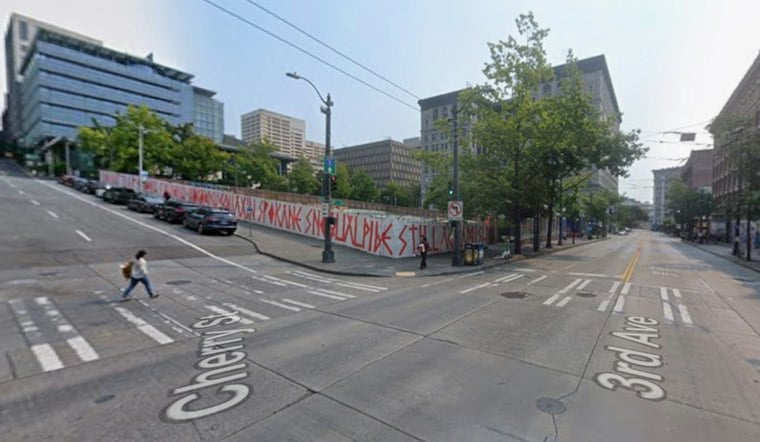
Across the street from Seattle City Hall, a fenced-off pit has sat empty for 21 years, and the city still can't say when — or whether — anyone will finally build something there. The lot at 3rd Avenue and Cherry Street has outlived two recessions, three developers and a campaign-finance scandal, and this year Seattle concluded that its current developer, Bosa Development, is in default of the 2017 agreement that gave the company the site.
A Civic Building Gone, Then a Void
The site once held the Seattle Public Safety Building, a 14-story tower completed in 1951 that housed police headquarters, health offices and a World War II memorial plaza before it was demolished in 2005, according to the Museum of History & Industry. Municipal services moved to the new Seattle Civic Center complex across Fourth Avenue, leaving the lot vacant — the start of a two-decade stretch during which, as KUOW reports, the lot across from City Hall has remained undeveloped since 2005.
In 2007, then-Mayor Greg Nickels' administration struck a $25 million public-private deal with Triad Development to build a 43-story tower and a 30,000-square-foot public plaza on the site, but the plan stalled once the 2008 Great Recession hit, according to Post Alley. Contract extensions let Triad hold development rights for eight years without ever breaking ground, the outlet's reporting shows.
A Scandal Ends the First Deal
Triad's arrangement with the city collapsed for good in October 2015, after a company executive offered to make a negative ad campaign against city council candidate Jon Grant disappear if Grant dropped a tenant lawsuit challenging Triad's permit extensions, KUOW reports. Grant was a council candidate and tenant advocate with an open lawsuit against Triad at the time, and the exchange amounted to an alleged quid pro quo tied to a Seattle City Council race, according to The Stranger. Seattle ended its contract with Triad once news of the exchange broke, and the city then sought a new developer for the stalled site.
That search led to Bosa Development, which took over the project after Triad became entangled in the scandal, per KUOW's account. When the Seattle City Council approved transferring the property to Bosa in September 2017, the agreement required Bosa to pay $16 million in cash plus $5.7 million in affordable housing fees earmarked for the city's Equitable Development Initiative, according to The Urbanist.
An Ambitious Tower, Then a Halt
Bosa's approved plans, designed by James K.M. Cheng Architects, called for a 629-foot, 57-story crescent-shaped tower with more than 400 condominium units, ground-level retail and a 25,000-square-foot public plaza, per UrbanAsh's reporting — a vision for a project now valued around $300 million, according to KUOW. Bosa had previously built the twin Insignia Towers in Belltown before taking on the Cherry Street site.
Bosa formally triggered its construction timeline in March 2022 by pulling excavation and shoring permits, the first active site work since 2005, setting contract deadlines of 48 months to finish the public plaza and 72 months to complete the tower, according to Post Alley's reporting. Just four months later, in July 2022, Bosa indefinitely suspended work on the pit, citing market volatility and cost escalation after Mortenson Cost Index data showed Seattle construction costs jumped 22% in a single year, compared with an 18% national increase over the same period. KUOW reports that Bosa has blamed COVID-era market deterioration, construction-cost escalation and continuing neighborhood impacts for making the original development plan impossible.
City Says Default, Developer Disagrees
Earlier this year, the City of Seattle concluded that Bosa is in default of the 2017 agreement, according to KUOW's reporting — but Bosa disagrees that it is in default. Under the contract, Seattle Finance and Administrative Services told KUOW that Bosa could face liquidated damages of up to $5,000 per day for unexcused delays past its completion milestones, though the contract also allows Bosa to claim adverse market conditions to seek timeline relief. A city spokesperson told KUOW that Seattle has so far declined to levy damages against Bosa, and officials say they have not determined when — or whether — they will fine the company at all.
Former Seattle City Council President Tim Burgess said the city needs to apply more pressure and should find out whether fining Bosa would actually help move the project forward, according to KUOW. Eddie Lin, meanwhile, said the city needs to determine what it wants to see happen at the site and how to achieve it, adding that all options should remain on the table. Lin also said he would be hesitant to develop the site himself unless costs came down.
A Downtown Market Working Against Recovery
The stall isn't happening in a vacuum. Residential high-rises across the region face high interest rates, elevated construction costs and relatively stable rents, a combination that discourages new towers even where land is already cleared, per KUOW. Seattle's central business district has an office vacancy rate of nearly 35%, KUOW notes, a figure that tracks with Cushman & Wakefield data showing downtown vacancy hit a record 35.6% in the fourth quarter of 2025, up from 32.3% a year earlier.
By July 2026, downtown Seattle's commercial vacancy rate had climbed to roughly 36.5% — about 20 million square feet of empty space — giving the city the highest downtown office vacancy rate among major U.S. cities, as reported by FOX 13. Local business groups have pointed to post-pandemic remote work shifts and city payroll taxes as major drivers of that vacancy. Against that backdrop, the fenced pit across from City Hall remains one of downtown Seattle's most visible symbols of a market that has yet to recover, with no timeline for when — or if — a shovel goes back into the ground.





