

























































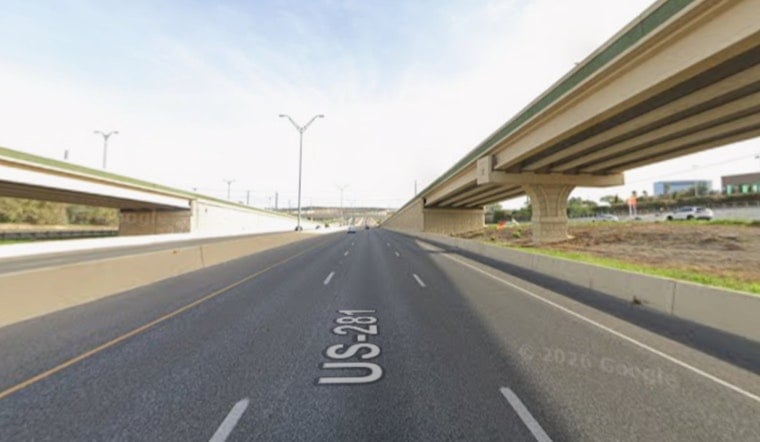
A 26-year-old man was hospitalized after being ejected from his Audi sedan during a rollover crash on U.S. Highway 281 North near Northeast Loop 410 in San Antonio before 3 a.m. Saturday. His injuries were initially described as life-threatening, but police later updated his condition to non-life-threatening.
According to WOAI, the man was driving northbound on U.S. 281 in the exit lane for Loop 410 when he attempted to change lanes to stay on the highway, per San Antonio police. That maneuver sent his Audi into an impact attenuator, the crash cushion positioned at the exit ramp gore where lanes split off from the main highway. Police say the impact caused the sedan to flip and come to rest in the number 1 lane, ejecting the driver, who was then taken to a local hospital.
How a Crash Cushion Becomes a Launch Point
Impact attenuators exist specifically to soften collisions at exit ramp gore points, absorbing energy so drivers don't slam directly into unyielding concrete barriers, according to the Texas Department of Transportation's roadway design manual. But those same devices can act as a pivot point when struck at highway speed, sending a vehicle into a rollover rather than a head-on stop. Gore areas see frequent strikes because drivers often make abrupt, last-second lane corrections near exit dividers.
Texas Transportation Code § 545.060 requires drivers on a multi-lane roadway to maintain a single lane and bars sudden lane shifts unless they can be made safely, per FindLaw. Failure to maintain a single lane is a factor investigators commonly cite in crash reports involving exit gore strikes, and it mirrors the maneuver San Antonio police described in Saturday's crash.
Ejection Risk Tied to Seat Belt Use
Whether the driver was belted has not been disclosed, but national data underscores why ejection crashes turn so severe. The National Highway Traffic Safety Administration has found that unbelted occupants are roughly 30 times more likely to be ejected in a collision, and about 75 percent of people fully ejected from a vehicle die of their injuries. Rollover crashes, meanwhile, account for nearly 35 percent of all passenger vehicle occupant deaths despite representing a small share of total crashes, largely because of violent rotational forces that follow a fixed-object strike like an attenuator hit.
Statewide numbers reflect the same pattern. Texas recorded 4,150 traffic fatalities in 2024, averaging one reportable crash every 57 seconds, and nearly half of fatal crash victims with known restraint status were not wearing seat belts, according to TxDOT crash facts. The department's Traffic Safety Data Portal also shows that unbuckled occupants killed after ejection nearly double the number who suffer serious non-fatal injuries, with drivers age 25 to 34 — the same bracket as Saturday's driver — representing the highest-risk group for severe unbelted crash injuries.
A Familiar Stretch of Freeway
The U.S. 281 and Loop 410 interchange, fully opened in June 2008 after a multi-year rebuild of what had been hazardous surface-street transfers between the two North Side freeways, carries heavy daily commuter and airport traffic. TxDOT has announced a $156 million project along the corridor set to begin construction this month, aimed at reconfiguring exit ramps and adding auxiliary lanes near San Antonio International Airport to ease merging bottlenecks in the same general area.
Saturday's crash is not an isolated incident along this corridor. In May 2024, a 30-year-old woman died on the city's Southwest Side when her SUV struck an impact attenuator on U.S. Highway 90 near South General McMullen Road while trying to reenter the main lanes from an exit ramp, as previously reported by Hoodline. And on August 15, a three-vehicle rollover on northbound U.S. 281 near Bitters Road ejected two children from a pickup truck and shut down northbound lanes for hours, part of a string of severe late-summer rollover incidents along the same corridor.
San Antonio police have not released additional details about the driver's condition beyond the update to non-life-threatening, and no further information on potential citations or charges tied to the lane change has been made public.





