

























































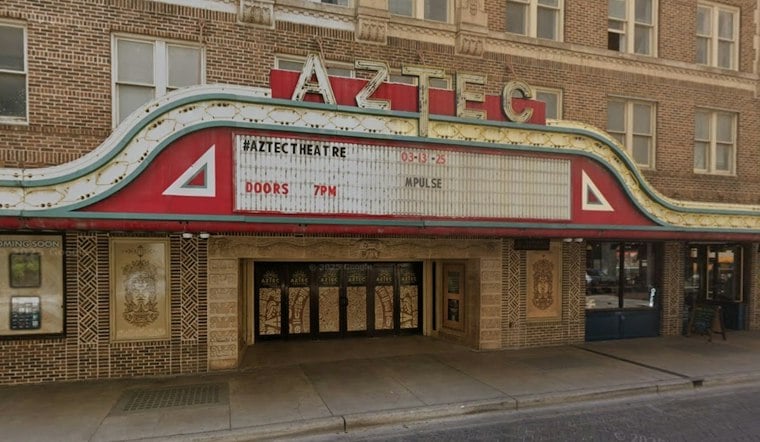
A new speakeasy called Fedora Lounge has opened below the Aztec Theatre at 201 E. Commerce St. in downtown San Antonio, bringing a moody, Prohibition-era atmosphere to the River Walk. The lounge leans hard into the 1920s, with backlit windows cut into its walls to set the mood and a centerpiece bar with a story stretching back to Chicago.
The Aztec opened on June 4, 1926, as a movie palace designed by Meyer and Holler, the firm behind Los Angeles’ Egyptian and Chinese theaters. After closing as a three-screen cinema in 1989, it was restored and reopened as Aztec on the River in 2006; that attraction closed in 2007. The theater was purchased and reimagined as a live entertainment venue in 2013, giving the building another chapter beyond its original movie-house role. The theater’s history spans its 1920s opening and later reinvention.
A Jazz-Era Vision Beneath the Aztec
According to KSAT, the owner is a longtime jazz fan with a soft spot for the 1920s, and that passion shaped the design of the new space. Most of the wood, parts and windows used throughout the lounge came from the building's original 1926 structure and are at least a century old, the station reports. That reuse of old materials gives Fedora Lounge a built-in sense of history rather than a manufactured throwback feel.
The station's report also details the lounge's most striking feature: a bar imported from the Lexington Hotel in Chicago, once home to Al Capone, which made its way to San Antonio and the original County Line before eventually landing at Fedora. It's a well-traveled piece of furniture with a storied past, now serving as the visual anchor of the new room.
The Lexington Hotel’s association with Capone is part of the hotel’s history, not proof of when this particular bar was made or who used it. Completed in 1892, the Chicago hotel served as Capone’s headquarters from 1928 to 1932. It later closed and, despite landmark status, was demolished in 1995, leaving the bar as a surviving object connected to a lost building. The Encyclopedia of Chicago traces the hotel’s history.
Following a Line of Basement Restaurants
The space itself has a long history of hosting dining and drinking spots beneath the Aztec Theatre. Per Fedora's own website, Ethel R. Brown brought the Old South Cafe to the basement of the Aztec Theatre in 1929, and its private dining rooms welcomed guests before and after the show. That restaurant was eventually followed by El Matador, according to the same source, before the space was reimagined once more as Fedora Lounge.
The Old South Cafe’s basement location was marketed as an extension of the theatergoing experience: customers could dine before or after a movie, with the theater’s cooling system and orchestra music among the advertised attractions. The restaurant closed in 1955, and El Matador took over the space the following year, operating there until 1969. The cafe’s history records how closely its business was tied to the theater.
Fedora's website also lays out how to find it: the lounge sits beneath the Aztec Theatre in downtown San Antonio, with one entrance at 106 N. St. Mary's Street and another reachable from the River Walk through the Aztec Hotel entrance. The site notes that walk-ins are welcome, though guests must be at least 21 years old, and cocktail attire is requested with the dress code enforced.





