

























































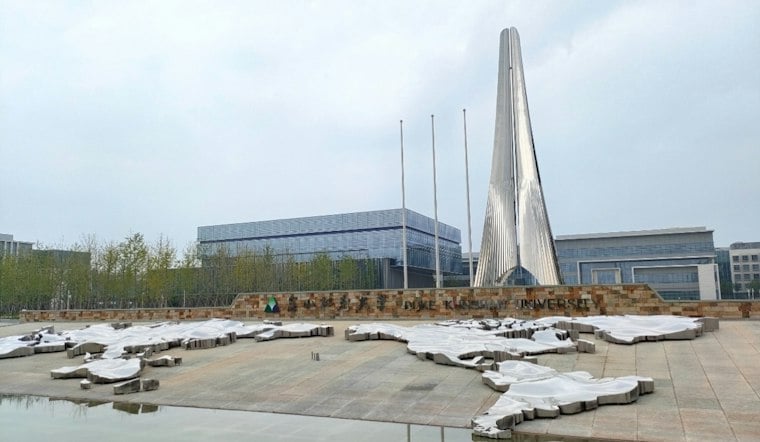
Duke University has 30 days to produce records after the U.S. Department of Education and the U.S. Department of State opened a joint investigation into the school's foreign-funding disclosures, zeroing in on its long-running academic partnership with Wuhan University in China. The agencies allege Duke submitted incomplete, inaccurate, and untimely foreign-funding disclosures, and they are demanding a full accounting of the school's financial ties to a Chinese institution the government links to military research.
The two federal agencies notified Duke of the investigation and said the university had reported qualifying foreign transactions, according to The News & Observer. Federal law requires American universities to report foreign gifts and contracts valued at $250,000 or more annually, and the agency letter alleges Duke misidentified governmental counterparties as nongovernmental, submitted incomplete descriptions for restricted transactions, and had systemic errors in timely disclosure of foreign contracts. Duke established a partnership with Wuhan University in 2013, and Duke Kunshan University was established as a joint institute in 2018, with the campus located in Kunshan, Jiangsu province.
Per the agency letter, investigators allege that Wuhan University trains cyberwarfare specialists and plays a central role in a satellite system supporting missile guidance, and that the institution is associated with research supporting People's Liberation Army weapons systems. The letter further alleges that Duke Kunshan University's governance appears designed to accommodate China's policy and security directives. Duke was asked to produce records and clarify its counterparties.
A Broader Multi-Agency Squeeze
The investigation did not emerge in isolation. The Department of Education and Department of State's joint effort traces back to Executive Order 14282, signed by President Trump in April 2025, which ordered federal agencies to aggressively enforce Section 117 foreign funding disclosures and conduct investigations. In February 2026, the Department of Education signed an interagency agreement with the State Department's Bureau of Educational and Cultural Affairs to jointly administer Section 117 reporting and share campus funding data for national security evaluations, according to Ropes & Gray LLP — the structural shift that now has the State Department co-leading the Duke probe.
Congressional pressure on Duke's China venture predates the formal federal investigation by more than a year. House Select Committee on the CCP Chairman John Moolenaar and House Education Committee Chairman Tim Walberg sent a letter to Duke President Vincent Price in May 2025 urging the immediate termination of Duke Kunshan University, according to the House Select Committee on the CCP, which cited high-tech research at the campus in AI and materials science. The Education Department said the current investigations follow a congressional subcommittee examination of covert malign influence tied to Cuba and China, and Nicholas Kent said the universities under scrutiny are expected to cooperate fully.
North Dakota Faces a Parallel Probe
Duke isn't alone. The University of North Dakota is undergoing a similar investigation, with federal officials focusing on its School of Aerospace Studies and uncrewed air systems research, which drew investment from Chinese aviation companies linked to the People's Liberation Army. That parallel probe opened September 15 and gave North Dakota the same 30-day deadline to produce foreign tax filings and aerospace partnership contracts, per the U.S. Department of Education.
Duke's China ties have also collided with a separate Department of Defense demand. The Pentagon asked Duke and other schools to urgently review their foreign ties against an updated list of threatening foreign institutions. That directive flows from Section 1286 of the FY2019 National Defense Authorization Act, which bars the Defense Department from funding fundamental research at universities maintaining active collaborations with foreign institutions on the Pentagon's risk list — the same statute Hoodline detailed when the Pentagon issued a two-week ultimatum to Harvard, MIT and 28 other schools last month. The available sources do not establish whether Wuhan University is on that Defense Department threat list.
Millions in Defense Dollars on the Line
The stakes for Duke are financial as much as reputational. The university received $863 million in federally sponsored research funding in fiscal year 2024, making federally sponsored research a significant financial stake. Under existing federal guidance, failure to comply with Section 117 disclosure rules could result in civil actions by the Education Department or Justice Department, court orders compelling compliance, repayment of investigation costs, or jeopardize its eligibility for Title IV federal student aid, according to Hunton Andrews Kurth LLP.
Duke's willingness to keep its Kunshan campus running stands out against a broader retreat from Sino-American academic ventures. The University of Michigan, Georgia Tech, and UC Berkeley all ended joint China-based academic programs in 2024 and 2025 following federal scrutiny, and the University of North Carolina at Chapel Hill was notified to review its foreign ties, according to the House Select Committee on the CCP.
The foreign-funding investigation remains an ongoing administrative matter at Duke. The Section 117 inquiry remains an ongoing administrative matter, and Duke has 30 days from notification to produce records and clarify its counterparties.




