

























































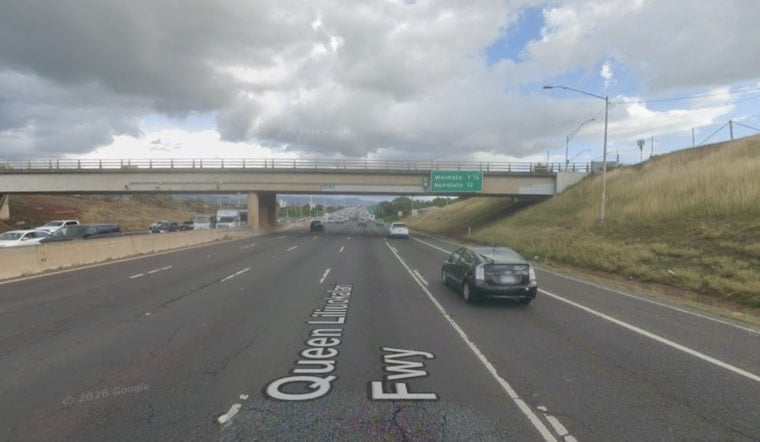
A dump truck traveling eastbound on the H-1 Freeway slammed into the Waiawa overpass around 1:08 p.m. Friday, tearing its bed loose and leaving it lodged beneath the bridge as another vehicle plowed into debris scattered across the roadway. Honolulu police reported no injuries from the crash, but two lanes, including the shoulder lane, remained closed for hours while crews worked the scene.
According to Honolulu police, the collision prompted a multi-agency response involving the Honolulu Police Department, the Honolulu Fire Department, and the Hawaii Department of Transportation, with officers issuing public advisories urging drivers to seek alternate routes. Witnesses told KHON2 that the truck merged onto the freeway with its dump bed fully raised before striking the bridge, shearing the bed off and wedging it under the overpass while the cab continued driving a short distance before stopping, according to witness accounts relayed by Hawaii News Now. The mismatch between a raised truck bed and a fixed overpass points to the kind of clearance violation Hawaii law is built to prevent.
State Height Limits Meant to Prevent This
Under Hawaii Revised Statutes § 291-34, the maximum legal overall height for a vehicle and its load on public roads is 14 feet, and driving under or through a bridge that doesn't offer enough clearance is prohibited outright. Hawaii Administrative Rules further cap the standard vehicle height without a special permit at 13 feet 6 inches, and any oversized load stretching beyond 15 feet requires a front lead pilot car equipped with a clearance pole. It remains unclear whether the driver faced a mechanical failure with the truck bed or simply failed to lower it before merging onto the highway, and whether state regulators or police will pursue citations tied to the height restriction.
The Hawaii Department of Transportation later confirmed the detached trailer bed had been cleared from beneath the overpass, allowing crews to reopen the affected lanes. The crash adds to a rough stretch for this stretch of freeway, which sits inside HDOT's active H-1 Pearl City and Waimalu Viaduct Improvement Project, an ongoing deck repair effort scheduled to run through May 2027 that already restricts commuter lanes overnight.
A Pattern of Overpass Strikes on Oahu
This is not the first time oversized equipment has collided with an H-1 overpass this year. In June, an excavator riding on a flatbed truck clipped an overpass near Punahou, spilling concrete debris onto the highway and shutting down three lanes during peak traffic, as Hoodline previously reported. And in April, commercial equipment struck the Gulick Avenue overpass — identified by HDOT as the lowest overpass on Oahu — a hit that accelerated state plans for a project exceeding $100 million to raise that bridge.
The Waiawa interchange area has its own troubled history. That same April, an overturned dump truck blocked four westbound H-1 lanes and spilled diesel fuel near the H-1/H-2 split, paralyzing Central Oahu commute traffic for hours, a crash Hoodline covered in its report on an eight-car pileup near the same split in August. Just east of the interchange, a fatal three-vehicle collision near the Kaamilo Street overpass in January killed a 27-year-old woman and injured six others.
Traffic Deaths Trending Down Islandwide
Despite the recurring chaos at this corridor, broader safety numbers on Oahu have improved this year. Honolulu Police Department traffic data published in August showed 25 traffic fatalities recorded through late July, down sharply from 46 during the same period in 2025, a year that ultimately saw annual traffic deaths reach an 18-year high of 64. Even so, the Waiawa and Pearl City stretch of H-1 continues to produce serious incidents, from hit-and-runs to overpass strikes, that repeatedly snarl Oahu's primary east-west artery for commuters trying to get across the island.



