

























































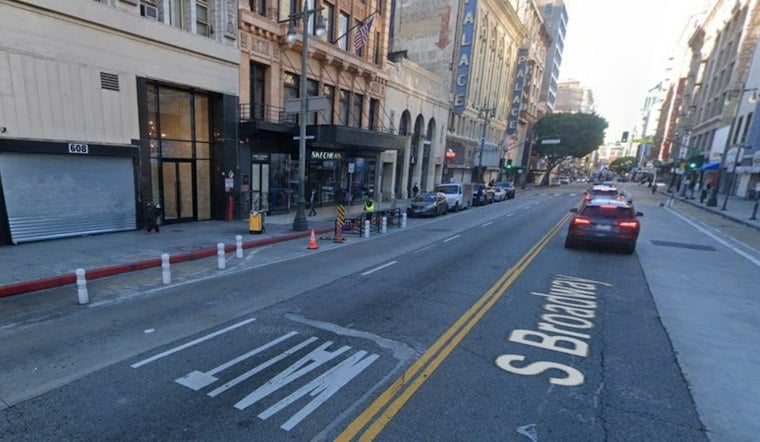
infinitSpace plans to make its U.S. debut in Downtown Los Angeles, opening a 32,000-square-foot flexible workspace at 612 S. Broadway on November 2, 2026. The space is designed for roughly 400 memberships, with private offices, shared workspaces, meeting rooms, lounges and a rooftop event space.
The company signed a 15-year agreement for the location, according to Bisnow. That agreement sits alongside a broader operating model in which infinitSpace says it works with property owners through monthly management agreements rather than traditional master leases, according to the company.
A Broadway Building Recast for New Uses
The address has already undergone a major change in use. The building opened in 1924 as the flagship of Desmond's Department Store, designed by Los Angeles architect A.C. Martin. In 2020, Omgivning completed a $12 million adaptive reuse, adding two floors to create an 80,000-square-foot creative office and retail building. The property previously hosted a coworking operator.
That earlier conversion may give infinitSpace a head start: the space required no major buildout before the company could move in.
Downtown Reuse Has Also Added Housing
The Desmond’s office conversion is one form of building reuse; housing conversions are another. Los Angeles City Planning says the city’s 1999 Adaptive Reuse Ordinance enabled more than 12,000 housing units in Downtown alone, and describes reuse as a way to extend buildings’ lives and retain resources used in their original construction, according to Los Angeles City Planning.
For the newer citywide policy, Los Angeles City Planning records list the Adaptive Reuse Ordinance’s adoption by City Council as December 10, 2025, and its effective date as February 1, 2026, according to Los Angeles City Planning. Those dates provide policy context but do not establish the ordinance’s specific eligibility rules or geographic reach; the Desmond’s project described here is a coworking conversion.
Leadership With WeWork Roots
CEO Wybo Wijnbergen previously served as Managing Director for WeWork across North and West Europe. He co-founded infinitSpace with CTO Wilco Wijnbergen in 2020, according to NoCamels. Wijnbergen told Bisnow that Los Angeles is the right place to begin the U.S. push, saying traditional office markets are having challenges and companies are looking for shorter-term space that is ready for usage. In 2025, infinitSpace appointed Andrea Pirrotti-Dranchak as Head of Real Estate for the Americas to lead the expansion. The company has also announced planned locations in New York, San Francisco, Austin and Toronto.
The company says it operates 15 locations globally, including four in London, three in Amsterdam and two in Berlin. It says members requested a Los Angeles office in January and is targeting 30 new U.S. locations over the next 24 months. Its first planned openings are in Los Angeles, San Francisco, Austin, Seattle and New York.
Downtown's Vacancy Creates an Opening—and a Test
Los Angeles has a large existing coworking market: 349 locations with approximately 7.5 million square feet, the highest location count in the country and third in flexible square footage behind New York and Chicago, according to Bisnow. Coworking accounts for roughly 2.5% of the city’s total office inventory.
Bisnow reported that national coworking locations grew 2.7% in the second quarter of 2026, after 3.2% growth in the first quarter. Downtown Los Angeles office vacancy was more than 35% that quarter, compared with a citywide average just above 25%. Flexible workspace is one possible way to put some of that office space to use.
infinitSpace is not the only flexible-workspace operator pursuing U.S. growth. Bisnow reported that Hubble announced its first new U.S. location in New York in August 2026, with plans to open in seven more U.S. markets.
UCLA Extension Downtown
UCLA Extension is located at 433 S. Spring Street.
The project brings together two bets: that Downtown tenants will seek flexible space and that a previously renovated building can reduce the time needed to bring it to market. Whether the 15-year agreement proves worthwhile will depend on demand in the Historic Core and the trajectory of Downtown LA’s high office vacancy.


