

























































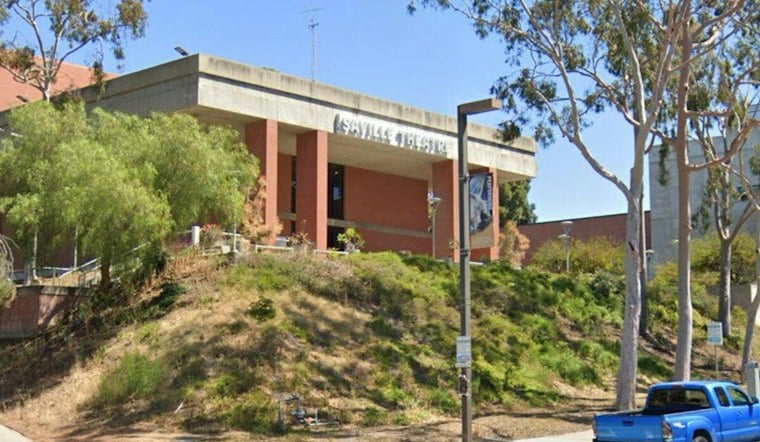
The next decision on San Diego City College’s planned $66 million Saville Theater replacement depends on what engineers find beneath the 57-year-old building. During a construction review, engineers identified two subsurface strands of the Rose Canyon fault near the theater, which stands near 15th and C streets. Officials are now pausing before committing to a full teardown and rebuild while they determine whether the strands affect the proposed project.
The San Diego Union-Tribune reported that engineers plan to drill boreholes to characterize the rock and soil beneath the complex and determine whether either strand extends under the theater. Joel Peterson said officials want that question answered before proceeding. A preliminary reading found no apparent evidence that the strands had been seismically active far back in time, but that assessment is not a final safety determination.
A Campus Already Sitting on Shaky Ground
San Diego City College sits on the Rose Canyon fault, a fault system that the report notes lies beneath the city of San Diego and runs from the ocean onto land in La Jolla, as detailed by The Guardian, UC San Diego. San Diego State University seismologist Tom Rockwell says the fault is thought to generate a magnitude 6.5 to 6.8 earthquake roughly once every 700 years, per the same Union-Tribune report. The fault has a documented history in the region — it produced a magnitude 6.2 quake back in 1862, according to the Guardian's reporting.
The risk isn't purely theoretical for the surrounding academic community. A 2020 Earthquake Engineering Research Institute San Diego report cited by the Guardian estimated an 18 percent probability of a magnitude 6.7-or-larger earthquake on or near the Rose Canyon fault within a 30-year window. That same report noted UC San Diego evaluated 519 of its structures and found 230 needed further evaluation, with 13 flagged as high priority for correction, and a separate California seismic safety survey found more than half of that campus's buildings posed a serious risk to life in an earthquake. UC San Diego has said it will retrofit, replace, or vacate all buildings with significant seismic deficiencies no later than 2030.
What the investigation can establish
According to San Diego City College, a separate Central Plant Expansion project is intended to upgrade campus utility systems in support of major upcoming expansions to the A Building and Saville Theatre. That establishes related infrastructure work, but the borehole investigation remains the next decision point for determining whether the $66 million theater replacement can proceed as planned; the fault discovery itself does not establish a revised budget or schedule. A U.S. Geological Survey-published study estimated the Rose Canyon Fault’s preferred slip rate at 2.4 ± 0.5 millimeters per year, a regional measure that does not determine whether a strand lies beneath the theater. In a separate USGS publication, researchers compared San Diego’s potential earthquakes with the 1933 earthquake at Long Beach, California, and the 1956 earthquake at San Miguel, Baja California; those events occurred elsewhere and are not evidence that the Rose Canyon Fault runs beneath the Saville Theater.
City College's Own History With the Fault
This isn't the first time San Diego City College has had to reckon with fault lines running through its footprint. San Diego City College geology professor Lisa Chaddock has said the college's R Building was moved from its original location because it sat on a fault line, and that massive posts were added after it was relocated between two other faults, according to Times of San Diego.
A nearby property offers a cautionary example of what can happen when a fault discovery derails a project. Times of San Diego reported that a downtown site across from the college was left vacant after developers found a fault line running directly beneath it during foundation excavation. That parcel belongs to Liberty National Corporation, which purchased four plots on Park Boulevard and Broadway in 2014 for more than $5 million and bought the rest of the block in 2019. The company had proposed a 40-story apartment tower along with two midrise buildings adding 640 new apartments, but the city's Development Services Department confirmed no construction permits had been issued for the property. Thomas Rockwell told the outlet that a fault dissecting that site would force developers to build two separate towers with a setback from the fault line rather than one continuous structure.
What Comes Next for Saville Theater
For now, San Diego City College has not announced a final decision on the Saville Theater replacement, and the borehole investigation is the next concrete step toward answering whether either fault strand actually runs under the building. The stakes are real given the theater's age and its role on campus, but officials appear to be treating the fault question as something to resolve before any demolition work begins rather than something to work around after the fact.



