

























































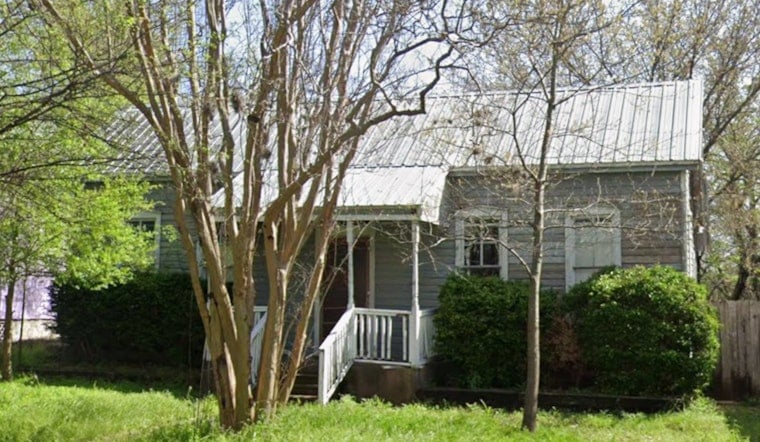
A more than 140-year-old house in East Austin's Swede Hill neighborhood is now a protected city landmark after the Austin City Council voted unanimously to designate it — over the objections of the Dallas-based developer that owns the property and wanted it torn down. The Goins-Versea-Nitschke House at 907 East 13th Street was built between 1873 and 1884, and its new status makes it only the sixth known property in Austin history to be landmarked against an owner's wishes.
That figure comes from Preservation Austin, whose executive director, Lindsey Derrington, called the vote a rare victory for the city's preservation efforts. “Austin's city council took a remarkable stand for preservation with this vote,” Derrington said, as reported by KEYE. The designation caps a monthslong fight between the city and Eureka Holdings, which purchased the house in 2019 and applied for a demolition permit this year, citing structural failures as the reason for wanting the house torn down.
Getting there was not simple. Under a 2019 Texas law and Austin's own land development rules, designating a property as a historic landmark over an owner's objection requires a three-fourths supermajority vote from both the Historic Landmark Commission and the City Council, according to the Austin Monitor. That threshold usually dooms city-initiated historic rezonings that owners fight — in 2025, the council approved 110 rezoning applications and rejected only two, both city-initiated historic landmark requests opposed by property owners, per the same publication.
A House With Two Histories
The property's layered past is central to why preservationists pushed so hard. City records show the house was constructed by German immigrant cabinetmakers, with builder Julius H. Nitschke arriving from Saxony in 1855 and later founding Nitschke Brothers Cabinetmakers on Congress Avenue with his four brothers, according to the City of Austin. The one-story, center-passage National Folk style residence retains horizontal wood siding, a standing-seam metal side-gabled roof, turned porch posts, and wood double-hung windows, per city architectural assessments.
Decades later, the home passed through Black ownership during a pivotal era for the neighborhood. Reverend Allen Versea, an African American minister, owned the property before Anna Eliza Goins — a Black woman living in segregated Austin — purchased it in 1924, city records show, marking a transition of ownership among Black community leaders in East Austin as the neighborhood shifted from a European immigrant enclave to a segregated Black community.
Months of Review Before the Final Vote
The path to landmark status moved through several formal steps. The Historic Landmark Commission delayed Eureka Holdings' demolition permit application on December 3, 2025, formally initiated historic zoning on January 7, 2026, and recommended landmark status with an 11-0 vote on February 4, 2026, according to city documents. The property had actually been flagged for potential landmark designation a decade earlier, in the 2016 East Austin Historic Resource Survey, due to its architectural integrity and historical associations, the city noted.
Derrington framed the council's ultimate decision as a rebuke of what preservationists call demolition by neglect. “The council sent a clear message that Austinites deserve better than demolition by neglect,” she said. City zoning records list the property's owner of record as Bubble Bee LP, based on West 8th Street in Austin, even though Eureka Holdings is the Dallas-based developer that purchased the house in 2019.
Room for Both Preservation and New Housing
The council's compromise didn't lock the entire lot away from development. Preservation Austin said the historic designation covers only the front portion of the lot containing the original sections of the house, leaving more than half of the property available for infill development by the owners. Preservation advocates pointed out that the unencumbered rear portion qualifies for high-density construction under the Preservation Bonus provisions of Austin's HOME (Home Options for Middle-Income Empowerment) ordinance, according to city documents.
That arrangement reflects a broader institutional reality: Austin's Historic Preservation Office reviews hundreds of demolition and relocation permits annually for properties older than 45 years, but approves roughly 87% of them administratively without ever sending them to the Historic Landmark Commission, per city records. Only a small fraction of historic-age permit requests trigger a formal landmark initiation like the one that unfolded at 907 East 13th Street.
What happens next for Eureka Holdings remains unclear. It is not known whether the developer, operating under Bubble Bee LP, will attempt to sell the now-divided parcel, pursue infill permits for the unrestricted rear lot, or challenge the city's forced landmark designation through legal channels.





