

























































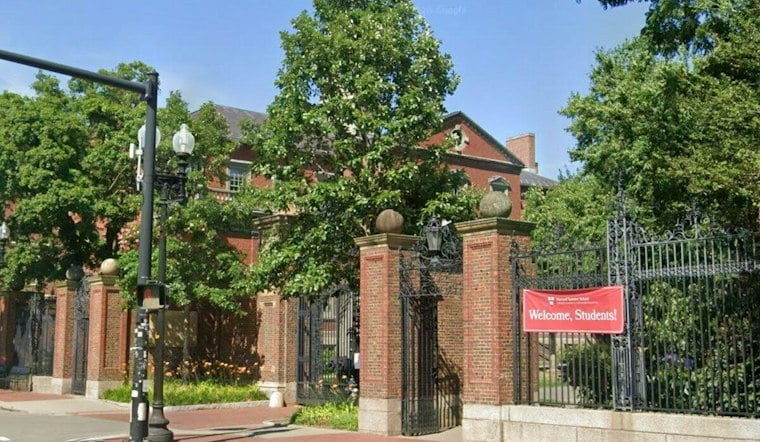
The U.S. Equal Employment Opportunity Commission has sued Harvard University, Cambridge's largest private employer, demanding the school hand over internal hiring records as part of a federal investigation into alleged discrimination against white men in its employment practices. The lawsuit, filed in federal court in Massachusetts, accuses Harvard of noncompliance with the agency's investigation and asks a judge to compel the university to produce the requested employment data.
According to The New York Times, the EEOC is investigating alleged systemic discrimination against white men in Harvard's hiring, a probe that traces back to a civil rights charge EEOC Chair Andrea Lucas filed against Harvard in April 2025. Harvard, which employs 13,583 workers within Cambridge across its 18 academic schools and central administration, is by far the city's dominant employer, according to the City of Cambridge Community Development Department. That makes any federal action reaching into Harvard's hiring practices a matter with outsized local stakes for a city where the university's payroll touches thousands of households.
Lucas's original charge, according to the same Times report, pointed to internal Harvard metrics showing white male tenure-track faculty fell from 46 percent in 2013 to 32 percent in 2023, while the share of non-white tenure-track faculty rose 37 percent over the same period, a trend detailed by the Washington Free Beacon when the probe was first reported in May 2025. Lucas, the Republican chair of the EEOC, has also filed similar charges against Nike, the University of Pennsylvania and Columbia University as she has targeted institutions over diversity, equity and inclusion practices, the Times reports. She has separately pursued discrimination claims against The New York Times and Coca-Cola.
A Legal Fight Playing Out on Multiple Fronts
The EEOC lawsuit lands amid a broader campaign by the Trump administration against Harvard. The administration has filed three lawsuits against the university in 2026 alone, using legal challenges and threats of funding cuts to pressure Harvard into cultural changes, including efforts to end sex-discrimination protections based on gender identity and to eliminate DEI programs, per the Times account. A federal judge in Boston dismissed one of the government's lawsuits against Harvard in August, and the administration appealed that dismissal the following month.
The Justice Department has separately accused Harvard of failing to protect Jewish students and faculty from antisemitism and claimed the university breached billions of dollars in federal research contracts. The department has also examined whether Harvard used admissions policies to discriminate against white applicants and has accused the university of illegally refusing to produce documents it sought. Harvard, for its part, sued the federal government in April 2025 over a freeze of $2.2 billion in funding, and the Times reports Harvard has said the administration's tactics crossed a legal line — an assessment a federal judge agreed with in September 2025, a ruling the White House has since appealed.
Harvard Calls the Probe Part of a Punitive Campaign
Harvard's lawyers have called the EEOC investigation part of the Trump administration's broader effort to punish the university, writing that the government has not concealed that its all-out campaign targets Harvard for the assertion of its constitutional rights, according to the Times report. The administration has also sought more direct oversight of Harvard's admissions, faculty hiring and classroom teaching, moves the university has resisted in court.
Because Title VII administrative subpoenas are not self-enforcing, the EEOC must ask a federal district judge to order compliance when an institution declines to produce records, a mechanism the U.S. Equal Employment Opportunity Commission has used with increasing frequency, including subpoena enforcement actions against Nike in February 2026, The New York Times in May 2026 and the City of San Francisco this month. Courts reviewing such subpoenas apply a broad, generous relevance standard under Supreme Court precedent set in EEOC v. Shell Oil Co. and reaffirmed in McLane Co. v. EEOC, compelling production unless an employer can show the demand is unduly burdensome or illegitimate.
A comparable fight recently played out at another Ivy League school: in April 2026, a federal district judge compelled the University of Pennsylvania to release employee contact records to the EEOC while barring disclosure of staff affiliations with specific religious organizations, according to Bond, Schoeneck & King. That case, stemming from a separate EEOC antisemitism probe, offers a preview of how a Massachusetts judge might navigate the competing privacy and disclosure concerns Harvard is expected to raise.
Roots in a 2023 Supreme Court Ruling
The scrutiny facing Harvard's hiring practices traces back to the Supreme Court's June 2023 decision in Students for Fair Admissions v. Harvard, which struck down race-conscious college admissions, according to Crowell & Moring LLP. Anti-DEI advocates and federal officials have since argued the same equal-protection rationale used in that admissions case should extend to workplace hiring decisions under Title VII, a legal theory now underpinning the EEOC's approach to Commissioner charges nationwide.



