

























































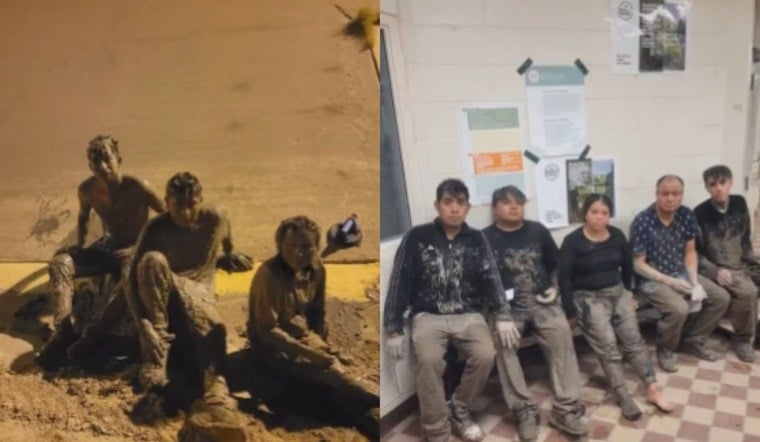
A newly released Border Patrol video shows agents chasing migrants through El Paso's underground storm drain system, with the border wall visible in the background as the group entered the drainage network. The footage, posted Sept. 1, captures agents pursuing and detaining migrants inside the tunnels, part of what officials describe as a persistent and dangerous smuggling route beneath the city.
According to the El Paso Times, the exact location shown in the video is unclear, but the El Paso Sector Border Patrol says it monitors this subterranean domain much like it surveils the border from the skies, watching for activity in networks that run beneath entire neighborhoods. Agents typically encounter two to three migrants at a time inside the drainage system, per the outlet's report, and Border Patrol has warned that the border remains closed to unlawful entry.
Border Patrol gave Fox News rare access inside the tunnels, according to the same report, revealing that the underground network has 32 entry points from the Rio Grande and hundreds of exit points scattered throughout El Paso. Smugglers reportedly charge migrants between $20,000 and $30,000 to move them through the system, a price tag that underscores just how organized this underground trade has become.
A System Built for Floods, Exploited for Smuggling
The drainpipe system stretches from the city of El Paso down to the Rio Grande, and some sections narrow to just a few inches in diameter, according to the El Paso Times report, creating conditions where migrants can become trapped with limited access to air. Border Patrol has said the complex network can also transport toxic and hazardous substances that pose serious health risks, adding chemical exposure to the list of dangers migrants already face underground.
That danger is not hypothetical. In Fiscal Year 2026 through July, U.S. Border Patrol recorded 161 migrant apprehensions within El Paso's storm drain system even as surface border crossings declined, according to a Border Patrol report obtained by Fox News. The reliance on subterranean routes has persisted despite fewer people attempting to cross above ground, suggesting smugglers have simply moved their operations below the streets.
The human cost of that shift has been severe. On October 7, 2025, one migrant died, and four others were hospitalized after smugglers abandoned a group of nine people inside an El Paso storm drain near the border for six hours, according to KVIA. Border Patrol agents have said migrants may drown or suffocate in the drains, and journeys through the system can take between 45 minutes and an hour to navigate in high heat and darkness, with oxygen levels that can drop unexpectedly, Fox News reported in July.
Smugglers Dig Tunnels Straight Into the Network
Criminal organizations have gone beyond simply using existing drains, in some cases physically breaching the border to connect with them. In January 2025, Border Patrol's Confined Space Entry Team and Homeland Security Investigations uncovered a 100-foot-long, 6-foot-tall cross-border smuggling tunnel, complete with wooden support beams, lighting, and ventilation, that ran from Ciudad Juárez directly into El Paso's Boone Street storm drain, according to U.S. Customs and Border Protection.
The scale of past enforcement operations shows how large these underground crossings can get. During a single night in January 2024, CSET agents arrested 69 migrants from five countries in El Paso storm drains near Interstate 10 and Paisano Avenue while also detecting hazardous levels of chlorine gas, per CBP's account of the operation. And in August 2025, El Paso Police and Border Patrol agents intercepted seven migrants from Mexico and Colombia alongside an alleged smuggler as they emerged from a sewer manhole in Downtown El Paso at Oregon Street and San Antonio Avenue, KVIA reported at the time.
Exit Points Near Schools and Backyards
The danger extends well beyond the tunnels themselves once migrants reach the surface. El Paso CSET lead agent Jason Hartman disclosed in July that storm drain exit points emerge near elementary school playgrounds, public parks, and residential backyards across El Paso neighborhoods, according to WHMI. That means smuggling operations that begin at the border can end up surfacing in the middle of everyday neighborhood life, far from any official border crossing.
Officials cannot simply seal off the drains to stop the problem. El Paso's municipal stormwater system comprises more than 500 miles of conduits, canals, 38 dams, and 270 retention ponds, which the utility El Paso Water must keep open to handle sudden desert flash floods during summer monsoon season. That flood-control need effectively prevents authorities from physically blocking the very infrastructure smugglers exploit.
Federal Charges Await Those Caught Underground
Migrants apprehended inside the drainage tunnels face federal criminal prosecution under Title 8 U.S.C. § 1325 for unlawful entry or § 1326 for felony re-entry after removal, which can carry up to 20 years in prison depending on a person's criminal history, according to CBP. Border Patrol established its specialized Confined Space Entry Team in El Paso specifically to conduct these hazardous subterranean searches, requiring agents to undergo technical rescue and hazmat training before entering the tunnels.
El Paso is not the only border city grappling with underground smuggling routes. Hoodline previously reported on a similar tunnel sting in San Diego, where a Border Patrol tunnel team apprehended 19 migrants inside storm drains near the border. Between the drownings, the toxic gas, and the sheer scale of the network beneath El Paso's streets, the newly released video is a reminder that the fight over the border has, in many places, moved underground.




