

























































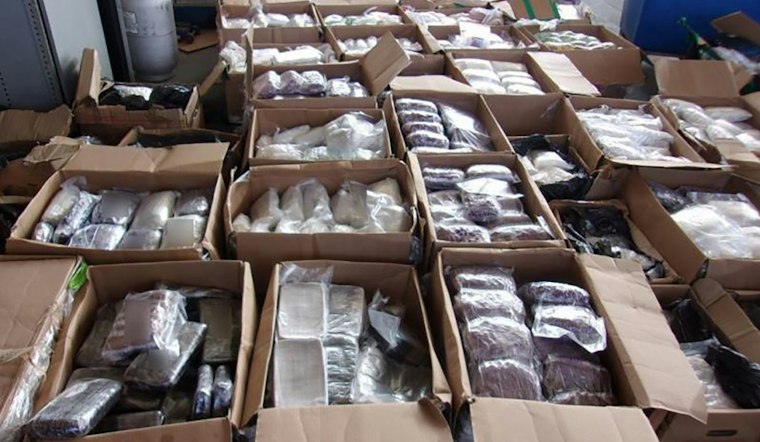
El Paso police are warning residents about a dangerous street drug cocktail known as Grey Death, a gray powder, concrete-like mix or rock-like chunk that can contain heroin, fentanyl, carfentanil and U-47700 in ratios so unpredictable that even seasoned users have no way of knowing its true strength.
According to KTSM 9 News, the mixture poses a severe health threat precisely because its composition varies drastically from batch to batch. Carfentanil, one of the potential ingredients, is roughly 10,000 times stronger than morphine, and tiny amounts can cause a fatal overdose, the outlet reports. Police are urging people to avoid touching Grey Death altogether and to steer clear of any skin exposure to unknown powdery substances.
A Drug With No Fixed Recipe
Law enforcement agents encountered Grey Death as far back as around 2012, and a fatal Georgia case was reported in February 2017, according to Into the Shadows. The mixture earned its unsettling name from its distinct concrete-powder or rock-like appearance. Carfentanil itself is approved exclusively as a veterinary tranquilizer for large mammals like elephants and has no approved human medical use, per Drug Rehab, with doses as small as 2 milligrams capable of killing a person.
U-47700, another synthetic opioid frequently detected in Grey Death batches, is classified as a Schedule I controlled substance under the federal Controlled Substances Act, while fentanyl and carfentanil fall under Schedule II, according to the Georgia Bureau of Investigation. Health and public safety authorities caution that first responders handling suspected Grey Death mixtures face possible transdermal and inhalation exposure risks, and protective gear is recommended to prevent accidental exposure on the job, according to Drugs.com.
Recognizing an Overdose and What to Do
El Paso police say the signs of an overdose include stopped or shallow breathing, loss of consciousness, cold or clammy skin, pinpoint pupils, and blue lips or fingertips, per the same KTSM report. Anyone who suspects someone is overdosing should call 911 immediately. Bystanders can also administer naloxone, also known as Narcan, though the station's report notes that repeated doses may be necessary because of the sheer strength of the synthetic opioids involved.
It remains unclear whether El Paso health authorities or forensic laboratories have confirmed any local overdose deaths specifically tied to Grey Death, or whether this week's police alert is a proactive warning issued in response to regional border drug seizures, according to Drugs.com. The warning follows a broader pattern for the border city: in Hoodline's coverage of a related April advisory, the DEA's El Paso Field Division warned about ciclorfina, an emerging synthetic opioid estimated to be up to 10 times more potent than fentanyl, while local officials monitored lab confirmations.
A Volatile Market With Deep Roots
Grey Death is not new to American drug markets.
Statewide, the picture is somewhat more complicated. Provisional CDC vital statistics reported by the Texas Medical Association show Texas recorded 5,009 drug overdose deaths in the 12-month period ending October 2024, a 13.3% decrease from the 5,779 deaths recorded the prior year. That decline follows a period in which Texas drug poisoning deaths had escalated 68% between 2019 and 2024, according to the Texas Department of State Health Services. Even with the recent dip, the arrival of unpredictable mixtures like Grey Death renews the risk for both users and first responders, given the resistance some synthetic opioids show to single doses of naloxone.
Legal Stakes
Texas law also treats fatal synthetic opioid poisonings with unusual severity. Under House Bill 6, which took effect in September 2023, prosecutors can charge individuals with first-degree felony murder if they manufacture or distribute fentanyl or synthetic opioids that result in a fatal poisoning, carrying penalties of 5 to 99 years or life in prison, according to Broden & Mickelsen LLP. The law expanded Texas Penal Code Section 19.02 to treat fatal synthetic drug exposures as poisonings under the murder statute.





