

























































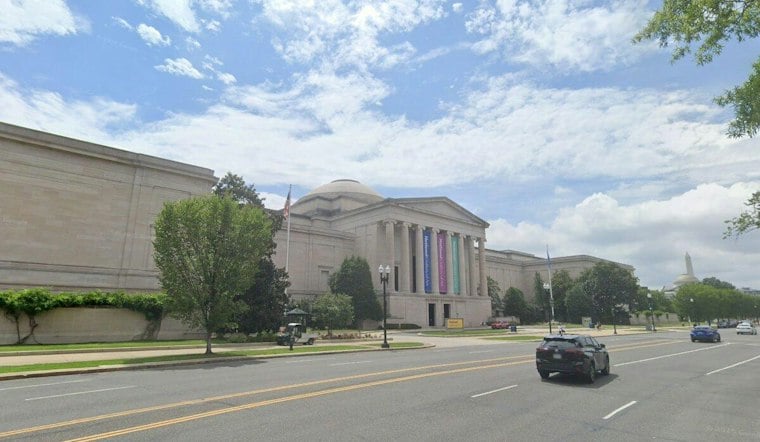
A 110-room mansion in Elkins Park that has sat locked away from the public for eight decades is finally throwing open its doors. Lynnewood Hall, one of the largest surviving Gilded Age estates in the country, will welcome visitors starting Friday for a 10-day floral exhibition themed around HBO's period drama The Gilded Age.
The event, called Fleurs de Villes: The Gilded Age, runs from Friday through October 4 and features 15 life-size floral mannequins built by local Philadelphia florists to represent characters from the show, according to The Philadelphia Inquirer. The designers used thousands of fresh blooms to recreate the series' elaborate costumes, per the same report. CBS News Philadelphia, which first reported on the reopening, noted that Siafa Lewis covered the mansion's public debut, and the station has CBS News Philadelphia as its outlet of record on the story.
A Gilded Age Estate Built for a Transit Magnate
Lynnewood Hall was designed by a then 29-year-old architect named Horace Trumbauer for transit magnate Peter A.B. Widener, built between 1897 and 1899 as a Neoclassical Revival mansion spanning nearly 110,000 square feet, according to Wikipedia. The commission helped launch Trumbauer's reputation as one of the era's premier estate architects up and down the East Coast. The mansion once held a world-renowned art collection featuring works by Rembrandt, Raphael, Titian, and Degas, which Joseph E. Widener donated to the National Gallery of Art in Washington, D.C., in 1942, as detailed by Islands.
The Widener family's story carries its own tragedy. In April 1912, patriarch Peter A.B. Widener lost his eldest son, George Dunton Widener, and his grandson, Harry Elkins Widener, in the sinking of the RMS Titanic, Islands reports. Harry Elkins Widener's mother later endowed Harvard's Harry Elkins Widener Memorial Library in his memory.
Eighty Years of Decay Before Preservation
The estate's original footprint spanned 300 acres and featured elaborate French formal gardens designed in 1916 by landscape architect Jacques Gréber, who also designed Philadelphia's Benjamin Franklin Parkway, according to Islands. Successive property sales whittled that down to the 34 acres that remain today.
Faith Theological Seminary bought the estate in 1952 for $192,000 and stripped many of its interior architectural elements, and the First Korean Church of New York later acquired it in 1996, according to a September 2026 Facebook post cited in reporting on the mansion's history. Water infiltration and vandalism threatened the structure for decades before preservationists intervened.
Nonprofit Rescue and National Recognition
The nonprofit Lynnewood Hall Preservation Foundation, formed in 2019 specifically to acquire and restore the mansion, officially bought the 34-acre estate in June 2023 for $9 million after raising funds from private donors, according to The Lansdale Reporter. The purchase ended decades of institutional neglect and set the stage for public access.
Lynnewood Hall was officially added to the National Register of Historic Places in August 2025, granting federal recognition to what is now considered the second-largest surviving Gilded Age mansion in the United States, per Wikipedia. The designation gives preservationists a formal framework to guide the restoration going forward.
A Massive Restoration Still Ahead
The full restoration is structured as a multi-phase project, with initial stabilization and mechanical work estimated at $20 million to $30 million, formal garden restoration projected at $25 million, and final furnishings and finishes expected to cost another $40 million, according to The Lansdale Reporter. The project depends on crowdfunding, government partnerships, and private philanthropy to reach completion.
Beyond serving as a cultural venue, the Lynnewood Hall Preservation Foundation plans to use the ongoing restoration as an educational incubator, training young workers in specialized historic preservation trades and traditional construction crafts, according to Philadelphia Magazine. The foundation modeled the program on historic stone and craft apprenticeships. For now, the Fleurs de Villes exhibit marks an early public-facing step toward that much longer vision, giving Elkins Park residents and visitors alike their first real look inside a mansion that spent eight decades locked away from view.





