

























































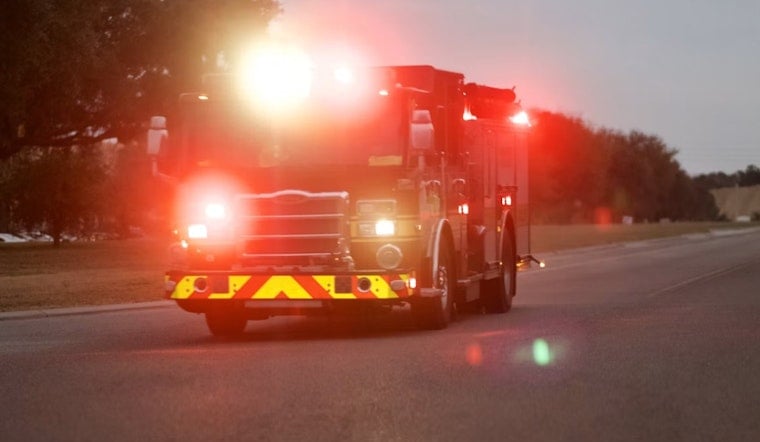
A fast-moving grass fire southeast of Ennis forced Ellis County officials to order immediate evacuations yesterday, sending residents along Zmolek Road, Bruce Road and Farm to Market 85 scrambling to leave as flames pushed north with zero containment. The blaze produced large plumes of smoke visible for miles as crews raced to keep it from spreading further into populated areas.
According to The Dallas Morning News, the fire moved north from Farm to Market 1182, east of Alma, per information from the City of Ennis. The Texas A&M Forest Service tracker listed the fire at approximately 230 acres and 0% contained as of the report, and evacuees were directed to Cowboy Church of Ennis on the Interstate 45 service road, where Ellis County emergency officials assisted those displaced by the flames. KXAS-TV provided aerial footage showing the scale of the fire from above.
Local reporting has identified the blaze as the Alma Fire on Texas A&M Forest Service incident tracking, noting that the fire forced emergency road closures on FM 1182, FM 85, Walker Creek Road, Mach Road and Zmolek Road, according to South Metro Weather. Ellis County Precinct 2 officials deployed water trucks and heavy equipment to support fire crews as local departments worked to contain flames moving toward populated areas.
A Countywide Burn Ban Already in Place
The fire ignited under an active countywide burn ban that Ellis County Commissioners Court formally enacted on July 21, 2026, prohibiting all open outdoor burning in unincorporated parts of the county. Hoodline previously reported on the burn ban taking effect, which officials issued in response to severe drought and rising fire danger across the region. Violating a county burn ban is a Class C misdemeanor under Texas Local Government Code § 352.081, punishable by a criminal fine of up to $500.
By late August, at least 140 of Texas's 254 counties had active outdoor burn bans in place as sustained triple-digit temperatures and drought dried out vegetation statewide. The Dallas Morning News reported that North Texas counties broadly remain under burn bans imposed because of extreme heat and dry vegetation, conditions that have turned roadside grass into ready fuel across the region.
Ross Fire Sets Grim Record to the West
The Ellis County blaze erupted as North Texas firefighters were still battling the Ross Fire, which the Dallas Morning News reported started off Highway 180 in Palo Pinto County in late August and had expanded to over 90,000 acres by early September. According to the Texas A&M Forest Service, the fire burned more than 90,400 acres across Palo Pinto and Jack counties, making it the largest summertime wildfire recorded in Texas since detailed statewide record-keeping began in 2005. As of Friday, the Ross Fire was 38% contained after destroying 167 structures, including 18 occupied residences, while crews protected 453 nearby structures.
Forest Service investigators determined the Ross Fire was human-caused, tracing its origin to equipment or vehicle use associated with a roadside start along Highway 180, according to FOX 4 Dallas-Fort Worth. Human activity and equipment sparks cause nearly half of all wildfires ignited in Texas during late-summer dry spells, with dragging trailer chains, lawn equipment and vehicle exhaust frequently igniting parched roadside grass — a hazard that mirrors the conditions along FM 85 and FM 1182 near Ennis.
Mutual Aid Crews Stretched Thin
The scale of the Ross Fire has pushed Texas's emergency response system to its limits. On September 1, the Texas A&M Forest Service elevated the State Wildland Fire Preparedness Level to Level 4, citing increasing wildfire complexity and resource demands along the I-35 corridor between Dallas and Waco. That strain has already had costly consequences for responding crews: Hoodline reported that on August 27, a fire engine from Katy's Willowfork Fire Department was involved in a severe head-on collision while deploying to assist with the Ross Fire, after a truck pulling a trailer lost control and crossed into its path, injuring firefighters aboard.
With state resources stretched thin by historic multi-county blazes, local county precincts and volunteer fire departments in places like Ellis County are increasingly relying on regional mutual aid and municipal emergency support to respond to fast-moving grass fires. Ellis County's own experience in mid-August, when a South Dallas grass fire jumped to a structure and drew seven engines amid the same burn ban, underscored how quickly these blazes can escalate. No containment figure had been reported for the Ellis County fire as of Friday, and officials had not indicated how many residents were displaced by the evacuation order.





