

























































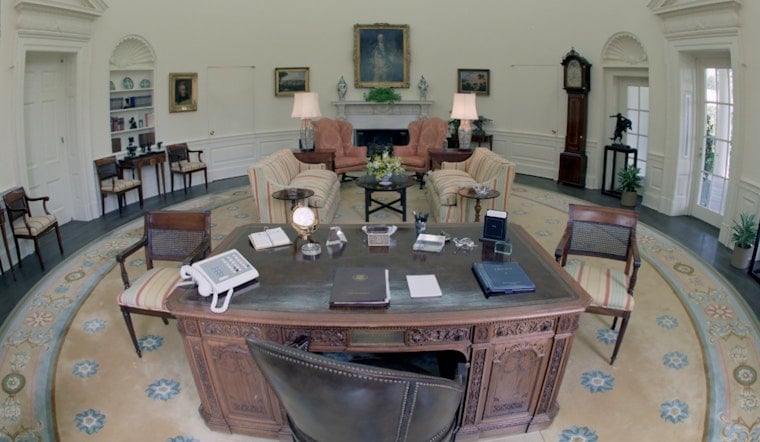
Two estranged Satmar Hasidic leaders who had not spoken face to face in decades ended up reconciling inside the Oval Office this week, during a rare White House summit that brought together grand rabbis from New York and New Jersey's largest ultra-Orthodox communities. Grand Rabbi Aaron Teitelbaum of Kiryas Joel and Grand Rabbi Zalman Leib Teitelbaum of Williamsburg, Brooklyn — the two brothers who have led rival factions of the Satmar movement since their father's death two decades ago — spoke in person for what was believed to be the first time in years.
The reconciliation, first detailed by JNS.org, capped a broader gathering President Trump held with New York and New Jersey Hasidic Jewish community leaders on September 3, according to the New York Post. Vice President JD Vance joined the group after a press briefing concluded, and the meeting was arranged by the White House Faith Office, which is led by Paula White-Cain, the Post reported. Yosef Stettner, one of the participants, said the meeting was an opportunity for the president to meet with grand rabbis of the largest Hasidic sect for the first time in over 50 years, and that attendees had the chance to thank Trump for everything he does for the country.
A Schism Two Decades in the Making
The Satmar community split into competing Williamsburg and Kiryas Joel factions after the 2006 death of Grand Rabbi Moshe Teitelbaum, the brothers' father, touching off a bitter succession dispute that has defined the movement ever since, per JNS.org. The rift had persisted for so long that the White House meeting marked a rare public thaw between the two sides. Representatives from Kiryas Joel, Lakewood, New Jersey, and Williamsburg, Brooklyn, all attended the Oval Office gathering, according to the Post.
During the audience, Grand Rebbe Aaron Teitelbaum presented Trump with a leather-embossed copy of a prayer and, per the official Satmar X account cited by the Post, recited a rare Jewish blessing traditionally reserved for kings. The White House said the gathering was the first of its kind since 1979, and officials noted that the previous comparable Oval Office meeting with major Hasidic leaders took place in December 1979 under President Jimmy Carter, according to Boro Park 24. That earlier gathering occurred during the Iran hostage crisis and included then-Satmar Grand Rebbe Moses Teitelbaum and Bobov Grand Rebbe Solomon Halberstam, who recited a traditional Hebrew royal blessing for Carter, Boro Park 24 reported.
A Private Letter on Israel
Grand Rabbi Aaron Teitelbaum also handed Trump a private letter during an eight-minute audience, stating that Israeli Prime Minister Benjamin Netanyahu and political Zionists do not represent all Jewish people, according to footage cited by Fine Day Radio and The Media Line. The letter urged the administration to treat American Hasidic Jews as U.S. citizens rather than as representatives or delegates of Israel — a message rooted in Satmar Hasidism's foundational belief that establishing a Jewish sovereign state before the arrival of the Messiah is forbidden under Jewish law. Reporting ahead of the summit indicated participants also sought to raise international religious concerns, specifically ongoing political and legal efforts in Israel to end draft exemptions for Haredi yeshiva students in the Israel Defense Forces.
Ahead of the visit, Grand Rabbi Aaron Teitelbaum revealed during a Friday gathering in Kiryas Joel that he initially considered declining the White House invitation so he could stay focused on Torah study during the Hebrew month of Elul, a penitential period preceding Rosh Hashanah, but ultimately agreed to attend in hopes of helping Jews facing legal or personal hardship, according to AhBlickLive.
Beyond Satmar: A Broad Coalition
The delegation extended well beyond the Satmar movement. It included Bobov Grand Rabbi Benzion Halberstam, Vizhnitz Monsey Grand Rabbi Yisroel Hager, Skverer leadership from New Square, and Rabbi Malkiel Kotler, head of the Beth Medrash Govoha yeshiva in Lakewood — one of the largest rabbinical seminaries in the world — per Ynetnews. Trump administration officials in attendance included Commerce Secretary Howard Lutnick, special envoy Steve Witkoff, and special envoy Jared Kushner, the president's son-in-law, according to the Post. Ivanka Trump converted to Judaism before marrying Kushner in 2009, and Trump has described himself as the most pro-Israel president in U.S. history, pointing to his focus on fighting antisemitism during Israel's war with Hamas in Gaza and his partnership with Netanyahu in efforts to prevent Iran from obtaining a nuclear weapon, per the Post.
Republican Rep. Mike Lawler, who represents large Orthodox and Hasidic communities in Rockland County, attended and helped coordinate the meeting. Lawler's 17th Congressional District includes Rockland County Hasidic strongholds such as Monsey and New Square and borders Orange County's Kiryas Joel, according to News 12. Lawler previously appeared alongside Trump during a visit to the district, as Hoodline reported in its piece on the Rockland visit with Lawler.
Housing, Tax Credits and Local Politics
The practical agenda inside the Oval Office centered heavily on domestic policy concerns affecting large Orthodox families. Hasidic leadership raised specific priorities including alleviating severe housing shortages, reforming criminal justice policies to offer leniency to Jewish non-violent prisoners, and expanding tax relief such as the Earned Income Tax Credit for families with more than three children, News 12 reported.
Those requests land against a backdrop of explosive population growth in the communities represented at the summit. Kiryas Joel's population grew by 63.3% between 2010 and 2020 to nearly 33,000 residents, while Lakewood Township accounted for nearly 70% of Ocean County, New Jersey's total population growth over the same decade, according to the Orthodox Jewish Public Affairs Council, citing U.S. Census Bureau data. The White House visit also coincided with a local land-use fight in Orange County, where property owners petitioned this month to annex nearly 500 acres from the neighboring Town of Woodbury into Kiryas Joel and the Town of Palm Tree, which was carved out as its own municipality in 2019 to accommodate the community's housing expansion, per News 12.
For Lawler, whose NY-17 seat is a closely watched swing district where bloc-voting Orthodox communities hold decisive leverage, facilitating high-level executive access carries obvious political value. The congressman's district has drawn national attention this year, including in the competitive race Hoodline covered involving a rival candidate's controversial social media history in its report on the lewd Facebook posts roiling NY-17.
Trump received about 35% of the Jewish vote in the 2024 election according to Pew Research Center estimates, while the Harvard Cooperative Election Study put the figure at 36% — either way, a showing widely described as the best for a Republican presidential candidate since the 1980s, per the Post. Whether the administration will act on the specific policy requests raised in the meeting, including prison reform or expanded tax credits, remains an open question, as does how pro-Israel advocacy groups will respond to the White House hosting non-Zionist Hasidic leadership.





