

























































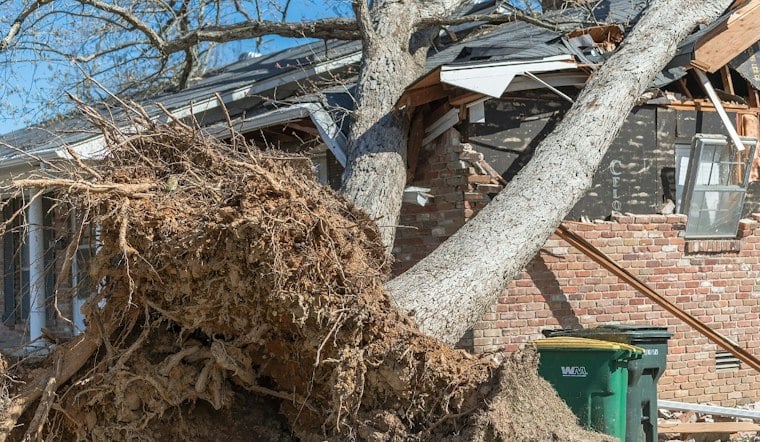
A 100-year-old tree came down on a Wake County woman's home, and in September a huge limb crushed her truck, all without a single storm or strong wind gust in sight. Barbara, who lives in the neighborhood, says trees have simply been collapsing around her with no obvious explanation, and the pattern has a name that sounds almost too strange to be real: falling limb syndrome.
Barbara emailed WRAL to describe a century-old tree that fell onto her home, causing water damage but sparing the structure from major damage. In September, a huge limb dropped onto her truck in Raleigh, and she noted that the trees in her neighborhood have been falling on days with no storms or wind to explain it. She referred to the phenomenon by its two common names: falling limb syndrome, also known as sudden branch drop syndrome.
Kelly Oten, an assistant professor at NC State University's College of Natural Resources, told the outlet that arborists are aware of the condition but cannot quite predict it. A tree can look completely fine from the outside, she said, and then randomly drop a limb. There is no single specific cause behind falling limb syndrome, though pests, bacteria and disease are among the contributing factors that can play a role, and it can strike trees that otherwise appear healthy without any warning at all.
Drought's Grip on Wake County Roots
Drought conditions may be a concern for area trees, though their role in these incidents is uncertain. Parts of Wake County currently fall into the severe drought category, and Falls Lake's water supply pool has dropped about 10% in the past month alone, per the same account. Statewide, more than two-thirds of North Carolina's counties were in active drought as of this month. The North Carolina Department of Environmental Quality said drought conditions had spread into parts of Wake County and other central counties, while the National Weather Service said severe D2 conditions were creeping back into the northeast Piedmont and Triangle area.
A drought statement from the National Weather Service traced central North Carolina's persistent dry spell back to August 2025, noting it has pushed Falls Lake down to roughly 80% capacity while Little Fishing Creek in the Tar River Basin recorded its lowest flow on record. WRAL reported that drought may be a problem for trees, but Oten could not definitively identify what was behind these incidents.
Why a Healthy-Looking Limb Can Suddenly Snap
The biological mechanics behind this help explain how a tree with green leaves can still fail catastrophically. University of California Cooperative Extension research has found that limbs may fracture three to 12 feet from the trunk, rather than near the trunk as in wind-related breaks.
This is not a new phenomenon, even if it feels alarming to residents watching it unfold in real time. Documentation of sudden branch drop dates back to 1882, when botanist Albert Kellogg first recorded healthy-looking shade tree limbs bursting with a loud pop and falling on windless summer days without any visible prior decay, according to Urban Forest Pro.
Drought Stress Can Linger For Years
Perhaps the most sobering part of the story is that the danger does not end when the rain finally returns. Tree stress from dry periods can last after rainfall resumes, WRAL reported, and trees can take time to recover from drought stress.
Drought stress can leave trees more vulnerable to pests. During a severe 2023 drought, southern pine beetles killed an estimated 12.5 million trees across 80,000 acres, according to NC State University's College of Natural Resources.
What Homeowners Can Actually Do
Falling limb syndrome is impossible to predict precisely, but Oten recommended that homeowners call an arborist certified through the International Society of Arboriculture's Tree Risk Assessment Qualification, a credential for professionals specifically trained to spot problem trees. The ISA offers the Tree Risk Assessment Qualification (TRAQ) as a credential for arborists.
One potential warning sign homeowners can watch for is a branch losing its leaves while the rest of the tree appears fine, though Oten cautioned that even that measure will not absolutely predict a tree-falling event. In the meantime, she recommended watering trees during droughts, since deep watering can help mitigate drought impacts and reduce the chance of a tree falling, while mulching at the base of trees can also help retain moisture.
Who Pays When the Limb Comes Down
The legal and financial fallout from these incidents is its own complicated territory. Under North Carolina common law, a property owner generally is not held liable for damage caused by a fallen tree or branch on a neighboring property unless the injured party can prove the tree's owner knew it was dead, diseased, or hazardous and negligently failed to act, according to NC State University's agricultural law program.
On the insurance side, the North Carolina Department of Insurance notes that standard homeowners policies typically cap tree removal payouts at just $500 per loss when a fallen branch strikes a structure.
The drought behind all of this has been building for more than a year, part of a pattern Hoodline previously reported could even shift the timing of fall foliage across the Carolinas this season. For now, Wake County homeowners are left watching their yards a little more warily, knowing that even a still, sunny afternoon offers no guarantee that every limb overhead will stay put.




